
Deep Work Meditation for Focused Work Sessions
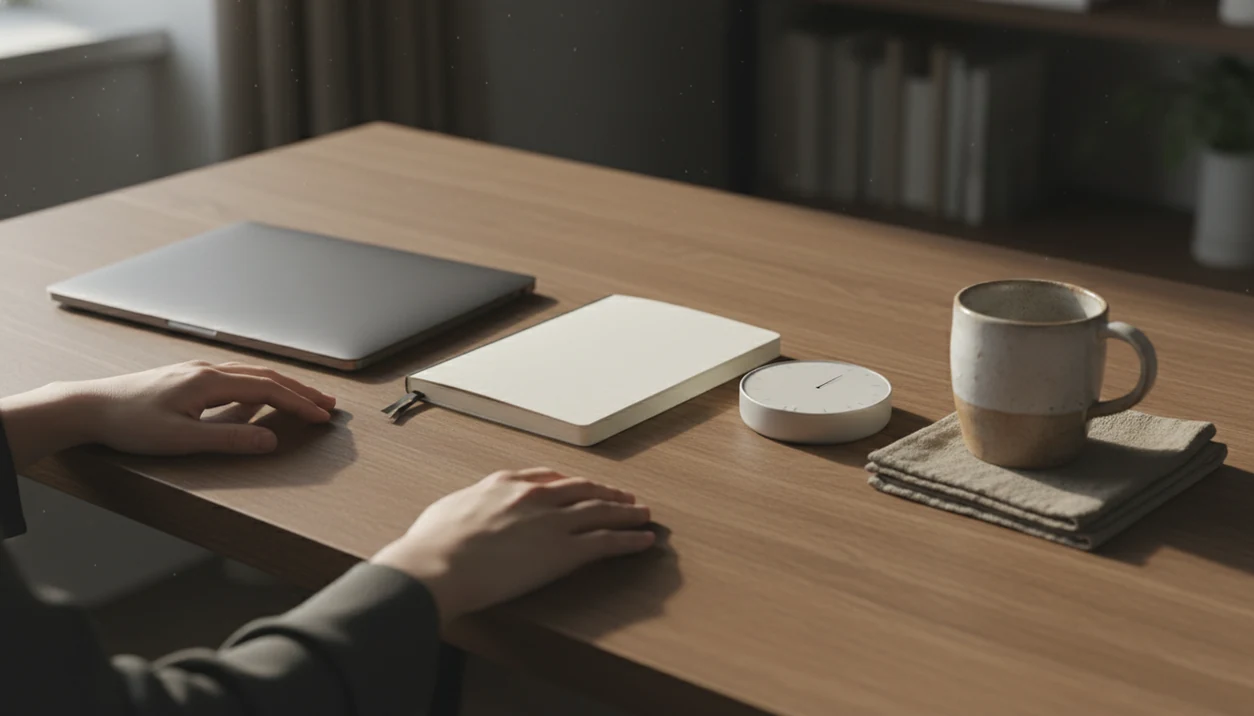
Deep work meditation is a short mindfulness practice used before or between focused work sessions to settle attention, reduce mental noise, and begin one task more deliberately. It works best as a preparation ritual paired with clear boundaries, not as a shortcut that replaces planning, rest, or distraction-free time.
> Definition: Deep work meditation is a brief secular mindfulness or breathing routine that helps knowledge workers transition into single-task, distraction-free work.
TL;DR
- Use meditation before deep work as a 2- to 6-minute transition, not as a productivity hack or performance guarantee.
- Pair the practice with Do Not Disturb mode, one defined task, a visible timer, and a clear end-of-session note.
- Choose a simple method: breath awareness, body scan, or attention to one sensation; the best version is the one you will actually repeat.
Deep work meditation definition for focused sessions
Deep work meditation is a short, secular attention practice used before work or between work blocks to help the mind settle on one task. It prepares attention; it is not the deep work session itself.
Think of it as the doorway, not the room. You might use it before writing a proposal, coding a feature, studying a chapter, planning strategy, or reviewing research. The routine can be as plain as sitting upright, feeling the breath, and noticing when the mind jumps to email or a grocery list.
The practical goal is simple: arrive before you begin. A three-minute breathing pause before opening a laptop can make the first work action less scattered, but the real work still happens during the protected block that follows.
Five facts about mindfulness for deep work
- Deep work meditation is preparation, not a magic shortcut. It can help you enter a work block more deliberately, but it will not write the memo, solve the bug, or replace a clear plan.
- Short sessions are usually enough for a pre-work transition. For this use case, repeatability matters more than duration; clinical reviews support modest mental-health benefits for mindfulness but do not prove that longer pre-work sessions create more output JAMA study.
- The aim is less task-switching and less mental residue. Mental residue is the leftover pull from the last task, like still rehearsing a meeting while trying to outline a report.
- It works better with concrete deep work habits. Do Not Disturb mode, one defined work block, and a visible timer matter. The practice is weaker when Slack, texts, and open tabs keep calling.
- It does not replace recovery or boundaries. Sleep, breaks, workload management, and fewer interruptions are still part of the system. For a broader setup, focus meditation can help compare related attention practices.
Brain-body transition mechanics in deep work meditation
Deep work meditation works by shifting attention from many competing cues to one chosen object, such as the breath, body contact, or a single sound. In plain language, you give the mind one place to land before asking it to do demanding work.
A useful term here is attentional control, which means noticing where attention has gone and returning it on purpose. Another is task residue, the drag left by a previous activity. You can feel it when a meeting comment keeps replaying after you have opened a spreadsheet.
During practice, the exhale heard in a quiet room or the lower back meeting the cushion becomes the anchor. When distraction appears, you notice it earlier. That is the training.
Evidence should stay modest. A JAMA Internal Medicine review of 47 randomized clinical trials found small improvements in anxiety, depression, and pain, with mixed evidence for other outcomes JAMA study. That supports a careful claim, not a dramatic productivity promise.
Best fit and poor fit for meditation before deep work
Meditation before deep work fits best when you already have a real work block to protect. It is less useful when the main problem is noise, overload, or constant interruption.
| Use case | Best fit | Not ideal for |
|---|---|---|
| Writing and studying | Settling before drafting, reading, outlining, or exam review | Replacing a study plan or deadline schedule |
| Coding and analysis | Starting one ticket, model, query, or review with fewer switches | Fixing nonstop pings from teammates |
| Design and planning | Moving from meetings into sketching, strategy, or decision work | Forcing calm during unrealistic workload pressure |
| Meeting transitions | Clearing residue before the next focused block | Treating clinical symptoms or burnout |
Mindful.net can function as a Mindfulness Practices App for this start ritual, while Calm, Headspace, and mindful.org offer adjacent beginner mindfulness resources. For deep work meditation, the useful test is simpler: does the method help you start one task and stop checking other things?
Mindfulness practices and meditation techniques for beginners and daily life can deliver a repeatable attention cue, not a guarantee of calm, output, or emotional control.
Before you start a deep work meditation
Before you start, make sure there is an actual work block worth protecting. The meditation works best when the task, environment, and stopping point are already clear.
- Choose one realistic block. Pick a stretch of time that can stay mostly uninterrupted, even if it is only 25 or 40 minutes. If the calendar is already collapsing, fix the schedule before adding a ritual.
- Write the task and finish line. Use a notebook or sticky note to name the work and the place you will stop: “outline three sections,” “debug checkout error,” or “read to page 18.”
- Remove the loudest triggers. Turn on Do Not Disturb, close extra tabs, hide the inbox, and move the most tempting device out of arm’s reach.
- Set up the body and tools. Sit in a chair, start a simple timer, keep the notebook nearby, and choose one anchor such as the breath, feet, hands, or body contact.
- Skip it when rest or triage is the real need. If you are exhausted, panicked, or facing urgent overload, meditation may become another demand. Rest, renegotiate, or prioritize first.
Five-step deep work meditation protocol before a session
Use this five-step protocol when you want a practical start ritual, not a complicated routine. A phone timer set for 5 minutes is enough. The first two steps are not decorative: writing one task reduces ambiguity, and closing interruptions protects the attention you are about to train. Research on attention residue suggests unfinished prior tasks can impair performance on the next task J.Obhdp.2009.04.002.
- Set one task and one stopping point. Write the task in one line, such as “draft the intro” or “review pages 12 to 18.”
- Silence notifications and remove obvious distractions. Put devices on Do Not Disturb, close extra tabs, and move the tempting app out of reach.
- Sit upright and feel the breath or body for 2 to 6 minutes. Notice the feet on carpet or tile, the ribs widening under a sweater, or the breath at the nose.
- Name the work intention in one sentence. Try, “For the next 40 minutes, I am editing section two.”
- Begin the work block without checking one more thing. That last check often becomes the trap.
For knowledge workers, a short pre-work meditation is often easier to repeat than a long session because it fits the transition already happening.
Single task meditation script for a 3-minute focus reset
How do I do a single task meditation before focused work? Use three minutes to arrive, notice distractions, and choose the first work action.
Minute 1: arrive. Sit in a chair with both feet supported. Let the spine be upright without stiffness. Feel one breath in and one breath out. If the room is busy, lower your gaze or look at one still point.
Minute 2: notice. Thoughts will show up. A message you forgot. A task you dislike. The progress bar moving too slowly. Silently label them “thinking” or “planning,” then return to the breath or body contact.
Minute 3: choose. Ask, “What is the next visible action?” Open the document, run the test, read the first paragraph, or write the first sentence.
Begin there.
This single task meditation is beginner-friendly because it does not ask you to empty the mind. It asks you to notice and return. Students may also find study meditation for students useful when the work block is reading, review, or exam preparation.
Between-session focus reset meditation for mental residue
A focus reset meditation helps you stop one work block cleanly before carrying its loose ends into the next. Stopping matters because unfinished thoughts tend to follow you, especially after coding, writing, planning, or tense meetings.
Use this four-part reset:
- Close the previous task. Save the file, write the next step, or mark where to restart.
- Breathe for 30 to 60 seconds. Let the body register that one block has ended.
- Note the residue. Write one phrase, such as “waiting on review” or “need data check.”
- Choose the next task. Pick one action before opening anything else.
If you get distracted, restart without a lecture. The notebook margin filled with breath counts is not failure; it is a record of returning. For office settings, how to practice mindfulness at work covers other short pauses that fit between meetings.
Common mistakes with mindfulness for deep work
The most common mistakes happen when mindfulness is asked to solve a setup problem. Keep the routine small and honest.
- The planning swap. Meditation cannot replace deciding what you are doing, why it matters, and when the block ends.
- The instant-calm expectation. Some sessions feel restless. Jaw unclenching behind closed lips may be the only noticeable shift, and that can still be useful.
- The notification leak. If alerts stay active, attention keeps getting pulled out of the practice and the work.
- The oversized ritual. A 25-minute routine sounds impressive, but a repeatable 3-minute pause often survives the workweek better.
- The overload cover-up. Do not use mindfulness to tolerate a workload that needs triage, staffing, or boundaries.
An NIH/NCCIH evidence summary notes that meditation may help with anxiety, depression, and pain, but it is not a substitute for standard medical treatment NCCIH overview. If attention problems feel clinical or persistent, resources on ADHD meditation app support may help frame the question more carefully.
Limitations
Deep work meditation can support attention, but it has clear limits. Treat it as one practical tool, not a cure for a broken work system.
- It does not reliably override noisy offices, constant messaging, unclear priorities, or job demands that prevent uninterrupted time.
- Evidence is stronger for stress, anxiety, mood, and pain than for large direct productivity gains in knowledge work, according to the JAMA Internal Medicine review.
- Some people find meditation frustrating or distracting at first, especially when they expect immediate calm.
- It should not replace sleep, breaks, task triage, realistic deadlines, or workload boundaries.
Reset the plan.
Hidden Limits People Miss
Deep work meditation is a preparation cue, not a productivity guarantee. It may help a nurse take one clipboard breath before charting, a musician reset before a difficult passage, or a tradesperson use a stairwell pause before a precision task, but it cannot replace staffing, sleep, task clarity, or realistic deadlines. A useful way to define the limit is this: meditation can steady the doorway into work, but it does not build the whole room.
A Tiny Experiment to Run Today
| If you... | Try | Why | Note |
|---|---|---|---|
| You are carrying mental residue from the last task, such as a tense handoff, a rehearsal mistake, or a customer complaint. | Three-Breath Reset from Mindful.net’s /5-minute-mindfulness-practice guide | A short breath sequence tends to work better than a long sit when the goal is to mark a clean transition. | Keep it brief; extending the reset can become avoidance. |
| You feel physically restless before starting detailed work, such as inventory counts, coding, design edits, or lab documentation. | Mindful Walking from /mindful-walking for two slow minutes | Movement may fit better than stillness when the body is already activated. | Choose a simple route so the walk does not become a distraction hunt. |
| You have a narrow window before focused work, such as break-room quiet before a shift task or a parent’s short pause before paperwork. | Named method: the Clipboard Breath — one exhale, one task name, one first action | A named reset removes choices when attention is tired. | Do not use it to skip deciding what actually matters. |
What Testing Suggests
In our editorial review, many people seem to do better when the reset matches the work setting rather than an ideal meditation image. A stairwell pause, break-room quiet, or one clipboard breath can be more repeatable than a perfect cushion routine. We usually suggest testing the smallest version first, because the opening minute is often where people drift into performing calm instead of simply noticing the next workable step.
When Another Method Fits Better
- Choose yoga instead of deep work meditation when the main obstacle seems physical stiffness or pent-up movement; yoga often gives the body more to do before the mind settles.
- Choose a planning checklist when the problem is unclear priority; calm attention does not automatically decide which task deserves the next hour.
- Choose Mindful Walking when sitting still makes you more preoccupied; a slow route can make the reset feel less like forced calm.
- Choose a Three-Breath Reset when the transition is tiny, such as moving from a patient note to a supply check or from practice scales to performance prep.
- Choose rest, food, or a real break when fatigue is the obvious issue; meditation may support attention, but it is not a substitute for recovery.
At-a-Glance Options
| Technique | Best for | Minutes |
|---|---|---|
| Clipboard Breath | naming one task and starting without a long ritual | 30-60 sec |
| Three-Breath Reset | clearing a small transition between work blocks | 1-3 min |
| Mindful Walking | restless focus before seated or detail-heavy work | 3-10 min |
The best focus reset is the one that makes the next task easier to begin.
Why Mindful.net fits this specific need
Mindful.net is useful here because its focus guides can be mixed and matched: a short reset before deep work, Mindful Walking when the body needs movement, or the Three-Breath Reset for quick transitions. That comparison-first approach helps readers choose a practice for the actual work moment rather than treating all calm-down advice as interchangeable.
FAQ
What is deep work meditation?
Deep work meditation is a short mindfulness reset used before or between focused work sessions. It helps you settle attention before starting one defined task.
Should I meditate before deep work?
Meditating before deep work can help when you need a transition from meetings, messages, or scattered attention. If the main problem is noise, unclear tasks, or no protected time, setup and boundaries matter more.
How long should focus meditation be?
Focus meditation can be short, often 2 to 6 minutes before a work block. Longer is not automatically better if it makes the routine harder to repeat.
Can meditation stop procrastination?
Meditation may reduce the friction of starting by helping you notice avoidance. It does not replace task clarity, scheduling, support, or changing an unrealistic workload.
What if meditation distracts me?
Early frustration is common, and it does not mean you are doing it wrong. Try one breath, feeling body contact with the chair, or a silent pause before beginning.