
When Thoughts Arise in Meditation
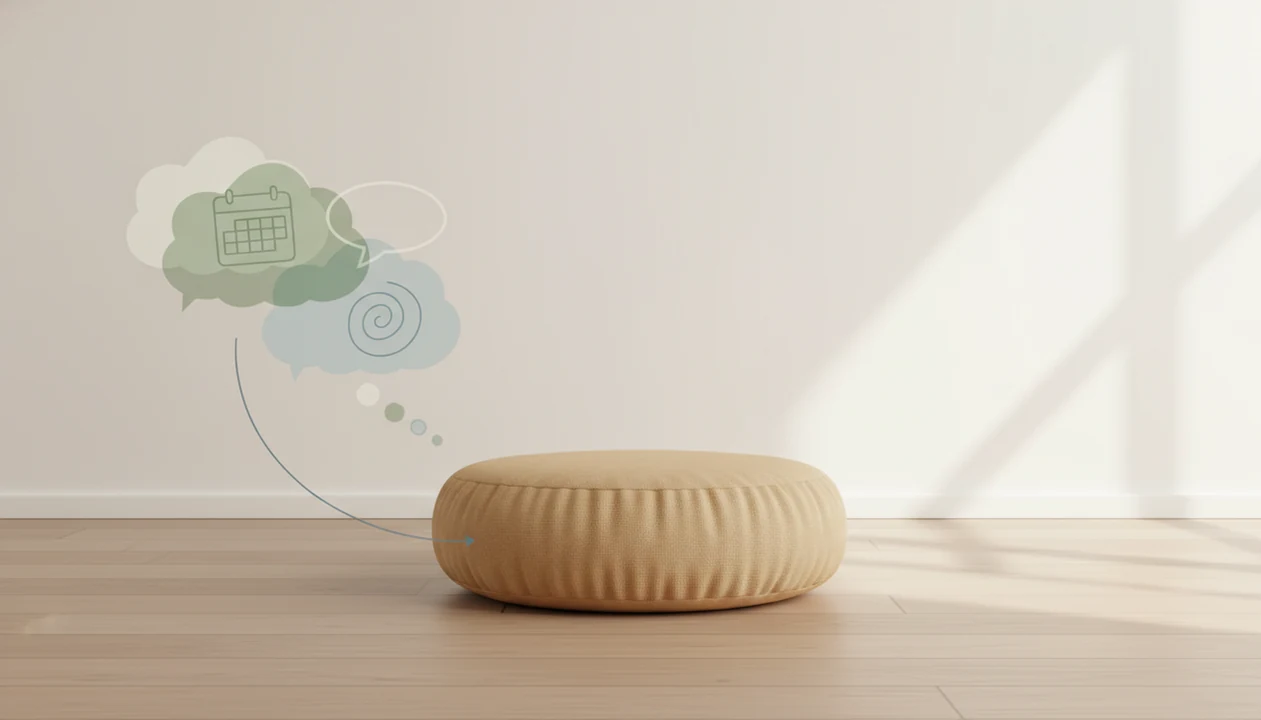
When thoughts arise, notice them without fighting, label them lightly if helpful, and gently return to your breath, body, or chosen anchor. The simplest answer to what to do when thoughts arise during meditation is: acknowledge, release, and return, again and again.
> Definition: Thoughts during meditation are normal mental events that become part of mindfulness practice when you notice them and return attention without judgment.
- Mind wandering is not failure; noticing it is the practice.
- Use a simple sequence: notice the thought, label it, soften judgment, and return to your anchor.
- If a thought feels important, remember or jot it down after the session rather than following it during meditation.
The simple answer: notice the thought, then come back
When thoughts arise during meditation, notice the thought, name it lightly, and return to your anchor. That anchor might be the breath, the body, the air conditioner hum, or the touch of your hands resting together.
Meditation is not a test of whether you can make the mind empty. A first-time meditator may remember a nursing handoff, wonder whether the hallway got vacuumed, or replay something awkward from earlier. The practice begins when you recognize, “thinking,” without turning it into a verdict.
Try this: breathe, notice, label, return. If you use breath as the anchor, breath awareness meditation gives a simple structure. If breath feels uncomfortable, choose the contact of your hands, sound in the room, cold fingertips, or another neutral body sensation instead.
Quietly returning counts.
How Thoughts During Meditation Work
Thoughts during meditation usually follow a workable pattern: attention moves away, awareness catches the movement, and attention is invited back. The point is not permanent mental silence; it is learning to notice the shift sooner and return with less friction.
Metacognitive awareness is the plain skill of knowing what your mind is doing while it is doing it. You are not diagnosing the thought or proving the session failed. You are recognizing a mental event, like an image, plan, memory, or sentence in the mind, and choosing not to build the whole story.
- Notice that attention has moved away from the anchor.
- Name the event gently, with a word like “thinking,” “planning,” or “remembering.”
- Let the label create a little space, so the thought can be seen without being pushed down.
- Return to the breath, body, sound, or touch point you chose.
Each return is a repetition. Over time, the training is recognition, not a guarantee that thoughts disappear.
Thoughts During Meditation in Mindfulness Practice
In mindfulness practice, wandering thoughts are part of the training, not an interruption of it. Attention drifts, awareness notices, and attention returns. That noticing is often called metacognitive awareness, meaning you know where your attention has gone while it is happening.
During a sitting practice, attention may move into planning, memory, evaluation, sensation, or commentary. One minute you feel the chest movement beneath a shirt. The next minute you are solving tomorrow’s schedule. Nothing has gone wrong.
How thoughts during meditation work is simple: the brain keeps producing mental events, and mindfulness practice trains the habit of noticing them sooner. The return is the repetition. Over time, many people find that this makes distraction easier to recognize, but it does not promise a permanently calm mind.
Good mindfulness practices and meditation techniques for beginners and daily life deliver repeatable attention practice, not instant silence or medical treatment.
5-Step Thoughts-Arise Meditation Guide
Use this guide during a short practice, before the story “I’m doing it wrong” has gathered too much force. Five quiet minutes marked by a clock, a meditation bell, or even the end of the air conditioner cycle can be enough.
- Choose an anchor. Settle attention on the breath, body sensations, sound, or touch.
- Notice the shift. Recognize when attention has moved into a thought, image, plan, or memory.
- Label it lightly. Use one word, such as “thinking,” “planning,” “remembering,” or “worrying.”
- Soften the reaction. Drop the extra layer of “I’m bad at this” if it appears.
- Return and repeat. Bring attention back to the anchor, then do the same thing next time.
For beginners, a body-based anchor can be easier than breath because it feels more concrete. The full range of simple meditation techniques can help you compare anchors without overthinking the choice.
5 Tips for Thoughts During Meditation
- Mind wandering is normal. Thinking during meditation is expected, even in a quiet room with a soft lamp and closed door.
- Acknowledging is not following. You can notice “that’s a work thought” without rehearsing the email.
- Labeling creates space. A small label like “planning” can reduce the pull to keep elaborating.
- Gentleness works better than force. Pushing thoughts away often adds tension and more commentary.
- Important thoughts can wait. If something seems useful, remember it for after the session or write it down afterward.
For most beginners, labeling is easier than arguing with the mind because it gives the thought a name without turning it into a project.
Best-Fit and Not-Fit Use Cases for Thoughts During Meditation Advice
This advice fits ordinary mind wandering during secular mindfulness practice. It is not meant to treat severe anxiety, trauma symptoms, or intrusive thoughts as a standalone method.
| Use case | Fit | Why |
|---|---|---|
| Ordinary planning thoughts | Good fit | Notice, label, return works well for everyday distraction. |
| Short secular sessions | Good fit | The method is simple enough for 3 to 10 minutes. |
| Body-based practice | Good fit | A concrete anchor can make returning easier. |
| Severe distress or unsafe thoughts | Not a standalone fit | Tailored clinical support may be needed. |
| Trauma-linked thoughts | Not a standalone fit | Some anchors or silence may feel activating. |
Best for
- Beginners distracted by planning, memory, or mental commentary.
- Short practices on a kitchen chair, bus seat, or office stairwell.
- People who want practical body scan meditation or breath-based anchors.
Not for
- Using meditation as the only support for severe anxiety, trauma symptoms, or intrusive thoughts.
- Forcing exposure to thoughts that feel overwhelming or unsafe.
Important Thoughts During Meditation: What To Do With Them
“What should I do if an important thought comes up during meditation?” Acknowledge that it feels important, make a brief mental note, and return to the anchor unless there is a genuine safety issue.
Use a small phrase like “later,” “remember,” or “write down.” That is different from mentally drafting the message, replaying the meeting, or turning the idea into a full task list. The pencil tapping during study time can wait until the bell, and most meditation thoughts can wait until the timer.
After the session, jot down the one item that still matters. Be careful, though. If every thought becomes a task, the meditation period quietly turns into planning time.
Noticing importance is allowed. Following every thread is optional.
5 Common Mistakes With Thoughts During Meditation
- The Blank-Mind Goal: Trying to stop all thoughts usually makes meditation tighter and more frustrating.
- The Self-Criticism Loop: Judging yourself for distraction adds a second thought on top of the first one.
- The Important-Idea Chase: Following every useful thought trains rehearsal, not return.
- The Harsh Label: Saying “thinking” like a command can feel punishing. Use it like a soft note.
- The One-Session Test: Expecting one session to feel calm or successful sets up disappointment.
For people who prefer observing thoughts more openly, open monitoring meditation may fit better than a strict return-to-breath style. Different styles relate to thoughts differently, and that is not a flaw.
Evidence Context for Thoughts During Meditation Practice
Meditation is widely used in the United States, not just in specialist settings. Per CDC/NCHS data, 14.2% of U.S. adults reported using meditation in the past 12 months in 2017, and 10.3% of children ages 4 to 17 did the same year (adults: CDC guidance children: CDC guidance).
Evidence is real, but modest. A large 2014 JAMA Internal Medicine meta-analysis found mindfulness meditation programs produced small to moderate reductions in anxiety, depression, and pain on average; the same review found smaller effects for stress or distress compared with control groups (JAMA study).
Clinicians typically recommend mindfulness as a possible support skill, not a replacement for needed medical or mental health care. Average findings do not guarantee that your next sit will feel calm. Sometimes the silence after the final chime feels ordinary. That still counts as practice.
Mindful.net Support for Thoughts During Meditation Tips
Guided practice can help when the “notice, label, return” sequence makes sense on paper but disappears in the moment. One pattern we notice is that a timely teacher cue can keep a wandering thought from turning into a full self-critique.
In Mindful.net, the most relevant support is a short guided session that cues the return before you start arguing with the thought. Look for practices that name an anchor clearly, leave enough quiet for wandering to happen, and then guide you back without drama.
Mindful.net is a mindfulness app that teaches mindfulness practices and meditation techniques for beginners and everyday life. Tools like Mindful.net, Headspace, Calm, and mindful.org can give beginners short, secular prompts for returning without judgment.
The useful feature is not magic. It is repetition. The Mindfulness Practices App framing is simply a way to practice with reminders when silent meditation feels too loose or vague.
Ready to try a guided session? Start small.
Limitations
This guidance has real limits, and knowing them makes practice safer and less frustrating.
- Meditation does not eliminate all thoughts, even for experienced practitioners.
- Blank-mind expectations are unrealistic and often make beginners tense.
- Labeling thoughts may feel awkward, mechanical, or silly at first.
- A breath anchor may not work for everyone; body, sound, or touch may feel steadier.
A practical next step may be comparing guided vs silent meditation, especially if unguided silence leaves too much room for rumination.
When Another Method Fits Better
If you have tried returning to one clear anchor for several short sessions and the same thought loop keeps dominating, the myth to drop is that you are simply “bad at meditation.” A steadier breath anchor may help when thoughts are mild, but movement-based attention, such as Mindful Walking, may fit better when restlessness is the main signal. If you are practicing between caregiving tasks, after a night shift, or before a rehearsal, choosing a technique that matches your energy often matters more than forcing stillness.
A Practical Comparison
- Mindfulness practice usually asks you to notice thoughts as events; breathing exercises usually give you a more direct task to follow with the breath.
- We do not know that one approach is universally better for wandering thoughts; the better fit often depends on whether you need observation, structure, or a brief reset.
- If thoughts feel like background chatter, mindfulness with one clear anchor may be enough; if thoughts feel fast and sticky, counted breathing may offer simpler decision support.
- For a nurse between rounds or an athlete before a start, breathing exercises may feel easier because the instruction is concrete and repeatable.
- For someone exploring Mindfulness at Work, mindfulness may be more useful when the goal is noticing interruptions without immediately reacting to them.
From Our Editorial Review
We usually see beginners assume that a successful session should contain fewer thoughts, but many seem to progress by changing their relationship to thoughts instead. One pattern we notice is that people do better when the instruction is small: choose one clear anchor, notice the thought, and return without commentary. The opening minute often feels awkward because the mind is still looking for a performance to complete.
The useful question is not “Why am I thinking?” but “What helps me return?”
Troubleshooting When It Feels Stuck
- Pause the session if you notice you are arguing with every thought; meditation is not a debate club for the mind.
- Try a shorter session if the practice turns into endurance training; two steady minutes may teach more than twenty strained ones.
- Open your eyes, feel the room, or switch to walking if sitting still seems to amplify agitation rather than clarify it.
- If you keep searching for the “right” thought-free state, restart with a simpler aim: notice one breath, then begin again.
- Consider guidance from a qualified professional if meditation repeatedly feels overwhelming or brings up distress you do not feel equipped to handle.
Three Paths Worth Trying
| Technique | Best for | Minutes |
|---|---|---|
| Breath-label return | Noticing ordinary thought drift and returning to a steady breath | 3-8 min |
| Open-eye grounding | Practicing during a short session when closed eyes feel too intense | 2-5 min |
| Mindful walking | Restless thinkers, shift workers, or anyone who focuses better with gentle movement | 5-15 min |
Why Mindful.net fits this specific need
Mindful.net’s techniques library is useful when you need a practical next step rather than a perfect meditation theory. This page pairs well with guides such as Mindfulness at Work and Mindful Walking when sitting with a breath anchor is not the best fit. The goal is to help you choose a repeatable practice for the session you are actually in.
FAQ
Should I stop my thoughts during meditation?
No. Stopping all thoughts is not the goal of mindfulness meditation; noticing thoughts and returning attention is the practice.
Is thinking during meditation bad?
Thinking during meditation is normal. The useful moment is recognizing that thinking has happened without judging yourself.
What does labeling thoughts mean?
Labeling means using a light word such as “thinking,” “planning,” “remembering,” or “worrying.” The label names the event without following it.
Should I return to my breathing when thoughts arise?
Breathing is a useful anchor if it feels comfortable. If it does not, use body sensations, sound, touch, or another steady focus.
What should I do if thoughts feel important?
Briefly note the thought with a word like “later” or “remember,” then return to the anchor. If needed, write it down after the session.
Why do thoughts keep coming during meditation?
The mind naturally produces plans, memories, images, and evaluations. Meditation trains noticing and returning, not stopping mental activity.
Can I meditate if I feel anxious?
You can try a short, gentle practice if it feels manageable. If anxiety feels overwhelming or unsafe, seek support from a qualified professional.
How long should I practice when my mind wanders?
Start with 3 to 5 minutes and practice consistently. Short sessions are often more useful for beginners than forcing a long sit.
What meditation anchor should I use?
Use breath, body sensations, sound, or touch as a simple anchor. Choose the one that feels steady enough to return to repeatedly.