
Meditation for Social Anxiety: Grounding and Practical Support


Meditation for social anxiety is a secular mindfulness practice that uses breath, body awareness, grounding, and self-compassion to help you respond to social worry. It can help you notice anxious thoughts without obeying them and return attention to the room or conversation. The aim is not to erase fear, but to make room for your next action.
Short practices can fit before a meeting, while waiting to speak, or after an uncomfortable exchange. You do not need a long quiet session or closed eyes. Meditation is a support skill, not a cure for social anxiety disorder or a replacement for therapy, medication, or exposure-based treatment. If fear is restricting work, relationships, or everyday activities, professional care matters more than finding the perfect meditation.
What matters most
- Use short practices before, during, and after social situations rather than waiting for a long quiet session.
- The goal is not to erase anxious thoughts; it is to notice them, return to the present, and choose your next action.
- Meditation may support evidence-based care, but severe or impairing social anxiety deserves professional help.
What a 60-second meditation practice for social anxiety can and cannot do
Quick answer: a 60-second meditation for social anxiety is a brief attention practice that helps you notice anxious thoughts, sense your body, and rejoin the room you are actually in. It can loosen the familiar spiral of “they noticed,” “I sounded strange,” or “I need to get out of here.”
That matters because social anxiety is common. The National Institute of Mental Health reports that about 7.1% of U.S. adults had social anxiety disorder in the past year, and 12.1% experience it during their lifetime Social Anxiety Disorder.
One minute may help you steady yourself in an airport queue, after warm cheeks from a brisk walk, or during the last stretch of a coding sprint when social pressure is already high. It cannot diagnose, treat, or promise calm. We usually suggest treating these practices as secular, beginner-friendly attention training, not medical care.
A small pause still counts.
Beginner mindfulness practices can help you steady attention and choose your next action, but they cannot promise that social fear will disappear on command.
Five facts about mindfulness for social anxiety support
- Mindfulness means present-moment attention without judging yourself. In social anxiety meditation support, that often means noticing “I’m worried” without turning it into “I’m failing.”
- Anxious thoughts do not need to disappear for practice to work. The skill is noticing and returning, even when the mind wanders to the grocery list or last week’s awkward sentence.
- Short grounding before social situations can be more realistic than long sessions. A phone timer set for 5 minutes is often easier than waiting for a quiet hour.
- Evidence supports modest to moderate anxiety symptom reductions, not a cure. A 2014 JAMA Internal Medicine meta-analysis found moderate anxiety symptom reduction from mindfulness programs across clinical and nonclinical samples JAMA study.
- Meditation fits best alongside CBT, exposure therapy, medication, or clinician guidance when appropriate. A 2013 systematic review described small to moderate anxiety improvements and supported mindfulness as an adjunct, not a standalone cure. PubMed research.
For many beginners, open-eye grounding is often easier than silent breath practice because it gives attention something stable outside the body.
Interrupting prediction, self-monitoring, and rumination
Social anxiety meditation works by changing your relationship to threat predictions, self-monitoring, rumination, and avoidance. It does not remove the social anxiety loop, but it can create a small gap inside it.
The loop often starts with a prediction: “I’ll embarrass myself.” Then attention turns inward. You monitor your voice, face, posture, and every pause. Afterward, rumination replays the moment. Avoidance can feel safer in the short term, but it may keep the fear pattern alive. If you hide frustration after difficult interactions, learning how to stop bottling up anger can support safer emotional expression.
Breath and body awareness give attention a place to land. You might notice dry lips, the weight of a wet umbrella in your hand, or the color bands on a library book spine before turning back toward the conversation. Naming thoughts as “predicting” or “judging” can reduce fusion, which means you are less glued to the worst-case story.
Self-compassion or loving-kindness adds another layer. After a hard conversation, a phrase like “That was uncomfortable, and I’m still allowed to learn” can soften shame without pretending the moment felt easy. When sadness follows a difficult conversation, mindfulness for sadness offers gentle ways to acknowledge the feeling without judging yourself.
Choose a practice for meetings, conversations, and social events
Different social worry moments call for different practices. The safest choice is the one that keeps you oriented, able to participate, and not trapped inside body sensations. When social worry comes with irritation, mindfulness for anger can help you pause before reacting.
| situation | practice | time needed | best for | not for |
|---|---|---|---|---|
| Before entering a room | Breath counting | 60 seconds to 3 minutes | Slowing the pace before a meeting, date, or call | People who feel panicky when focusing on breath |
| Waiting to speak | Five-senses grounding | 1 to 2 minutes | Grounding before social situations with eyes open | Settings where scanning the room feels conspicuous |
| During conversation | Feet-on-floor awareness | 10 to 30 seconds | Staying present while listening | People who need a stronger external anchor |
| After a stressful event | Body scan | 3 to 10 minutes | Noticing tension after social effort | People overwhelmed by body-focused practice |
| After shame or replaying | Loving-kindness | 2 to 5 minutes | Softening harsh self-talk | People who find kind phrases irritating or false |
If body sensations feel too intense, use open-eye, environment-based grounding. Count blue objects, notice doorframes, or listen for three neutral sounds.
Before you start: when meditation is a safe fit
Meditation is a safer fit when you can stay oriented, stop when needed, and choose a practice that matches the moment. Start where the stakes are low before bringing it into conversations, meetings, dates, or crowded rooms.
- Choose an easy practice setting first, such as a kitchen chair, parked public bench, or quiet office corner, so the skill is not learned for the first time during peak social fear.
- Keep your eyes open if closing them, focusing on breath, or scanning the body makes panic, unreality, or disconnection stronger.
- Avoid practicing when you need full alertness, including while driving, crossing streets, handling equipment, or supervising someone else’s safety.
- Plan an exit from the exercise before you begin: look around the room, name objects, feel your feet, text a support person, or switch to external grounding.
- Seek clinician support if avoidance is shrinking your life, panic feels unmanageable, trauma symptoms show up, or you have any concern about safety. For broader guidance on practice limits and wellbeing, review stress, sleep and mindfulness safety before choosing your next exercise.
A good practice leaves you a little more able to participate. If it makes you feel trapped inside fear, that is information, not failure.
Five steps to return to the conversation
Use this 5-step sequence before or during a social moment when you need a practical next step. The goal is participation with anxiety, not perfect calm.
- Set a realistic time window, such as 60 seconds before entering or 5 minutes in a quiet corner.
- Feel one anchor: feet on the floor, hands touching fabric, or breath moving at the nose.
- Name worry thoughts as “planning,” “judging,” or “predicting” when they show up.
- Orient to three neutral objects or sounds in the room, such as a window edge, a chair leg, or distant traffic.
- Rejoin the person, task, or next small action, even if anxiety is still present. If tension rises during a conversation, try mindfulness for anger in relationships to pause before responding to the other person.
Practice first in ordinary, low-stakes moments. While waiting near a gate. Beside a garden trowel after pulling weeds. In a quiet hallway during a long project day.
If you are new to practice, what to expect when starting meditation can help normalize wandering attention, restlessness, and uneven sessions.
Grounding before social situations: a two-minute script
How do you ground yourself before a social situation? Try this open-eye social worry meditation for two minutes, and stop if distress increases.
Sit or stand with your eyes open. Let your gaze rest on one ordinary object. Feel both feet touching the floor. Notice pressure, temperature, and contact. You do not need to like the feeling. Just find it.
Take one easy breath in. Let the exhale leave without forcing it. If your face softens, your itchy scalp becomes less interesting, or your breath feels slightly less crowded, notice that. If nothing changes, that still counts as practice.
Name five things you can see. Name four sounds or textures. Notice one place where your body is supported. Say quietly, “This is a hard moment, and I can take one small step.”
If focusing inward makes anxiety spike, stop the practice. Open your eyes wider, look around, and switch to external objects. You are allowed to ground through the room instead of the body.
For broader skill-building, our guide to mindfulness for anxiety support explains similar practices with the same non-treatment boundary.
Five common mistakes in social anxiety meditation practice
- Trying to clear the mind completely. Reframe it as noticing thoughts and returning, not emptying the mind.
- Judging the practice by instant calm. A useful session may still include a racing heart, sweaty palms, or awkward pauses.
- Using meditation to avoid calls, meetings, dates, or exposure work. Reframe meditation as preparation for participation, not a loophole out of life. If avoiding social contact leaves you feeling isolated, mindfulness for loneliness can support gentle attention to that discomfort.
- Forcing long body scans when sensations feel too intense. Choose open-eye grounding, sound, or objects in the room instead.
- Replacing therapy or medication without professional guidance. Meditation can support care, but it should not overrule a qualified clinician’s plan.
The pocket check is real.
If you keep using practice to measure whether you are “fixed,” pause and reset. For stress patterns outside social worry, mindfulness for stress may give a broader everyday mindfulness frame.
When social anxiety meditation should be paired with CBT or clinician support
Social anxiety meditation should be paired with professional support when symptoms cause moderate to severe impairment, panic, major avoidance, depression, trauma symptoms, substance use, or safety concerns. Clinicians typically recommend evidence-based care such as CBT, exposure therapy, medication, or a combination when social anxiety is persistent and impairing.
Mindfulness can help some people stay present during gradual exposure. For example, you might feel your feet, name “predicting,” and continue a short conversation. But that is not the same as designing treatment for yourself.
Care gaps are common. NIMH reports that 36.9% of U.S. adults with social anxiety disorder received treatment in the previous year Social Anxiety Disorder. That statistic is a reminder to take distress seriously, not to tough it out.
Mindful.net can provide educational practice support, and the Mindfulness Practices App may help beginners compare techniques. It does not diagnose social anxiety disorder or replace a licensed mental health professional.
Measure participation, not just how calm you feel
A useful way to track practice is to record what you did while anxiety was present. Did you enter the room, ask a question, or stay for the conversation you planned? A 2025 review of uncertainty-focused treatment mechanisms describes mindfulness and exposure as complementary: notice the prediction, allow discomfort, do the planned activity, and review what you learned rather than checking whether anxiety reached zero.
After a manageable social situation, write down your prediction and what actually happened. Then note one action you took despite uncertainty. This is different from replaying every pause or trying to prove that nobody judged you. The record can show changes in avoidance and participation even when your heart still races. If you are receiving treatment, agree on these goals with your clinician.
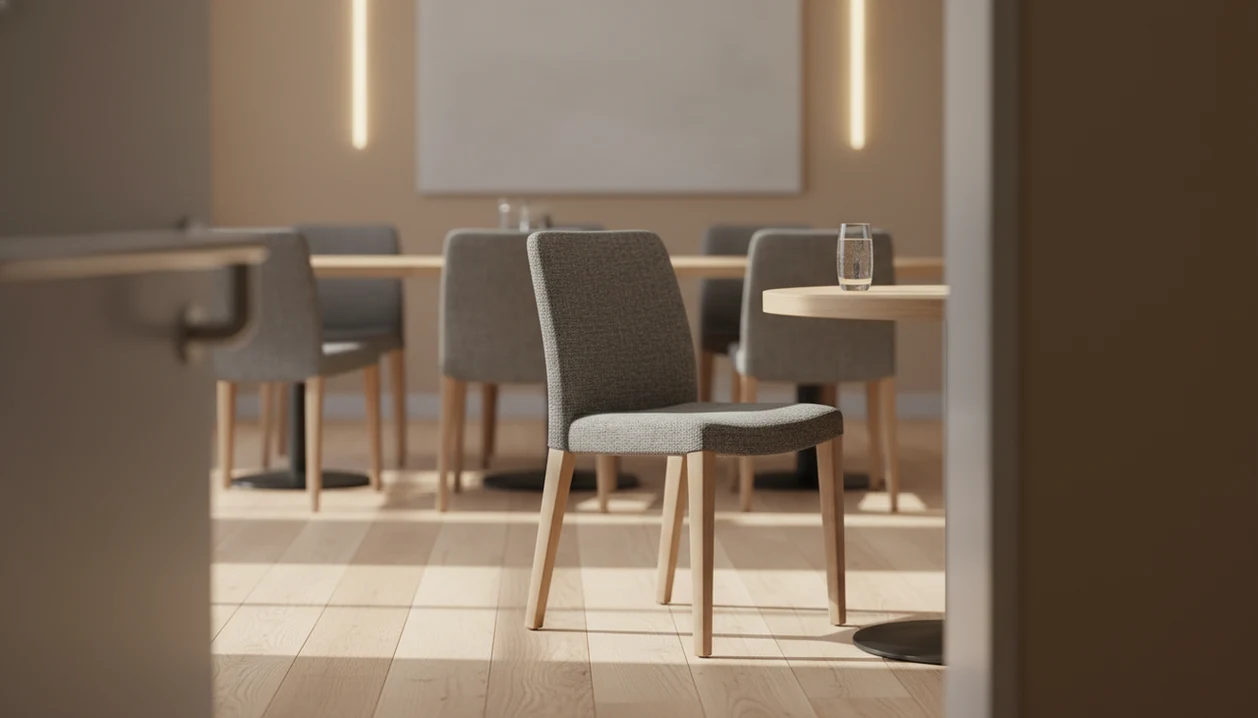
Image caption: open-eye grounding for social anxiety meditation
A person stands near the edge of a social event, practicing open-eye grounding as part of meditation for social anxiety. Their posture is ordinary, not posed: hands relaxed, gaze noticing the room, breath unforced. The practice uses a gentle breath, contact with nearby surfaces, and three neutral visual details to help attention return to the present moment.
This image shows a practical setup for social anxiety meditation support. It does not show treatment, a guaranteed calming method, or a requirement to close the eyes. The point is simple: stay oriented enough to take the next small social step.
Social Anxiety Meditation Limits
- Meditation cannot replace professional treatment for moderate to severe social anxiety disorder.
- Evidence does not prove that one meditation style is best for everyone.
- If quiet practice increases distress, can meditation make anxiety worse explains reasons and safer adjustments.
- Apps and recordings lack personalization, especially during panic, trauma symptoms, or complex mental health needs.
Social anxiety meditation questions
Can meditation help with social anxiety?
Meditation may help you notice anxious predictions, return attention to your surroundings, and take part despite discomfort. It is better treated as a support skill than a cure. If social fear causes substantial avoidance or disrupts work, relationships, or daily tasks, seek professional care rather than relying on meditation alone.
What meditation should I try before a social event?
Try a short, eyes-open grounding practice: feel your feet on the floor, notice three neutral details in the room, and label a worry as “predicting.” Then choose your next small action, such as entering or greeting someone. Use an external anchor instead of breath awareness if focusing on breathing increases distress.
Can I meditate while talking to someone?
Use a brief anchor rather than a full meditation session. Notice your feet touching the floor, then return attention to what the person is saying. If tracking your breath or body makes you monitor yourself more closely, drop that anchor and focus on the conversation. The purpose is participation, not constant inward attention.
How long should I meditate for social anxiety?
Start with a realistic window, such as 60 seconds before entering a room or two to five minutes in a quiet setting. Longer is not automatically better. Practise first in a low-stakes setting, and judge usefulness by whether you can return to the activity, not by whether every anxious sensation disappears.
Why does focusing on my breath make social anxiety worse?
Breath focus can intensify attention to sensations that already feel threatening. Some people become more panicky or disconnected when turning inward. Stop if distress increases. Keep your eyes open and try noticing an ordinary object, a sound, or contact with the floor instead. Persistent or severe reactions deserve professional guidance.
Can meditation replace CBT or exposure therapy for social anxiety?
Meditation should not replace needed CBT, exposure therapy, or medication. It can support treatment by helping you notice anxious thoughts without treating them as instructions to escape. Planning exposure and addressing substantial avoidance require more than a grounding exercise. Discuss changes to treatment with your clinician rather than stopping care on your own.
How do I know meditation is helping if I still feel anxious?
Look for changes in what you can do: making the call, staying in a conversation, or returning attention after a worrying thought. A racing heart does not automatically mean the practice failed. Progress can mean less avoidance and more participation, even when fear remains. Do not make complete calm a condition for taking part.