
How to Calm Panic in Your Body Without Forcing Your Breath


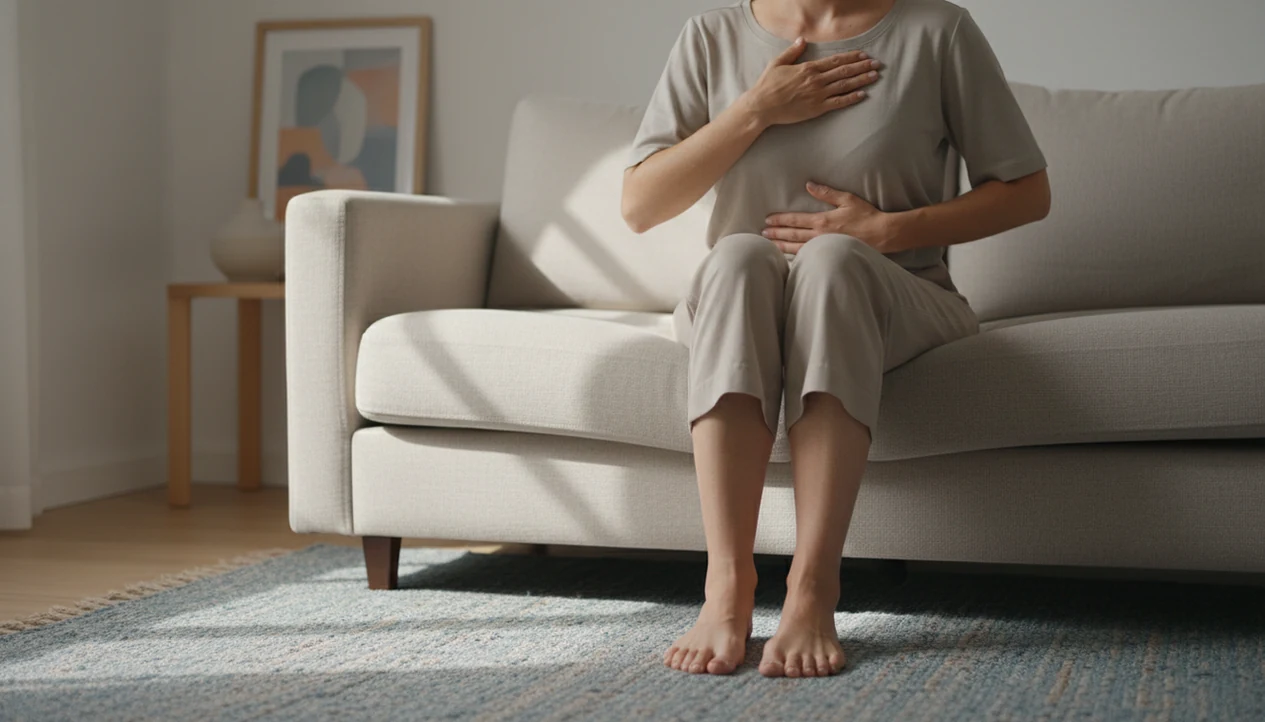
To calm panic in your body, breathe gently and more slowly, notice concrete details around you, and let sensations be present without trying to force them away. These steps combine breathing, sensory grounding and mindful body awareness to reduce the alarm response while keeping you oriented to the present. The aim is to help the peak pass, not to make fear disappear immediately.
Start with comfortable breaths rather than huge inhales or breath-holding. If focusing on your body increases fear, look outward instead: name a color, a sound or the pressure of your feet on the floor. Practice during calm moments, too. Panic-like symptoms can overlap with medical illness, so NHS guidance on panic disorder should not replace assessment of new or unusual symptoms.
The essentials
- Start with slower breathing, but do not hold your breath or force deep breaths.
- Use sensory grounding to shift attention from the panic loop to concrete details around you.
- Practice these skills when you are calm so they are easier to access during panic. These small mindfulness steps to feel better offer everyday ways to steady attention without demanding immediate calm.
What a panic rush feels like in the body
Calming panic in your body means using breath, grounding, and body awareness to lower panic intensity while the alarm response runs its course.
Panic is a body alarm response, not a character flaw. Your heart may race, your breath may get tight, your muscles may brace, and your attention may scan for danger. Calming does not mean instantly deleting fear. It means giving the body fewer threat signals and enough present-moment information to ride out the peak.
Field note: a secular mindfulness approach does not treat panic sensations as proof that something is wrong with you. It treats them as attention training. You notice breath, pressure, sound, dry mouth, or a fluttering stomach without turning the moment into a spiritual test or a medical treatment. A steady hand on a coat sleeve can be enough to begin.
5 Body Panic Facts Before You Try Techniques
Before you try a technique, know what the technique is trying to change. Panic often feeds on speed, fear of sensations, and threat-focused attention.
- Slower breathing can reduce physical intensity. Rapid shallow breathing can make dizziness, tightness, and tingling feel stronger.
- Grounding redirects attention. It moves focus from panic thoughts to sensory facts, such as color, sound, texture, and pressure.
- Mindful body awareness changes the relationship to sensations. Noticing “tightness is here” can reduce the fear added on top of the feeling.
- Practice matters outside panic. A phone timer set for 5 minutes during a calm afternoon teaches the pattern before you need it.
- Some panic symptoms need evaluation. Frequent, severe, new, or frightening symptoms should be discussed with a qualified clinician.
For broader context, our guide to mindfulness for anxiety support explains what mindfulness can and cannot do.
Body Alarm Loop Behind Panic Sensations
Panic works like a false alarm in the body. Breathing speeds up, heart rate rises, muscles tighten, and attention narrows toward possible threat.
The loop often gets stronger when the sensations themselves feel dangerous. A racing heart leads to “something is wrong,” which adds more adrenaline, which makes the heart race more. Fighting every sensation can accidentally send the body another warning signal: this feeling must be an emergency. If interactions intensify your alarm, understanding why people trigger you can help you respond with less judgment.
Mindfulness-based approaches aim to interrupt that loop with orientation, breath, and less judgment. Evidence is promising but not absolute. A meta-analysis of 39 studies found mindfulness-based therapy had a moderate effect on anxiety symptoms, with Hedges’ g = 0.63 (PubMed research). A 2014 AHRQ/JAMA review found small improvements in anxiety, depression, and pain, while noting that many studies did not show mindfulness outperforming active control treatments (PubMed research).
Helpful, not magic.
5-Step Body Panic Sequence for the Moment
Use this sequence when panic is already active. Keep it plain and repeatable; panic is not the time for complicated instructions. For a simple starting point, try meditation for panic attacks with gentle attention and no pressure to feel calm.
- Orient to safety. Look around and name where you are, the date, and one sign that you are not in immediate danger.
- Lengthen the exhale. Inhale gently for 3, then exhale for 4 or 5. Do not force deep breaths if that makes symptoms worse.
- Name sensory details. Say three things you see, two things you hear, and one thing you feel against your body.
- Relax one area. Drop your shoulders, unclench your jaw, or let your hands rest open on your lap.
- Stay with the wave. Label the experience: “the wave is rising” or “the wave is falling.”
For many people, a slower exhale plus sensory grounding is easier during panic than trying to think reassuring thoughts, because it gives the body direct safety cues.
Common Mistakes When Calming Panic in Your Body
Trying to overpower panic can add pressure; gentle breathing and grounding work with the body’s alarm response instead. These skills usually help best when they are gentle, repeated, and paired with good judgment.
- Soften the breath instead of forcing it. Huge inhales, breath-holding, or “perfect” breathing can make tightness, dizziness, or air hunger feel worse. Aim for medium breaths and a slightly longer exhale.
- Limit symptom checking. Repeatedly measuring your pulse, testing your breathing, or scanning for proof that something is wrong can feed the same alarm loop you are trying to calm. If checking extends to others’ reactions, these steps to stop worrying about being liked address that related pattern.
- Give the technique time. Thirty seconds is often too soon to call it a failure. Panic may still be peaking while the skill is beginning to reduce extra fear around it.
- Switch to grounding when scanning feels unsafe. If body awareness makes you feel trapped inside sensations, open your eyes, name room details, press your feet into the floor, or move slowly.
- Use self-help without delaying care. If symptoms are new, severe, medically concerning, or involve chest pain, fainting, or self-harm risk, seek urgent help rather than practicing through it.
When self-support is appropriate, and when it is not
This guide is for practical self-support during body-based panic sensations. It is not a substitute for medical or mental health care. Our stress, sleep and mindfulness safety resources explain how to practice gently and recognize when additional support matters.
| Best for | Not for |
|---|---|
| Mild to moderate panic sensations | Chest pain or pressure that could be medical |
| Stress spikes during work, travel, or bedtime | Fainting, collapse, or severe dizziness |
| Anticipatory anxiety before a meeting or appointment | Suicidal thoughts or urges to harm yourself |
| Practice between panic episodes | New, severe, or unusual symptoms |
| Learning breath, grounding, and body awareness skills | Recurring panic that disrupts daily life |
Self-help skills can support care, but they should not delay urgent help. Clinicians typically recommend evaluation when symptoms are new, severe, medically concerning, or repeatedly interfere with life.
If there is any risk of self-harm, call or text 988 in the U.S. for the Suicide & Crisis Lifeline, or use your local emergency number outside the U.S. (Reference).
If practice ever feels destabilizing, our page on meditation side effects gives a calmer way to sort normal discomfort from warning signs.
When to Seek Medical or Mental Health Help
Seek urgent help when panic-like symptoms could signal immediate danger, such as chest pain or pressure, fainting, collapse, severe shortness of breath, or suicidal thoughts. Recurring panic also deserves professional support when it starts shaping your choices, sleep, work, relationships, or ability to leave home.
Panic can feel intensely physical, and some symptoms overlap with medical issues involving the heart, lungs, hormones, medication effects, or substances. A clinician can help rule out medical causes, while a therapist or qualified mental health professional can assess panic patterns and offer treatment options.
- Call emergency services if symptoms feel life-threatening, include chest pain, fainting, signs of stroke, or a risk of harming yourself or someone else.
- Use crisis support if immediate safety is uncertain; in the U.S., call or text 988, and outside the U.S., use your local crisis line or emergency number.
- Book a medical evaluation for new, severe, unusual, or medically confusing symptoms, even if you suspect panic.
- Seek mental health care when panic repeats, avoidance grows, or self-help skills are not enough.
Breathing Technique for Panic in Your Body
Does breathing help when panic is in your body? It can, especially when the breath is softened rather than forced.
Rapid shallow breathing can intensify panic sensations. It may increase lightheadedness, chest tightness, tingling, or the feeling that you cannot get enough air. A safer starting point is gentle slower breathing with a slightly longer exhale.
Try this for one minute: inhale through the nose or mouth for 3, then exhale for 4 or 5. Let the breath be medium-sized. Avoid breath-holding as a shortcut; for some people, it increases alarm.
If controlled breathing makes distress worse, stop managing the breath. Return to natural breathing and use grounding instead. The goal is steadiness, not a breathing performance.
Grounding Exercise for Panic in Your Body
Grounding means bringing attention to present-moment sensory facts. It is not dismissive distraction; it is attention reorientation.
- 5-4-3-2-1 grounding: Name 5 things you see, 4 things you feel, 3 sounds, 2 smells, and 1 taste or breath sensation.
- Color naming: Pick one color and find five examples in the room.
- Texture check: Notice fabric, chair pressure, sleeve edges, or the coolness of tile under your feet.
- Sound map: Name the nearest sound, the farthest sound, and the quietest sound.
- Slow movement: Press your feet into the floor or walk slowly across the room, noticing each step.
The pocket check is real. A phone buzz can pull attention back into the panic loop, so leave it face down if you can.
For stress spikes outside panic, mindfulness for stress offers everyday mindfulness practices that fit work breaks and daily routines. During stressful periods, a short reset for overwhelm can help you pause and choose one manageable next step.
Mindful Body Awareness for Panic Sensations
Mindful body awareness means noticing sensations without turning the scan into an investigation of what is wrong. You are observing, not diagnosing.
Start with a neutral area, such as the feet, hands, or the lower back meeting the cushion. Then notice warmth, tightness, tingling, pressure, pulsing, or movement. Use soft labels: “tightness is here,” “warmth is here,” or “the wave is rising and falling.”
If attention on body sensations feels unsafe, do not force it. Open your eyes, look around the room, or return to grounding. Body awareness should make the moment more workable, not more trapped.
Beginner mindfulness and meditation practices can train attention for daily life, but they do not promise to cure panic.
3-Minute Daily Practice for Body Panic Skills
Panic-calming skills are easier to use when practiced during calm moments. Repetition teaches the nervous system a familiar route back to steadier attention.
Try 3 to 5 minutes daily. While watering plants, pause by the sink or window and let the room come into focus. Take five soft breaths with a longer exhale. Name three ordinary details, such as leaf shape, water sound, or the weight of the can. Then scan one neutral body area for pressure, warmth, or movement. Done.
Practice after waking, during an afternoon reset, or as the house gets quiet at night. The goal is not to force calm. It is nervous-system learning, like recognizing the airport queue sign and remembering there is a next step.
If sleep is part of the pattern, meditation for sleep may be a useful next reference.
Illustrating grounded posture and gentle breathing
Use an image that makes the practice look safe and ordinary. A good choice is a person seated or standing with grounded feet, one hand resting on the chest or belly, and eyes softly oriented toward the room.
Avoid dramatic panic imagery, such as a person clutching their chest in a dark corner. That can make the page feel more threatening than helpful.
Suggested caption: A person practicing how to calm panic in your body with a slow exhale, grounded feet, and quiet naming of sensory details in the room.
For accessibility, the image should show posture, hand placement, and orientation clearly. The viewer should understand the method without needing a long explanation.
Between panic episodes: rehearse a short practice
During a calm moment, set aside three minutes to practice gentle breathing and name a few details around you. The free meditation timer can mark that practice period without prescribing a breathing rhythm. Mindful.net also offers short guided meditations in its app. During active panic, simple external grounding may be more useful than following audio, especially when inward attention increases fear. Neither option replaces clinical care.
Limits of Panic Techniques
- Mindfulness has limits for panic disorder, and breathing or grounding cannot guarantee immediate relief.
- Breathing too deeply or too fast may worsen distress for some people.
- Grounding and body scans can be difficult during severe panic or dissociation.
- Take the question can meditation make anxiety worse seriously if meditation increases anxiety.
Questions about calming panic
What should I do first when panic hits?
Check that you are somewhere safe, then sit or stay where you are if appropriate. Relax your shoulders and breathe gently, with a comfortable exhale at least as long as the inhale. Name a few things you can see or hear. New, severe or unusual symptoms need medical judgment, not an assumption of panic.
What if breathing exercises make my panic worse?
Stop controlling the breath if doing so increases distress. Open your eyes and shift attention to the room: name colors, listen for nearby sounds or feel the floor beneath your feet. Walking slowly or speaking with someone may be more useful than continuing an inward-focused exercise. Marked breathing difficulty needs urgent medical assessment.
How does the 5-4-3-2-1 grounding exercise help panic?
Name five things you see, four you feel, three you hear, two you smell and one you taste. This directs attention toward present sensory information rather than repeated symptom checking. It may help you feel more oriented, but no grounding formula reliably stops every panic attack. Use a simpler version if counting feels difficult.
Why does panic cause tingling and dizziness?
Panic can change breathing, heart rate and muscle tension. Breathing faster or deeper than your body needs lowers carbon dioxide, which can contribute to dizziness, tingling and feelings of unreality. Fear of those sensations can intensify the alarm. These symptoms also have other possible causes, so unfamiliar episodes should not automatically be labeled panic.
How long does a panic attack usually last?
Panic attacks often pass within minutes, although there is no exact timetable for every episode. Try not to turn the clock into another test of whether you are safe. Gentle breathing and grounding may help you through the peak. Persistent, severe or substantially different symptoms need assessment rather than continued waiting for panic to pass.
Can mindfulness stop panic attacks from coming back?
Mindfulness can help you practice attention and notice sensations with less added judgment, but it is not a guaranteed way to prevent attacks or a cure for panic disorder. Recurrent attacks, fear of another attack and avoidance deserve professional assessment. Clinical treatment commonly includes cognitive-behavioral therapy, including methods that address learned fear of sensations.
When should I get urgent help instead of using panic techniques?
Seek urgent medical help for severe or persistent chest pain, fainting, marked breathing difficulty, confusion, blue lips or new neurological symptoms. Symptoms during exertion, suspected overdose, or an episode substantially different from your usual pattern also need caution. Do not let reassurance about panic delay assessment. Suicidal thoughts or urges to harm yourself require urgent support.