
How Your Brain Creates Your Sense of Self


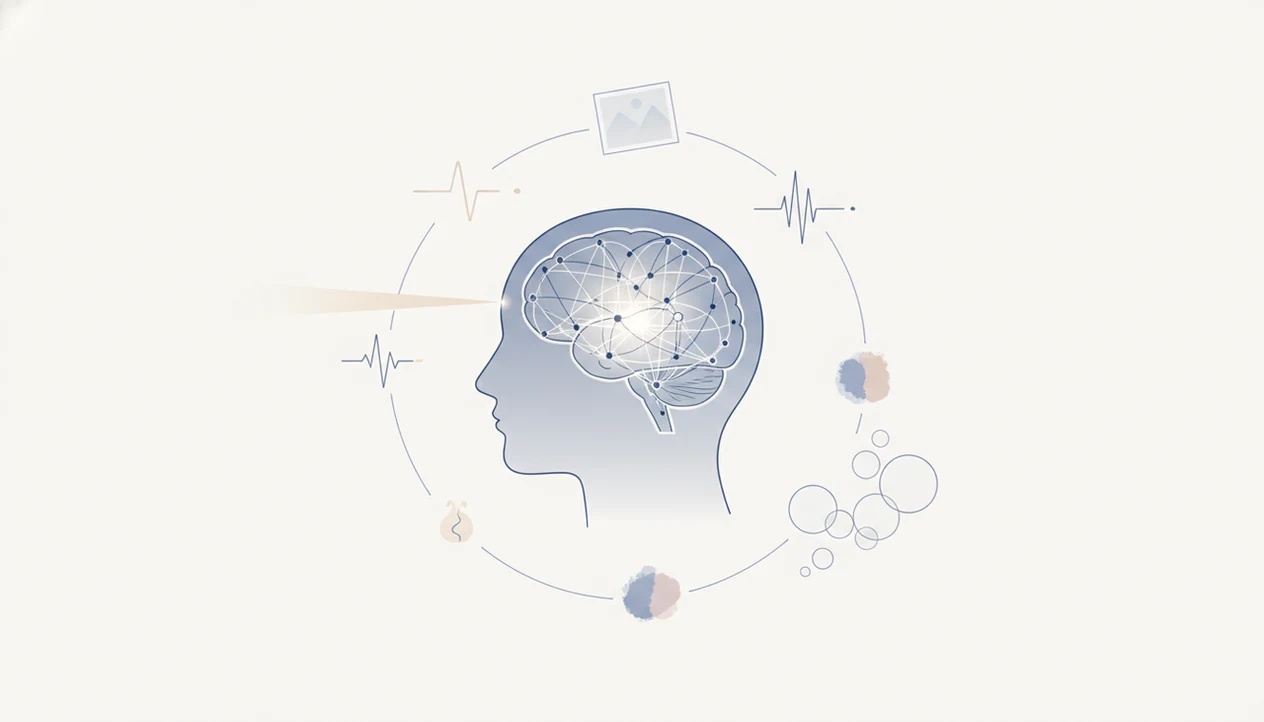
Your brain creates your sense of self by combining memories, body signals, emotions, attention, and thoughts into a changing account of “me.” This sense of self includes what you feel now, what you remember, and how you understand yourself in a social setting. No single brain region holds all of it. Several interacting networks contribute to the experience.
That helps explain why a thought such as “I always get things wrong” can feel like a fact about your identity rather than a passing judgment. Mindfulness offers a way to notice the thought, the sensations accompanying it, and where attention goes next. It does not erase your identity or require you to stop thinking. Comparing optimism and negative thinking can help distinguish realistic perspective from rigid conclusions about yourself.
Definition: The sense of self is the brain’s ongoing construction of “me” from self-related thoughts, body sensations, memories, emotions, and social context.
Key points
- The brain does not appear to have one fixed “self spot”; the self emerges from interacting networks.
- The default mode network is strongly involved in mind-wandering, autobiographical memory, and self-referential thought.
- Mindfulness does not erase the self; it trains attention so self-stories can feel less rigid and more workable.
How memory, sensation, and thought become a self-story
How the brain creates sense of self: it assembles memory, body sensation, emotion, attention, and thought into a live-updating story. There is no single self-center in the brain that stores the whole of “you.”
A simple model is this: memory says, “Here is what happened before.” Body signals say, “Here is what is happening now.” Emotion adds importance. Attention selects what gets foregrounded. Thought turns the mix into a sentence like, “I’m the kind of person who always worries.”
That sentence can feel solid, especially at 2 a.m. or before a hard meeting. But it is closer to a news feed than a stone statue. It updates.
Image caption suggestion: Brain networks combine memory, body awareness, and attention to create the felt sense of “me.”
Five findings about the brain and sense of self
- No single brain region fully contains the self. Self-experience appears to emerge from interacting systems for memory, body awareness, emotion, attention, and social meaning; meta-analyses of self-referential processing point to distributed cortical midline and related systems rather than one fixed 'self spot' PubMed research.
- The default mode network supports self-talk and mental time travel. It is active when the mind wanders, remembers the past, imagines the future, or narrates “what this means about me.”
- Salience and attention networks help shift the mind. They can move attention from a self-story into direct experience, like cool air at the nostrils.
- Meditation research links practice to brain changes. A 2014 meta-analysis of 21 neuroimaging studies associated meditation with structural changes in 8 brain regions, including areas tied to self-awareness and memory NIH research.
- Mindfulness changes the relationship to self-related thoughts. It does not delete thoughts; it helps you notice them as events in the mind.
For beginners, present-moment anchoring is often easier than analyzing identity because the body gives attention somewhere concrete to land.
How to use this sense-of-self model in mindfulness practice
Use this model by treating the self-story as something the mind is producing, not as a final verdict on who you are. The aim is not to argue with the story, but to notice its ingredients and choose a useful next response.
- Name one current self-story in simple language, such as “I’m failing,” “I always mess this up,” or “They must be upset with me.”
- Locate the body sensations that arrive with it. You might notice a tight chest, warm face, clenched jaw, heavy stomach, or restless hands.
- Label the mental process gently as “remembering,” “judging,” “planning,” or “worrying,” depending on what the mind is doing.
- Return attention to one sensory anchor for several breaths, such as the feeling of air at the nostrils, feet on the floor, or sounds in the room.
- Ask what response would be useful now without treating the story as complete truth. Sometimes the answer is to send the email, rest, apologize, set a boundary, or simply wait. Research on self talk and emotional regulation examines how inner speech can influence feelings and responses.
This keeps mindfulness practical: notice the construction, steady attention, then act with a little more choice.
Three brain networks involved in self-related thought
The brain creates self-experience through networks that cooperate and compete as attention moves inward, outward, or onto a task. Three networks matter most in a practical explanation: the default mode network, salience network, and frontoparietal control network.
Default mode network and self-story
The default mode network is linked with self-referential thought, autobiographical memory, and imagined futures. It is the system behind many “me” narratives: what I did, what they think of me, what might happen next. For a deeper background, our internal monologue science guide explains why self-talk can feel so convincing.
Salience and control networks
The salience network detects what matters in the body and environment. The frontoparietal control network supports attention, choice, and regulation. A neuroscience review describes meditation-related changes in attention, emotion regulation, and self-related processing systems Nrn3916.
During an elevator ride, leave messages unchecked and notice the thoughts and sensations that arise. You can feel which network wins.
Mindfulness effects on brain networks and self-talk
Mindfulness trains attention toward breath, body, sound, and present-moment sensations. Over time, practice may reduce automatic identification with excessive self-referential thinking and rumination, but it does not instantly rewrite identity. Evidence on negative thinking and cognitive decline requires careful interpretation, since associations do not establish that thoughts cause harm.
Study findings are suggestive, not final. Resting-state fMRI research has found that experienced meditators show altered default mode activity and connectivity compared with non-meditators Pnas.1112029108. One 8-week MBSR study found increased gray matter concentration in regions linked with learning, memory, self-relevance, and perspective-taking NIH research.
A practical session is less dramatic than the scan language sounds. You sit, notice the mind wander to a grocery list, and return to the breath. Then it happens again.
For a broader evidence summary, the science of mindfulness page separates brain findings from overclaims. Mindfulness practices and meditation techniques for beginners and daily life offer attention training and steadier noticing, not a guaranteed new personality.
A brain scan cannot show that meditation has erased the self
A change in brain activity is not the same as a change in identity. A 2016 review and meta-analysis of meditation imaging studies implicated several systems, including attention, cognitive control, body awareness, and self-related processing. It did not establish one universal meditation pattern. These findings support a narrower interpretation: meditation can involve changes in how attention and self-related information are processed, not proof that the self has disappeared.
Cause is a separate question. A 2014 review of structural brain imaging relied heavily on comparisons between existing meditators and nonmeditators. Those groups may already differ in lifestyle, stress, education, or other factors. To connect a scan finding with a useful change in self-experience, researchers also need measures of behavior and reported experience. A scan alone cannot establish that someone feels less trapped by self-critical thoughts.
Five mindfulness tips to observe your sense of self
Use this short practice to observe self-construction without turning it into a philosophy exam.
- Set a 3-minute timer and choose a neutral posture, such as sitting on a kitchen chair with both feet on the floor.
- Notice breath or body sensations before analyzing thoughts. Feel the shoulders dropping after an exhale.
- Label self-related thoughts as “planning,” “remembering,” “judging,” or “worrying.”
- Return attention to one sensory anchor, such as feet on carpet, the breath, or sounds in the room.
- Soften the thought with a kind phrase: “This is a thought, not the whole of me.”
Tools like Mindful.net can be useful when you want beginner-friendly secular mindfulness practices with short instructions. Apps such as Headspace and Calm also offer guided practice, so compare your options by tone, length, and how much explanation you want.
Start small. Three honest minutes count.
Best-fit readers and safety notes for sense-of-self practice
This guide fits readers who want a plain-language neuroscience explanation, not a diagnosis or spiritual authority. It is also useful for meditators who notice strong self-talk, rumination, or inner criticism during practice.
| Reader or situation | Best for | Not ideal for |
|---|---|---|
| Curious beginner | Understanding the self as a brain-based process | Diagnosing a brain or mental health condition |
| Meditator with busy self-talk | Learning to label thoughts without obeying every one | Forcing long inward practice when it feels destabilizing |
| Secular learner | Exploring attention practice without spiritual claims | Replacing therapy, medication, or crisis care |
| App user | Trying short guided sessions through a Mindfulness Practices App or another tool | Expecting an app to resolve trauma or severe distress alone |
If inward attention feels unsafe, adapt the practice. Open your eyes, use sound, or work with a qualified clinician.
Common myths about how the brain creates sense of self
- Myth: one brain region controls the entire self. The self is better understood as a network process involving memory, body awareness, emotion, attention, and social context.
- Myth: mindfulness eliminates the self. Mindfulness usually softens rigid self-stories; it does not erase practical identity.
- Myth: meditation means stopping all self-related thoughts. The more realistic skill is noticing thoughts, labeling them, and returning to direct experience.
- Myth: a few short sessions instantly rewire identity. Meaningful change usually takes repeated practice over weeks or months.
- Myth: brain scans can fully explain subjective experience. Imaging can show patterns, but it cannot capture every lived detail of being a person.
For most beginners, labeling self-talk is often more workable than trying to silence it because the mind naturally produces commentary. If you want the broader mechanism, our guide to how mindfulness changes the brain covers related research.
Limits of Self Research
- Research lacks a complete self model, studies have sampling limitations, and brain imaging shows correlation rather than definitive causation.
- Findings from labs, retreats, and expert meditators may not apply directly to brief phone timer practices.
- Seek support from a licensed clinician if changes in self-experience feel frightening, persist, or impair daily life.
- This page is educational, not diagnostic; read how the brain changes when you meditate for related brain-change basics.
Brain and sense of self questions
Where is the sense of self located in the brain?
There is no single brain region that contains the whole self. Self-experience draws on interacting systems involved in memory, body awareness, emotion, attention, and social meaning. Different parts of that experience, such as remembering your past or noticing your body now, involve different processes.
How does the default mode network relate to the self?
The default mode network is involved in self-related thought, autobiographical memory, and imagining the future. It contributes to thoughts about what happened to you and what events mean about you. It is part of a larger network system, not a separate identity center or simply a source of unwanted thoughts.
Why can a self-critical thought feel like a fact?
A self-critical thought can combine a memory, a strong emotion, and body sensations into one convincing account of who you are. Attention may keep that account in the foreground. In mindfulness practice, naming the thought and noticing its accompanying sensations can help you treat it as a mental event rather than a final verdict.
Does mindfulness stop self-talk?
Stopping every self-related thought is not the aim. Mindfulness practices train you to notice thinking, label processes such as remembering or worrying, and return attention to a sensory anchor. Self-talk may continue. The useful change is becoming less automatically caught up in it, rather than achieving a silent mind.
Does meditation change your identity or erase your sense of self?
Meditation does not need to erase identity to be useful. It may help rigid self-stories feel less compelling by changing how you attend to thoughts and sensations. Brain activity findings do not prove a loss of self. Frightening or persistent changes in self-experience should be discussed with a licensed clinician.
Do brain scans prove that meditation changes the brain?
Some studies report differences in brain activity or structure, but those findings need careful interpretation. Comparisons of experienced meditators with nonmeditators cannot reliably separate practice effects from pre-existing differences. Reviews also identify small samples and other methodological weaknesses. A scan difference does not by itself prove lasting change or an everyday benefit.
How can I observe a self-story during meditation?
Choose one current thought, such as “I am failing,” and notice the body sensations that come with it. Label the process as judging, remembering, or worrying. Then return to your feet, breath, or sounds in the room. A brief practice is enough to observe the process; you do not need to resolve the thought.
What if meditation makes me feel detached from myself?
Do not force longer inward practice when it feels destabilizing. Pause rather than treating detachment as evidence of progress. Meditation can produce negative experiences, and it is not a medical treatment. If the feeling is frightening, persists, or interferes with daily life, seek support from a licensed clinician.