
Meditation Effects on the Brain: What Changes and What Remains Uncertain


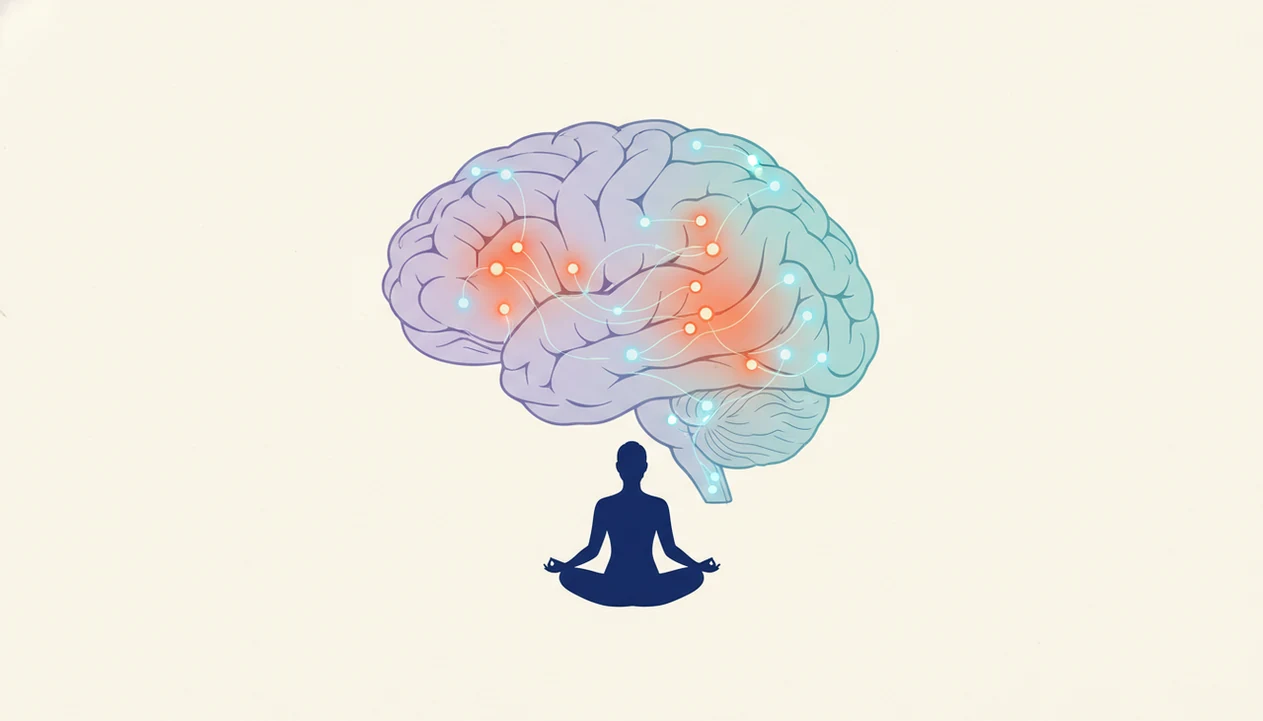
Meditation effects on the brain include temporary shifts in attention, stress reactivity, and brain-wave activity, alongside possible longer-term changes in structure and connectivity with repeated practice. This capacity to adapt is called neuroplasticity. Research examines networks involved in attention, memory, emotion regulation, stress response, and body awareness, but it has not established one universal brain pattern for meditation.
A change during a session is not the same as a lasting change outside practice. Nor does a difference on a brain scan guarantee better focus or less anxiety. Findings depend on the meditation method, amount of practice, and individual context. Meditation is a skill you can practice, not a cure-all, and claims about permanent brain changes need more caution than many headlines suggest.
What matters most
- Meditation can change brain activity during a session and may support longer-term structural changes with regular practice.
- Research links meditation with attention, memory, emotion regulation, stress response, and body-awareness networks.
- The evidence is promising but not magical: meditation is not a cure-all, and brain changes depend on practice type, consistency, and individual context.
Temporary brain activity shifts and longer-term adaptation
Meditation affects the brain in two broad ways: short-term activity changes during practice and longer-term neuroplastic changes with repetition. In plain language, the brain practices noticing, shifting, calming, and returning.
During a session, attention networks become active as you follow the breath, sounds, or body sensations. The default mode network, which is often linked with mind-wandering and self-focused thought, may quiet or change its pattern. Over time, studies connect meditation with regions involved in memory, emotional regulation, stress response, and body awareness.
One session can feel useful. It is not a permanent brain remodel.
Most meaningful changes are linked with repeated practice, such as five or ten minutes most days. A three-minute breathing pause before opening a laptop still counts as attention practice, especially when you notice the mind wander and return without making it a problem.
Five research findings on meditation and the brain
- Meditation is linked with gray matter changes. An eight-week MBSR study found increased gray matter concentration in the hippocampus and other learning-memory regions compared with controls NIH research.
- The amygdala may become less reactive in some studies. An MBSR study found that reduced perceived stress correlated with decreased amygdala gray matter density, but this was a small intervention study rather than proof that meditation permanently shrinks fear responses PubMed research.
- Cortical thickness and connectivity can shift. Reviews of mindfulness neuroscience report changes in attention, emotion-regulation, and self-referential networks, but findings vary by practice type, sample size, and imaging method PubMed research.
- Brain waves can change during practice. EEG research links meditation with shifts in alpha, theta, beta, and gamma patterns, though the pattern depends heavily on meditation style and practitioner experience PubMed research.
- Different practices train different networks. Focused attention, open monitoring, body scan, mantra, and loving-kindness meditation do not all ask the brain to do the same job.
For a broader map, our Mindfulness Science Hub organizes related research topics in one place.
Check what participants actually practiced
A study of experienced meditators cannot show, on its own, that meditation caused their brain differences. Participants may already differ in lifestyle, education, stress, or other factors before researchers scan them. A 2014 review of structural brain studies drew heavily on these cross-sectional comparisons. That makes the findings useful for identifying possible relationships, but weaker evidence for a lasting change caused by training.
The intervention matters too. Mindfulness-based stress reduction generally combines eight weeks of group sessions, body scanning, sitting meditation, mindful movement, and home practice. That is not interchangeable with a few minutes of breath awareness. When reading a study, check the practice, attendance, home practice, comparison group, and participant expectations. The NCCIH summary of stress-related interventions helps distinguish structured programs from meditation as a broad category.
Brain activity during a meditation session
State changes are temporary shifts in brain activity that happen during meditation or shortly after practice. They can include changes in attention, body awareness, emotional tone, and brain-wave patterns.
A simple breath meditation is repeated cognitive training. You choose an anchor, notice attention drift, and return. Then you do it again. The teacher's cue to notice wandering is not a failure cue; it is the training moment. Over many repetitions, the brain practices monitoring without immediately chasing every thought.
Several systems may be involved. Attention networks help you stay with the anchor. The default mode network may become less dominant when you stop rehearsing old conversations. Salience and interoception systems help you notice signals from the body, such as the chest rising or the jaw tightening. Learning about the brain and sense of self adds context to research on meditation and self-focused thought.
Brain waves may also shift toward patterns associated with calm attention, relaxation, or monitoring. That does not mean the brain shuts down. It is active in a quieter, more organized way.
Brain regions affected when you meditate regularly
Regular meditation is most often discussed through a few brain regions tied to practical mental skills. These are not “meditation centers.” They are parts of wider networks.
- Hippocampus: Supports learning, memory, context, and emotional regulation. This is why hippocampus findings often appear in studies of mindfulness-based stress reduction.
- Prefrontal cortex: Helps with attention, planning, impulse control, and perspective-taking. In daily life, this may look like one extra breath before replying.
- Amygdala: Detects threat and participates in stress reactivity. Meditation may affect its density or reactivity in some studies, but it does not turn the alarm system off.
- Anterior cingulate cortex: Helps monitor attention and detect conflict, such as noticing that your mind left the breath.
- Insula: Supports interoception, body awareness, and present-moment signals. Feet on carpet or tile can become a practical grounding cue. For persistent discomfort, mindfulness for pain management may help you relate differently to sensations without replacing medical care.
Related mechanisms are covered in more detail in our guide to how mindfulness changes the brain.
State changes versus trait changes after meditation practice
A calm session is a state change, not proof of permanent rewiring. Trait changes are more durable patterns that may carry into ordinary life after consistent practice over weeks or months.
| Change type | What it means | Realistic example |
|---|---|---|
| State change | Temporary shift during or shortly after meditation | You feel steadier after a 5-minute timer on your phone |
| Trait change | More durable shift that shows up outside practice | You notice rumination sooner during a commute |
| State change | Brain waves and attention may shift for that session | Breath awareness feels easier after the first minute |
| Trait change | Attention and emotional regulation may become more available | You pause before reacting in a tense conversation |
The most useful sign is often ordinary. You return faster. You catch the spiral earlier. You soften the tongue from the palate and realize the body was bracing before the thought became a story.
How to use meditation to support brain change
Use meditation to support brain change by making the practice small enough to repeat and clear enough for the brain to learn. The core loop is simple: choose an anchor, notice wandering, return, and repeat without turning distraction into failure.
- Choose one short practice window. Pick a time you can do most days, such as three minutes after brushing your teeth or five minutes before opening your laptop.
- Use one steady anchor. Follow the breath, sounds in the room, feet on the floor, or a body sensation. Keep the target plain so attention has somewhere to return.
- Notice distraction kindly. When thoughts, plans, or worries pull you away, register that the mind wandered without scoring the session as bad.
- Return gently and repeat. Bring attention back to the anchor, then do the same thing again. This notice-and-return cycle is the training.
- Increase duration slowly. Add time only after the habit feels stable, not because one session felt unusually calm.
- Stop if practice feels destabilizing. Shorten the session, use guidance, or seek professional support if meditation increases panic, dissociation, trauma symptoms, or severe distress.
Six ways to make attention practice repeatable
A beginner routine should be small, repeatable, and secular. For beginners, the aim is to practice returning attention and noticing experience more clearly, not to change personality overnight.
- Set a small daily target. Start with 3 to 5 minutes, most days, rather than waiting for a long quiet session.
- Choose a stable posture. Sit on a chair, bus seat, cushion, or office stairwell landing with the body awake but not stiff.
- Use one anchor. Follow the breath, feet, sounds, or body sensations. Keep it simple.
- Notice mind-wandering. When the mind jumps to a grocery list, label it gently as thinking.
- Return without scolding yourself. The return is the practice, not a sign that you did it wrong.
- Track experience lightly. Note sleep, mood, or focus if useful, but do not obsess over brain changes.
Tools like Mindful.net can support beginner mindfulness practices when you want guided structure, alongside options such as Calm and Headspace.
Best fit and poor fit for meditation-based brain training
Meditation-based brain training fits people who want to practice attention, stress regulation, and present-moment awareness. It is not a substitute for therapy, medication, crisis care, or professional mental health treatment.
| Fit | Who it may suit | Why |
|---|---|---|
| ✅ Best for attention training | Beginners who can practice briefly and consistently | Repeated notice-and-return practice trains attentional control |
| ✅ Best for stress regulation practice | People who want a pause before reacting | Breath and body anchors create a usable interruption |
| ✅ Best for everyday mindfulness | People who prefer practical, secular exercises | Short practices can fit work, commuting, or bedtime |
| ❌ Not ideal alone | People in crisis or with serious symptoms | Professional support is more appropriate |
| ❌ Not ideal to force | People who feel distressed during practice | Guidance, shorter sessions, or another approach may be safer |
For beginners, short daily practice is often easier than occasional long sessions because the habit has less friction.
When meditation makes distress worse
Uncomfortable experiences deserve attention, not an instruction to push through. A review of 83 studies involving 6,703 participants found that approximately 8% reported a negative effect, most commonly anxiety or depression. The NCCIH safety summary also describes a smaller analysis in which MBSR was not more harmful than no treatment. Neither finding establishes that every practice is safe for every person. Research on mindfulness and depression examines possible brain changes, but findings do not guarantee symptom relief.
If a session increases anxiety or leaves you feeling worse, stop rather than treating distress as proof that the practice is working. Consider whether a shorter practice or an external anchor, such as sounds or contact with the floor, is more manageable. Persistent or worsening symptoms call for professional support. Meditation should not replace therapy, medication, or other needed care.
Brain before and after meditation: realistic expectations
What changes in the brain before and after meditation? Neuroimaging findings usually describe group averages, not a personal guarantee that your scan would change in the same way.
Eight-week MBSR research found measurable gray matter changes, including hippocampal increases NIH research. A meta-analysis of 21 morphometric neuroimaging studies also reported structural differences across eight brain regions in meditators compared with non-meditators PubMed research. Useful, yes. Dramatic before-and-after transformation, no.
Daily-life changes may be quieter than people expect. Less rumination after a stressful message. Faster recovery after being interrupted. A steadier return to the task when the cursor is blinking on an email.
Exercise, therapy, sleep, learning, social connection, and stress exposure also shape neuroplasticity. If you are comparing brain-supportive habits, our guide to the best exercise for brain health gives a useful contrast. Simple habits for a happier brain can complement meditation through regular movement, supportive relationships, and consistent sleep.
Reading the brain-network illustration
Caption: Meditation and brain network changes may involve the hippocampus, amygdala, prefrontal cortex, insula, and attention networks. During practice, the brain may show calmer or more organized activity in systems related to attention, body awareness, and emotional regulation. With consistent practice, research suggests possible longer-term changes in structure and connectivity.
This image should not suggest that meditation turns off any brain region. The amygdala, for example, still detects threat. The prefrontal cortex still plans. The insula still tracks body signals. Meditation practice is better understood as training regulation and awareness within active brain networks.
Limits of Meditation Research
- Some studies rely on small samples, highly experienced meditators, or designs that cannot establish cause and effect.
- Brain changes reflect group averages, while individual effects vary with meditation type, practice, teaching, setting, and personal history.
- Clinicians recommend mindfulness as an additional skill when appropriate, not a replacement for care supported by evidence.
- Seek professional support if meditation feels uncomfortable or silence makes anxious thoughts louder.
Meditation and brain changes: common questions
Does meditation permanently rewire your brain?
Repeated meditation may support neuroplasticity, but permanent rewiring is too strong a promise. Brain activity can change during a session without producing a durable change afterward. Structural studies also have methodological limits, so a difference between meditators and nonmeditators does not establish that meditation caused it.
How long does meditation take to change the brain?
Some activity changes occur during meditation, while longer-term changes require repeated practice and follow-up measurements to establish. There is no reliable deadline for an individual. An eight-week research program usually includes instruction and substantial home practice, so its findings cannot simply be applied to eight weeks of occasional short sessions.
Does meditation increase gray matter?
Some MRI studies report mindfulness-related gray-matter changes, but reviews identify small samples, weak statistical power, and several forms of bias. The evidence does not establish that meditation reliably enlarges particular brain regions. A structural difference also does not automatically mean better memory, attention, or emotional health.
Does meditation shrink the amygdala?
The claim is more definite than the evidence allows. Research on meditation-related structural differences has important limitations and cannot establish that everyone's amygdala will shrink with practice. Size alone is not a measure of fear or emotional health, and meditation does not turn off the brain's threat response.
Which brain waves change during meditation?
Researchers study changes in EEG frequency bands, including alpha, theta, and gamma, but no single pattern reliably defines meditation. Results vary across studies and methods. More activity in one band is not proof of a deeper or better session, and brain-wave measurements alone cannot establish a useful everyday benefit.
Does meditation turn off the default mode network?
Meditation may alter activity in networks involved in mind-wandering and self-related thought, including the default mode network. That is not the same as switching a network off or removing the sense of self. Brain imaging needs to be considered alongside what participants experience and how they perform on relevant tasks.
Does a brain change mean meditation has improved my focus?
Not necessarily. A measurable neural change and better performance are different outcomes. To support a claim about focus, a study needs attention measures, not only brain scans or EEG. In daily practice, noticing distraction and returning to an anchor is the task; a quiet mind is not required.
Can meditation make anxiety worse?
Yes, negative experiences are reported, including anxiety and depression. Stop a practice that increases distress rather than forcing yourself to continue. A shorter session or external focus may be more manageable, but persistent or worsening symptoms need professional support. Meditation is not a replacement for mental health treatment.