
Internal Monologue Science: How Your Inner Voice Works


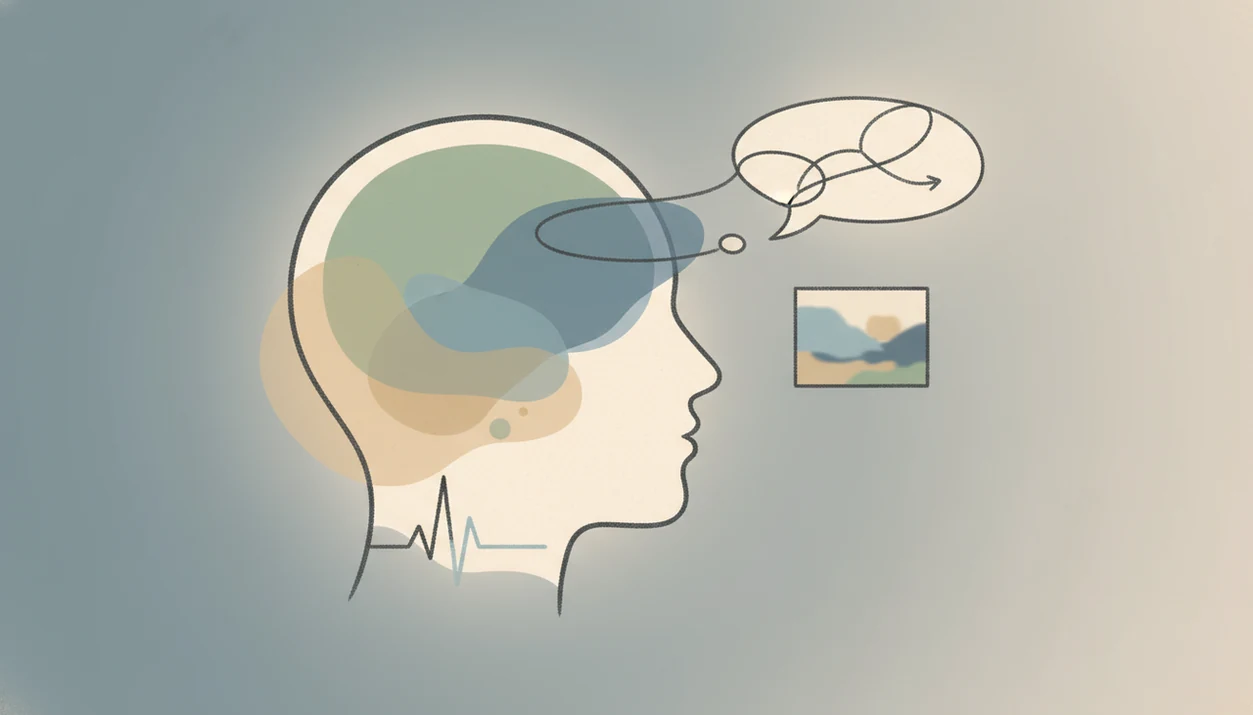
Internal monologue science studies inner speech, the words or private voice that some people experience as they think. It is one form of conscious thought, alongside mental images, bodily sensations, emotions, and wordless understanding. Some people notice a clear inner narrator; others think mostly without words. Inner speech can help with planning and self-coaching, but it can also become repetitive, harsh, or caught in worry.
The aim of mindfulness is not to force that voice into silence. Instead, notice what it is doing: helping you choose a next step, rehearsing a conversation, or repeating criticism without resolving anything. This guide covers ordinary inner speech and mindfulness education. It is not a diagnostic guide for hallucinations, obsessive thoughts, trauma symptoms, or suicidal thoughts.
The essentials
- Inner speech is normal, but it is not universal or constant.
- One experience-sampling study found inner speaking in about 26% of sampled waking moments.
- Mindfulness can help you relate to inner chatter more skillfully without trying to erase thoughts.
Inner monologue is verbal thought, not all thought
Internal monologue is inner speech, meaning thought that feels like words, sentences, or a private voice. It is not the same as all thought.
People also think through mental pictures, emotional tones, body signals, memory flashes, and wordless “I know what I mean” impressions. You might rehearse a caption while finishing a photography edit, then later choose from a cold-fingertip hunch or a remembered image of garden soil after rain.
Neither style is automatically better.
More inner speech can help with planning, reading, and self-coaching, but it can also loop into worry. Less inner speech can feel quiet, visual, or intuitive without being abnormal. It trains you to notice thought, name it lightly, and return to what is happening now, such as brushing the dog or reading the next line on a recipe card.
How inner speech supports memory and self-regulation
Internal monologue science works by treating the inner voice as simulated language: the mind is using word-like patterns without necessarily speaking out loud. That means inner speech is one kind of conscious thought, not the whole stream of awareness.
The inner voice is shaped by attention, working memory, and self-regulation. Attention decides what gets foregrounded, working memory briefly holds a phrase like “send the form,” and self-regulation uses that phrase to guide behavior, slow an impulse, or rehearse a response. But verbal thought is only one channel. A decision may also come as a mental image, a body signal, an emotional shift, or a wordless sense of knowing before any sentence forms. Mind-wandering works the same way: it may become a running commentary, a visual daydream, an anxious feeling, a remembered sound, or a mixed scene with words and sensations tangled together. Research on neuroplasticity and thoughts explores how repeated mental activity can shape brain networks over time.
Five findings about how often people think in words
- Inner speech is one normal mode of thought. It sits beside visual imagery, body sensation, emotion, memory, and wordless understanding.
- Not everyone has a constant narrator. Some people report a steady inner voice, some hear it only during reading or planning, and some rarely notice words inside.
- A 2011 descriptive experience sampling study found inner speaking in about 26% of randomly sampled moments. The study followed 30 adults and suggests that inner speech is common, but not dominant in every moment APA research.
- Prevalence claims are still uncertain. Self-report surveys depend on how people interpret “inner voice,” while moment-by-moment sampling is detailed but small.
- Internal monologue can help or hurt. For many people, it supports planning and self-coaching; under stress, the same channel can turn into rumination or harsh self-criticism. For beginners, labeling the pattern is often easier than trying to force silence.
Attention, mind-wandering, and the inner voice
Inner speech is mentally simulated language that often helps people plan, remember, rehearse, and regulate behavior. In plain terms, the brain can run a quiet version of speaking without moving the mouth.
That quiet language is only one part of conscious experience. Visual imagery may show a remembered room. Bodily sensation may feel like palms tingling in the lap. Emotion may arrive as dread, warmth, irritation, or relief before any sentence appears. Some thoughts are also unsymbolized, meaning they are understood without clear words or pictures.
Mind-wandering creates more chances for inner commentary because attention has drifted from the current task. A 2010 Science experience-sampling study estimated that adults spend about 47% of waking hours thinking about something other than what they are doing source, but that does not mean all mind-wandering is verbal. If you want the wider brain context, our guide to how mindfulness changes the brain explains attention networks in beginner-friendly terms.
Words, images, sensations, and wordless thought compared
Internal monologue is verbal thought, while thoughts can also be visual, sensory, emotional, or wordless. A person may shift among these modes dozens of times in one ordinary day.
| Experience type | What it feels like | Everyday example |
|---|---|---|
| Inner speech | Words, phrases, or a private voice | “Don’t forget the form before 3.” |
| Mental imagery | Pictures, scenes, or spatial memory | Seeing the route to the bus stop in your mind |
| Bodily sensation | Physical signals or pressure | Tight shoulders before a hard conversation |
| Emotion | Mood or feeling tone | A wave of annoyance before any words appear |
| Wordless thought | Knowing without clear words or images | Realizing you forgot something, but not yet naming it |
The phrase “inner monologue vs thoughts” usually asks whether the voice is the whole mind. It is not. “Inner monologue vs no inner monologue” is better understood as a difference in thought style, not a ranking. The broader science of mindfulness also treats attention as more than verbal thinking.
Five steps for responding to unhelpful inner speech
Use this plan when inner speech gets loud, repetitive, or unhelpful. It takes less than a minute once you know the steps.
- Notice the thought mode. Ask whether the moment is verbal, visual, bodily, emotional, or wordless.
- Label the inner voice gently. Use simple tags like planning, worrying, judging, remembering, or rehearsing.
- Pause with one breath or one body sensation. Feel one exhale in a quiet room, or notice both feet pressing into carpet.
- Reframe harsh self-talk into useful language. Change “I always ruin this” to “I need one clear first sentence.”
- Return attention to the next concrete action. Open the document, send the message, stand up, or write the next line. Beyond attention practice, an exercise plan for brain health can help you add regular movement to your week.
For people with a busy inner narrator, one breath plus one next action is often more workable than a long attempt to clear the mind. Practical mindfulness practices and meditation techniques for beginners and daily life build attention and emotional steadiness, not a blank mind or a flawless personality. To support consistent practice, try daily neuroplasticity exercises that turn learning and attention training into manageable habits.
Match the practice to rumination, criticism, or overplanning
Different inner monologue patterns call for different tools. The point is to match the practice to the pattern, not to use breath awareness for everything.
- Best for rumination: labeling and returning to the senses. Name “replaying” or “worrying,” then feel sound, touch, or posture. Not ideal when the issue needs a real decision.
- Best for self-criticism: distancing self-talk and compassionate reframing. Try “You’re having a hard moment” instead of “I’m failing.” It can feel awkward at first. Still useful.
- Best for overplanning: if-then plans and a next-action list. Write “If it is 9 a.m., then I call the clinic,” then stop rehearsing the whole week.
- Best for scattered attention: brief breath awareness or sound awareness. A single earbud during a guided session can help in a noisy office, but unguided practice may suit quieter settings.
These tools are not for acute crisis, psychosis symptoms, or replacing professional care.
When inward attention makes symptoms worse
Paying close attention to breathing or bodily sensations can sometimes intensify panic, flashbacks, dissociation, or overwhelming sensations. Do not treat worsening symptoms as a reason to push harder. A brief alternative is to keep your eyes open, name objects in the room, and notice your feet on the floor. Stop if symptoms escalate, and seek guidance from a trauma-informed clinician. The science of resilience after trauma explains recovery patterns, but it does not replace individualized clinical support.
Meditation and self-talk are not crisis care. Seek emergency help immediately if you have a suicide plan with intent, cannot stay safe, or pose an immediate danger to someone else. Psychosis or severe agitation also needs urgent assessment rather than a meditation exercise. NICE guidance on depression care recommends urgent specialist referral when there is considerable immediate risk of harm to oneself or others.
What mindfulness studies show about distress and rumination
Mindfulness research supports a careful claim: practice can change attention and the relationship to thoughts, which may reduce anxiety, depression symptoms, and rumination for some people. It does not prove that meditation stops inner speech.
A 2014 JAMA Internal Medicine meta-analysis of 47 randomized controlled trials found a moderate reduction in anxiety symptoms, with Hedges g around 0.63 JAMA study. A 2013 comprehensive meta-analysis of 209 mindfulness-based therapy studies found strongest effects for anxiety, depression, and stress, while effects varied by condition and study quality source. The CDC's National Health Interview Survey reported that meditation use among U.S. adults rose from 4.1% in 2012 to 14.2% in 2017 source. For treatment context, review mindfulness versus medication for anxiety before discussing options with a qualified clinician.
Clinicians typically recommend mindfulness as a supportive skill, not as a stand-alone substitute for diagnosis, therapy, medication, or crisis care. Mindful.net can be a beginner-friendly place to learn secular mindfulness practices, especially if you want short exercises before comparing deeper programs. For meditation-specific brain changes, read how the brain changes when you meditate.
Five misconceptions about inner speech and anendophasia
Does everyone constantly think in words? No. Many people move between words, images, sensations, emotions, and wordless knowing.
- “Everyone has a running inner narrator.” False. Some people have frequent inner speech, while others notice little or none.
- “No inner monologue means something is wrong.” Not by itself. Low inner speech can be a normal variation in inner experience.
- “A strong inner voice proves higher IQ.” Inner speech may support some tasks, but it does not prove greater intelligence or deeper self-awareness.
- “Anendophasia is always a disorder.” Anendophasia is sometimes used to describe reduced or absent inner speech. The term should not be used to diagnose someone casually.
- “Mindfulness is a thought-stopping contest.” Mindfulness is noticing and returning. The cursor may still blink on an email while the mind drafts three possible replies.
A brief pause during repetitive self-talk
When the same sentence keeps repeating in your mind, a brief breathing pause can give you something concrete to attend to. The free breathing timer can pace that pause, while the Mindful.net app’s meditation timer can set a boundary for quiet practice. Neither tool needs to stop your thoughts to be useful. When a worry needs a decision, write down the next action instead; when symptoms are severe or worsening, professional assessment is more appropriate.
Inner Speech Research Limits
- Population data remain imprecise, and surveys are biased because people define inner experiences differently.
- Moment sampling studies are valuable, but often small, labor intensive, and hard to scale.
- Mindfulness cannot replace professional mental health care; stop and consider qualified support if symptoms worsen.
- Alternatives include shorter grounding exercises, therapist informed plans, or walking; best exercise for brain health may also matter.
Inner monologue questions
Does everyone have an internal monologue?
No. People differ in how much inner speech they notice, and a single person can shift between words, images, sensations, emotions, and wordless understanding. A constant narrator is not the standard everyone must meet. Having little inner speech does not, by itself, mean something is wrong.
Can you think without an inner voice?
Yes. Thought can take the form of a mental picture, a bodily signal, an emotion, or an understanding without clear words or images. Inner monologue is verbal thought, not a synonym for thinking. You can understand something without hearing a sentence in your mind.
What is anendophasia?
Anendophasia is a term used for little or no inner speech. It describes an aspect of inner experience, not automatically a disorder. Someone who rarely thinks in words may still experience images, emotions, sensations, or wordless understanding. The term does not mean an absence of thought.
Why does my inner voice keep criticizing me?
Inner speech can become a loop of negative, self-focused thinking rather than a useful instruction. The pattern alone does not explain its cause or establish a diagnosis. Try naming it as judging or replaying, then replace a broad attack with one realistic next action. Persistent distress deserves professional support.
Can meditation stop my internal monologue?
Mindfulness is not a proven way to eliminate inner speech. Its purpose here is to notice thoughts and return attention without adding self-criticism. Research supports benefits for some distress and rumination outcomes, not the claim that meditation produces a silent mind. Continuing to think during practice is not failure.
Is inner monologue linked to intelligence?
A frequent inner voice does not prove higher intelligence or deeper self-awareness. Inner speech can support planning, remembering, rehearsing, and self-regulation, but those uses do not make verbal thinking superior to other forms of thought. How often someone thinks in words is not an IQ measure.
How can I tell useful self-talk from rumination?
Useful self-talk helps you identify or carry out a next step, such as sending a message or preparing a reply. Rumination repeats negative, self-focused material without resolving it. Ask what action the thought supports. If there is none, label the repetition and briefly return attention to a present sensation.
What should I do if focusing on my thoughts makes me panic?
Stop the inward-focused exercise rather than pushing through worsening symptoms. Try a brief, eyes-open practice: name objects around you and notice your feet on the floor. Seek clinical guidance if panic, flashbacks, or dissociation intensify. Meditation is not a substitute for urgent help when you cannot stay safe.