
How Happy Brains Respond to Negativity Without Ignoring It


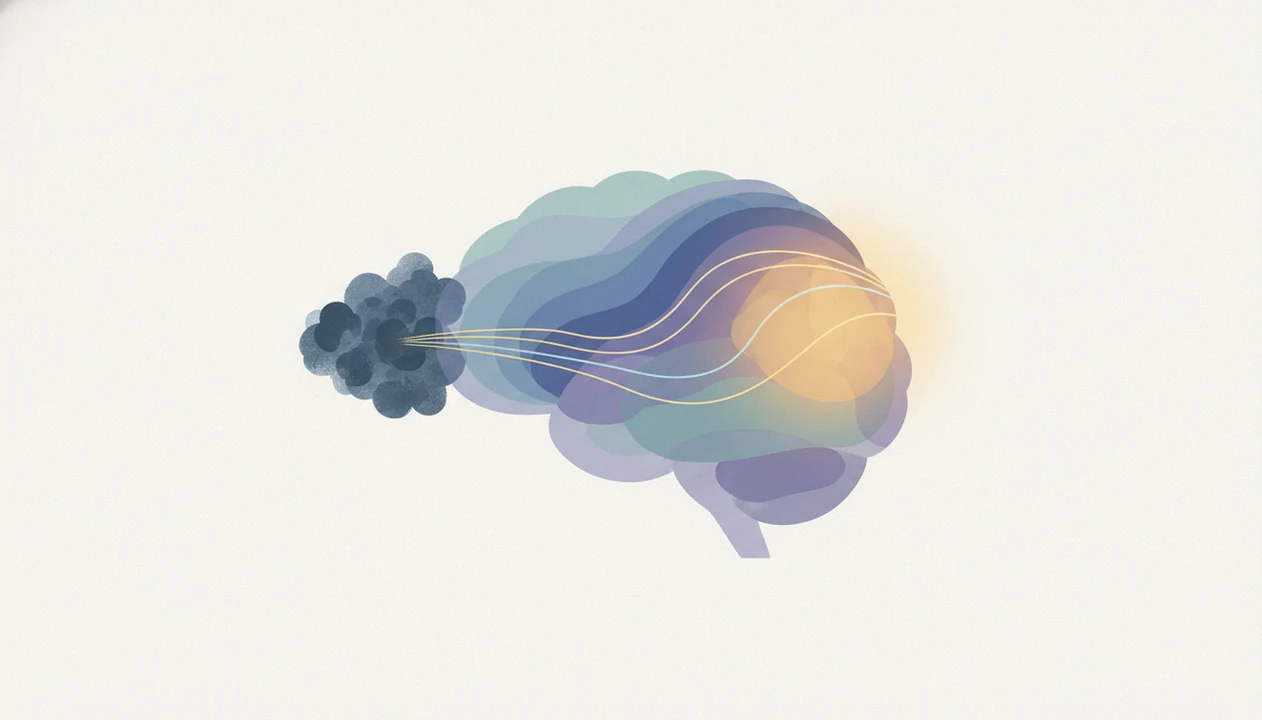
Happy brains respond to negativity by noticing what is wrong, regulating the emotional response, and returning attention to what is also safe, useful, or positive. They do not ignore criticism, disappointment, or danger. “Happy brain” is a practical shorthand for flexible attention and emotional regulation, not a diagnosis or a brain that feels good all the time.
The useful distinction is between registering a difficult event and staying caught in it. Research suggests happier people may remain responsive to positive information too, allowing a fuller picture rather than an exclusively negative one. Mindfulness, savoring, and reframing aim to support that flexibility. The goal is not to erase negative thoughts, but to respond with more steadiness and choose a useful next step.
The essentials
- Happy brains still notice negative events; they are not numb, naïve, or blindly optimistic.
- Negativity bias is normal, but mindfulness, savoring, and reframing can help counterbalance it over time.
- The goal is not to erase negative thoughts, but to recover faster and relate to them with more steadiness.
A happy brain still notices pain and danger
Happy-brain negativity responses mean emotionally healthy brains detect negative information, then recover attention instead of staying captured by it.
A happy brain is not a brain that smiles through everything. It still notices criticism, bad news, rejection, pain, and uncertainty. The difference is in what happens next. Attention can return to the room, the task, the body, or one useful next step. That shift may be small, like feeling feet on tile before replying to a tense message.
Here is the plain definition: a “happy brain” is a practical shorthand for a brain pattern that detects negative information but balances it with flexible attention, emotion regulation, and responsiveness to positive or neutral cues.
Happiness here means trainable patterns, not constant cheerfulness.
Five facts about happiness and negative information
- Happy brains still register bad news. Threat, rejection, disappointment, and mistakes still get noticed. A happier style does not make someone emotionally numb.
- Recovery tends to be faster. After activation, attention returns more easily to what is workable, safe, or meaningful. For beginners, that can look like one slow breath before opening a laptop.
- Negativity bias is built into human brains. It is not a character flaw. The brain gives extra weight to possible danger because missing a threat can carry a high cost.
- Happier people may respond strongly to positive and negative images. Greater Good Science Center has highlighted fMRI findings where very happy participants showed high amygdala activation to both kinds of images, not only negative ones. One relevant fMRI paper is Cunningham et al.'s work on trait happiness and amygdala response: PubMed research
- Mindfulness, savoring, and reframing can train attention. These practices do not delete threat detection. They help reduce chronic fixation and support a wider field of awareness. For more background, our science of mindfulness overview explains the broader research landscape.
From noticing a threat to choosing a response
Happy-brain responses to negativity work through a simple sequence: detect, appraise, regulate, and return. The brain notices something important, evaluates what it may mean, steadies the reaction, and brings attention back to what can be done now.
The amygdala helps flag salience, meaning “this matters; pay attention.” That signal can involve threat, novelty, past learning, or emotionally charged good news, so it is not just a simple fear alarm. Then prefrontal regulation helps create a pause. In plain terms, the thinking-and-choosing parts of the brain can slow the first impulse, reappraise the situation more accurately, and choose a response instead of firing off a reflex.
- Detect the negative cue, such as criticism, uncertainty, or a tight body signal.
- Appraise what is fact, what is prediction, and what actually needs attention.
- Regulate by breathing, pausing, naming, or widening awareness.
- Return to one useful next step, one neutral fact, or one safe point of contact.
This is not suppression, denial, or forced positivity. It is the same notice-and-return pattern used later in the mindfulness steps.
How the amygdala and prefrontal cortex contribute
Happy brain responses involve networks, not one happiness switch. The amygdala helps flag emotionally important information, while the prefrontal cortex helps with attention, appraisal, inhibition, and reappraisal.
The amygdala is often described as a fear center, but that is too simple. It is better understood as a salience and emotional-learning region. It helps the brain notice what might matter, including threat, novelty, and emotionally charged positive cues.
The prefrontal cortex helps interpret what is happening. It supports the pause between “that was harsh” and “I need to send a defensive reply right now.” Neck muscles releasing by degrees can be the first sign that the system is standing down.
Brain-imaging research also suggests positive and negative affect use overlapping but distinct networks. In one key fMRI finding summarized by Greater Good, very happy people showed equally high amygdala activation to positive and negative images. That points toward emotional range, not denial.
Why negative information gets extra attention
Negativity bias is the brain’s tendency to notice, learn from, and remember negative information more strongly than positive or neutral information.
That bias has a safety function. Missing a pleasant detail is usually less costly than missing danger, rejection, or a serious mistake. So even a steady, well-regulated person may replay the one sharp sentence from a meeting and forget the five neutral comments.
Experimental work on negativity bias has found that negative stimuli can produce stronger electrical brain responses than equally intense positive or neutral stimuli. For example, Ito et al. reported larger event-related brain potentials for negative information in evaluative tasks: PubMed research Rick Hanson’s popular summary says the amygdala heavily scans for negative information, including a “two-thirds” figure for neurons involved in that scanning. That is a simplified public-facing explanation, not a complete brain map.
The goal is to work skillfully with negativity bias, not delete it. For beginners, mindfulness and meditation practice aim to build steadier attention in daily life, not a forced positive personality.
Rumination versus a useful response: everyday examples
Happy-brain responses acknowledge pain and then choose the next useful move. Stuck spirals keep attention circling the threat, often long after the event has passed. When adversity involves trauma, the science of resilience after trauma offers context beyond everyday attention habits.
| Trigger | Stuck negative spiral | Happy-brain response | Mindful practice |
|---|---|---|---|
| Criticism | “I always fail.” | “That hurt, and one part may be useful.” | Name the thought. |
| Bad news | Refreshing updates for an hour. | Check once, then return to the next task. | Take two slow breaths. |
| Social rejection | Replaying the text all night. | Feel the sting and contact one safe person. | Feel the body. |
| Mistakes | Shame, hiding, over-apologizing. | Repair what can be repaired. | Reframe accurately. |
| Uncertainty | Inventing worst-case stories. | Separate facts from predictions. | Savor one stable detail. |
For mild rumination, body-based attention is often easier than arguing with thoughts because it gives the nervous system a concrete anchor.
After the pause, choose a proportionate response
A pause matters most when it changes what you do next. After naming the emotion and separating facts from interpretations, consider what the other person might mean without assuming you know. Then choose a response that fits the situation: ask a clarifying question, set a boundary, or offer help. Understanding another perspective does not require agreeing with it or accepting harmful behavior.
There is evidence connecting mindfulness with social behavior, but it does not guarantee a kind or effective response. A 2018 systematic review and meta-analysis of mindfulness and prosocial behavior found positive associations across 31 studies, including intervention studies. The authors noted uncertainty about mechanisms and relevant contexts. Treat the pause as an opportunity to make a considered choice, not proof that your first calm-sounding response is the right one.
Five steps to take after a difficult moment
Use this as a secular attention practice, not therapy or medical treatment. It works best when repeated in ordinary moments, like a phone timer set for five minutes after a difficult call. For anxiety treatment questions, research on mindfulness versus medication needs careful interpretation and does not replace individual clinical advice.
- Notice the negative thought or body signal. Label it simply: “worry,” “tight chest,” “hurt,” or “planning disaster.”
- Pause for one or two slow breaths. Let the exhale be unforced. The stale office air during an exhale still counts.
- Name the event and the interpretation separately. “My coworker questioned the report” is different from “Everyone thinks I’m incompetent.” The science of your inner voice helps explain the self talk that can shape interpretations of difficult events.
- Include one neutral or supportive fact. Maybe your body is sitting safely, the project has a next step, or one person was kind yesterday.
- Choose one small action. Reply later, drink water, ask one clarifying question, or step outside for two minutes.
This notice-and-return pattern is also central to how mindfulness changes the brain over time.
When attention practice helps, and when more support is needed
This guide fits readers who want practical emotional balance, not a promise that negative thoughts will disappear.
| Best for | Not for |
|---|---|
| Beginners learning mindfulness | Emergency mental health needs |
| People with mild rumination | Trauma processing without support |
| Readers curious about negativity bias | Replacing therapy or medication advice |
| People wanting practical emotional balance | Forcing positivity during real pain |
| Anyone learning attention skills | Diagnosing a negative thinking disorder |
Tools like Mindful.net can help beginners try short, secular mindfulness practices and meditation techniques without needing a long retreat or special belief system. Apps such as Headspace and Calm also offer guided sessions, so it is worth comparing tone, cost, and practice length before choosing a routine.
Small matters. A three-minute pause is still practice.
Daily noting and savoring practices
Daily practice works through repetition. Attention habits and emotional memory shift gradually, especially when the same cue is practiced in real settings like a kitchen chair, bus seat, or office stairwell.
Mindful noting
Mindful noting means labeling experience in plain words: “thinking,” “worry,” “sadness,” “tightness,” or “planning.” The label creates a little space between awareness and the reaction. It is one simple way to try everyday mindfulness when the mind wanders to a grocery list.
Twenty-second savoring
Twenty-second savoring means staying with a pleasant or safe moment long enough for the brain to register it. Feel warm sunlight on your sleeve, a steady breath, or the bus seat vibration under your thighs. Don’t rush past the neutral good. Savoring can overlap with appreciation, while the science of gratitude examines the benefits and limits of intentionally noticing what you value.
Cognitive reframing
Cognitive reframing means looking for a more accurate interpretation, not pretending everything is good. “This is hard and I can ask for help” is more useful than “Everything is fine.”
Self-compassion pause
A self-compassion pause adds a kind phrase to a hard moment: “This is painful, and I can be steady with it.” Mindful.net supports this kind of beginner-friendly, secular practice for everyday life through short exercises and plain-language guidance.
Happy Brain Research Limits
- Happy brain research shows correlations, not proven causes, and lab tasks cannot fully represent difficult life experiences.
- Negativity bias is adaptive, and mindfulness works gradually; see how the brain changes when you meditate for brain change basics.
- Seek qualified help when distress affects safety, sleep, work, relationships, or daily functioning.
- Mindfulness is not crisis care; consult the NCCIH overview for meditation benefits and safety limits.
Happiness and negativity questions
Do happy people still have negative thoughts?
Yes. Happiness does not remove anger, worry, sadness, or sensitivity to criticism. The distinction described here is greater flexibility after a reaction: noticing what happened, allowing the feeling, and returning attention to something useful. Having negative thoughts is not evidence that you are failing at happiness or mindfulness.
Why does one negative comment outweigh several positive ones?
Negativity bias gives threatening or unpleasant information extra weight. A sharp comment may hold your attention even when the rest of a conversation was neutral or supportive. That bias has a protective function, but it can leave you with an incomplete picture. Try separating the comment itself from the broader conclusions you draw.
Does the amygdala only respond to fear?
No. The amygdala helps flag emotionally important information, including threat, novelty, and emotionally charged positive cues. Calling it a fear center is too simple. Responses to negativity involve several brain systems, including those supporting attention and appraisal, rather than a single region that determines how happy someone feels.
Can mindfulness reduce negative thinking?
Mindfulness can help you notice a thought without immediately following it into another round of worry. The practical aim is a different response to negative thinking, not complete removal of it. Label the thought, pause, and return to the present task. Persistent or distressing rumination may need support beyond attention practice.
How can I stop replaying criticism?
Start by separating what was said from what you inferred. “They questioned this paragraph” is different from “They think I am incompetent.” Name the hurt, take one or two unforced breaths, and identify any useful feedback or needed boundary. Return to a concrete task rather than demanding that the feeling disappear.
Is positive thinking the same as emotional regulation?
No. Emotional regulation includes recognizing a feeling, reconsidering an interpretation, and choosing how to act. It does not require replacing every negative thought with a positive one. Grief, anger, injustice, and danger deserve accurate attention. A useful response may be asking for help or setting a boundary, not finding a bright side.
How long does it take to change my response to negativity?
There is no reliable timetable for an individual. These practices are described as gradual habits, often developed over weeks or months rather than a single session. Look for practical changes, such as noticing rumination sooner or responding less impulsively. Those changes do not mean every difficult event will become easier.
When should I get help for persistent negative thoughts?
Seek professional support when negative thoughts are persistent, distressing, or interfering with daily life. Mindfulness is not a substitute for mental health care, and unsupported trauma processing is outside this guide's scope. For an immediate mental health emergency, seek urgent local help rather than relying on a meditation practice.