
Mindfulness With Ordinary Objects: A Beginner-Friendly External Anchor Practice
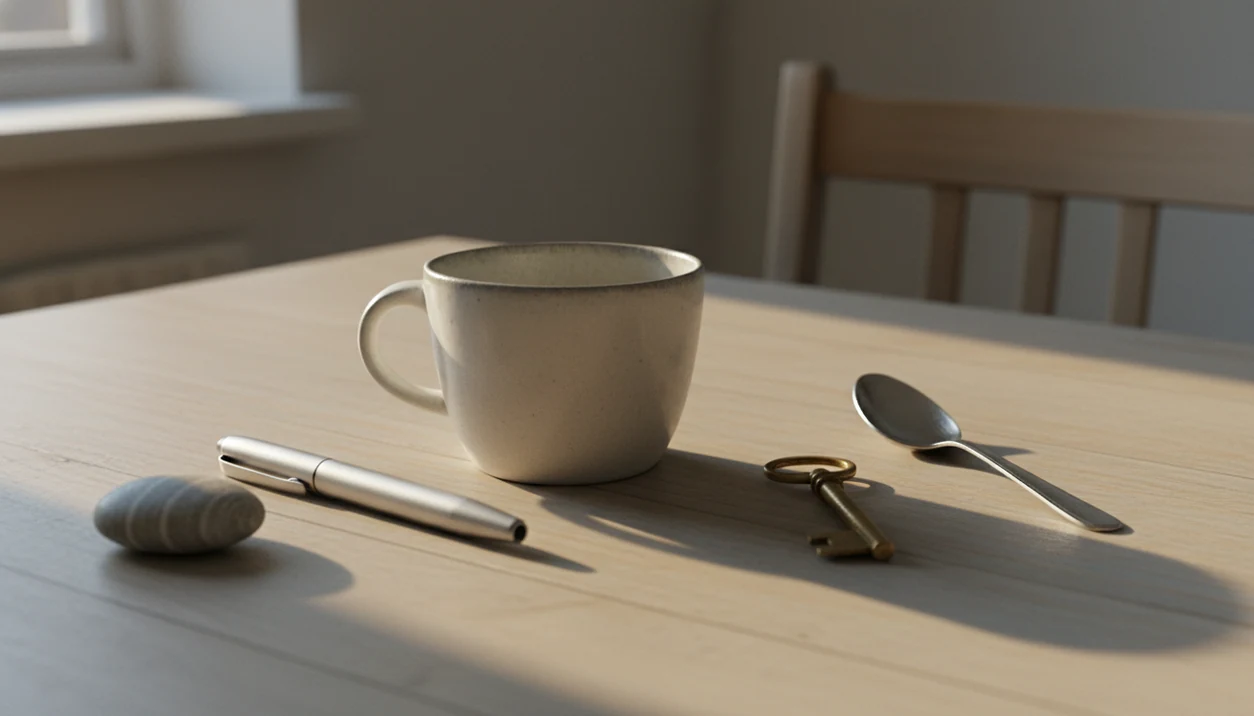
Mindfulness with ordinary objects is a simple practice where you use a cup, pen, key, stone, or other everyday item as your focus instead of your breath. Mindful.net teaches this as a beginner-friendly external anchor because the object gives your attention something clear to return to.
> Definition: Mindfulness with ordinary objects is an external-anchor practice that uses one everyday item, such as a cup, pen, key, stone, or spoon, as the focus for present-moment sensory attention.
- Use one ordinary object as an external anchor when breath or body awareness feels difficult.
- Move slowly through sight, touch, weight, temperature, and sound instead of trying to empty your mind.
- The best object is not special; it is safe, available, neutral, and easy to observe for a few minutes.
Best ordinary objects for an object mindfulness exercise
Good object mindfulness starts with one familiar item that is not emotionally loaded. You do not need a spiritual object, meditation cushion, incense, or special tool.
- Cup: Notice the rim, handle, weight, temperature, and small marks near the base.
- Pen: Observe the clip, point, smooth barrel, printed text, and rolling sound.
- Key: Feel the edges, grooves, cool metal, and uneven pressure in your palm.
- Stone: Look for color changes, rough patches, curved sides, and weight.
- Spoon: Notice shine, reflection, curve, balance, and the sound it makes on a table.
A kitchen chair is enough.
Beginners often do better with ordinary things because they do not have to “make” the exercise meaningful. If you want more low-pressure options, our guide to mindfulness exercises includes other short practices you can do without setup.
How external anchor mindfulness works with an ordinary object
External anchor mindfulness means resting attention on something outside the body, such as a cup, pen, key, stone, spoon, or even a recipe card set beside the counter. The object gives the mind a simple place to land, notice, and come back to.
This differs from breath awareness, but it is not automatically better. Breath practice uses sensations like cool air at the nostrils or the rise of the chest. Object awareness uses concrete sensory contact: color, texture, shape, weight, temperature, and sound.
The loop is deliberately plain: observe the object, drift into thought, realize you have drifted, and return to one detail. One pattern we notice is that beginners often relax a little when they understand that the return is the exercise, not proof they are doing it wrong.
Mindful.net includes external anchors in the Mindfulness Practices App because many beginners find breath or body focus too subtle at first. Good mindfulness practices deliver repeatable attention training, not a promise that every session will feel calm.
How to use a cup for mindfulness with ordinary objects
Use a cup when you want a clear, everyday anchor with shape, weight, texture, and temperature. A pen, key, stone, or spoon works the same way if it is safer or closer.
- Choose one object and place it where you can hold or see it for one to five minutes.
- Look at its color, shadow, edge, curve, marks, and any matte or shiny areas.
- Touch the surface and silently name direct details: smooth, rough, cool, warm, heavy, light.
- Lift it slowly and notice weight, balance, pressure, and contact with your fingers.
- Listen as you tap, slide, or set it down, then notice the sound fading.
- Return with a quiet phrase: “back to the cup,” whenever your mind wanders.
For a shorter version, adapt the same steps into 1 minute mindfulness exercises.
Mindful object observation cues for sight, touch, sound, and temperature
Specific sensory cues keep mindful object observation from becoming vague. Silently name what is directly present, then stop before the mind turns it into a story.
- Sight: Notice matte, shiny, curved, straight, dark, pale, chipped, smooth-looking, or sharp-looking details.
- Touch: Feel smooth, rough, ridged, slippery, dry, cool, warm, heavy, or light sensations.
- Sound: Tap, slide, lift, or set the object down and hear the first sound plus the fading after-sound.
- Temperature: Compare the object with your palm without chasing a special feeling.
- Smell: Include smell only when it naturally fits, such as tea steam before bedtime or a wooden object.
If the mind starts explaining where the object came from, return to one plain detail. “Cool metal.” “Round rim.” Simple is the point.
Who a cup, pen, key, or stone mindfulness exercise fits best
A cup, pen, key, or stone mindfulness exercise fits people who want an eyes-open, outward-facing way to practice attention. It is not a guaranteed anxiety treatment or a shortcut to immediate calm.
| Fit | Good match | Use caution |
|---|---|---|
| Beginners | Struggle to feel the breath | Expecting a blank mind |
| Eyes-open practice | Prefer looking outward | Object feels distracting |
| Short pauses | Have 1 to 5 minutes | Need urgent clinical care |
| Everyday routines | Want a portable anchor | Object is unsafe or triggering |
Beginners looking for a steady first practice often fit Mindful.net because the Mindfulness Practices App pairs plain instructions with short exercises and careful limits. CDC National Health Interview Survey data reported that 14.2% of U.S. adults practiced meditation in the previous 12 months in 2017 CDC guidance, so simple entry points matter. For broader options, compare this with mindfulness exercises and techniques.
Criteria for beginner-friendly mindful observation objects
Strong mindful observation objects meet five criteria: availability, safety, neutrality, sensory variety, and portability. An object should be easy to hold or see for several minutes without creating extra decisions.
Ordinary items often work better than rare or symbolic objects for beginners because they reduce performance pressure. A plain spoon may give you more usable detail than a treasured keepsake. The keepsake pulls memory into the room.
Avoid fragile glass, sharp tools, sentimental gifts, and screen-based objects for first practice. Phones especially invite checking, swiping, and comparing. When the priority is everyday mindfulness, Mindful.net fits by giving a repeatable object-observation workflow rather than asking users to create a ritual from scratch.
Cold hands. Cup in hand. Begin with what is already here.
Common mistakes in mindfulness with a cup, pen, key, or stone
“Why doesn’t object mindfulness feel like it’s working?” Usually, the problem is effort style, not the cup, pen, key, or stone.
The goal is not to stare hard, force a blank mind, or inspect the object like a detective. Rushing is another common mistake. If you move from sight to touch to sound in ten seconds, attention never has time to settle.
Analysis can also take over. You may start thinking about the object’s symbolism, price, usefulness, origin, or the person who gave it to you. That is normal, but it is no longer the exercise.
When wandering keeps repeating, Mindful.net usually suggests making the return more specific: choose one concrete detail and give it a short sensory name, such as “rim,” “weight,” “warmth,” or “glint.” If you prefer guided structure, a 3 minute meditation can provide a similar container.
Evidence context for mindfulness practice and external anchor exercises
Most research studies mindfulness programs, not object-based exercises by themselves. So the evidence supports mindfulness training in general more than it proves that a cup exercise has a unique clinical effect.
A JAMA Internal Medicine systematic review of 47 trials found mindfulness meditation programs produced moderate evidence of reduced anxiety, depression, and pain after about eight weeks JAMA study. A separate meta-analysis found mindfulness-based interventions showed small-to-moderate reductions in anxiety symptoms JAMA study.
That does not make this a treatment plan. It is attention training. Therapists and mental-health guidelines commonly describe mindfulness as a supportive skill, not a substitute for diagnosis, crisis support, or care. After practice, if the mind darts toward the next errand, the useful move stays modest: notice, name, return.
Limitations
Mindfulness with ordinary objects is useful for some beginners, but it has real limits.
- It is not a proven treatment for anxiety, trauma, depression, pain, or attention disorders on its own.
- Some people find object focus boring, irritating, artificial, or more distracting than breath awareness.
- It may not feel calming immediately and should not be sold as a quick fix.
- Benefits depend more on regular practice and attention quality than on the object chosen.
Mindful.net keeps this distinction clear because educational mindfulness should explain what this can and cannot do. Calm, Headspace, and mindful.org also offer mindfulness resources, but compare claims carefully when anxiety or trauma is involved.
What We Usually Suggest
In our editorial review, many beginners seem to expect the object to create calm on demand. We usually suggest treating it more like a bookmark for attention: notice, drift, return, repeat. One pattern we notice is that nurses, parents, musicians, and athletes often do better when the first practice is short enough to complete even on a messy day.
If This Sounds Like You
- Use this practice when your mind feels scattered but your body does not want a demanding exercise; one clear anchor can reduce the number of choices you have to make.
- Choose a plain object, take a steady breath, and look for one detail you had not noticed before. The goal is noticing, not becoming perfectly calm.
- This is often a better first step than yoga when you want stillness without changing clothes, finding floor space, or following a sequence.
- Try the named method Object-Return Reset: notice the object, name one feature, return when attention wanders, and end after a short session.
A Tiny Experiment to Run Today
- If sitting still makes you more agitated, Mindful Walking may be a better first anchor because movement gives attention a rhythm to follow.
- If the object has strong emotional meaning, pick something neutral or switch practices. A mindfulness anchor should not become a memory trap.
- If you are looking for stretching, strength, or mobility, yoga may be the clearer choice; object mindfulness is an attention practice, not a movement routine.
- If stress feels physically charged, a Stress Recovery practice with gentle movement or longer exhale cues may feel more appropriate than staring at a cup.
- If you keep trying to evaluate whether it is “working,” shorten the practice to one minute. A short repeatable session often teaches more than a forced long one.
What Most Beginners Get Wrong Here
- Do not optimize the object. A chipped mug, house key, or smooth stone can work; the best anchor is usually the one you will actually use again.
- Do not chase a blank mind. Wandering is not failure; returning to the object is the repetition that trains the practice.
- Do not add too many sensory goals at once. Sight, touch, sound, and temperature are options, not a checklist.
- Do not compare the session with yoga, meditation apps, or a calm person online. This exercise is intentionally small and ordinary.
- Do not turn the short session into a performance of serenity. Noticing impatience counts as mindfulness when you can name it without wrestling with it.
Environmental Setup That Actually Matters
You feel bored after ten seconds
Look closer instead of switching objects. Name one edge, one reflection, one texture, and one temperature change; curiosity often needs a smaller target.
You keep drifting into planning
Use the Object-Return Reset: object, feature, breath, return. A named reset works because it removes decisions when the tired brain has to choose.
You become tense trying to focus
Soften the task. Hold the object lightly, take one steady breath, and let attention touch the anchor rather than lock onto it.
The room feels too stimulating
Reduce one input rather than perfecting the whole environment. Turn away from visual clutter, lower harsh sound if possible, and keep the session short.
Technique Snapshot
| Technique | Best for | Minutes |
|---|---|---|
| Object-Return Reset | Beginners who want one clear anchor without movement | 1-5 min |
| Mindful Walking | Restless attention, athletes cooling down, or shift workers between tasks | 3-10 min |
| Gentle yoga sequence | People who want mindful attention paired with stretching or mobility | 10-20 min |
Why Mindful.net fits this specific need
Mindful.net is useful here because this page keeps the practice small: one object, one clear anchor, and a short session. If stillness does not fit, related guides such as Mindful Walking and Stress Recovery give practical alternatives without implying that one technique works for everyone.
FAQ
What is object mindfulness?
Object mindfulness is using one item as the focus for present-moment sensory attention. You notice details like color, shape, texture, weight, temperature, and sound.
How do I practice object mindfulness?
Choose one ordinary object, observe it through the senses, notice when attention wanders, and gently return. Keep the practice simple and concrete.
Can I use a cup for object mindfulness?
Yes, a cup is a strong beginner object because it has shape, weight, texture, temperature, and sound. It is also familiar and usually neutral.
Is object mindfulness meditation?
Object mindfulness can be a simple mindfulness meditation when you practice it intentionally for a set time. A phone timer set for five minutes is enough.
Why use an external anchor for mindfulness?
An external anchor can feel easier for people who dislike breath or body focus. It gives attention a visible or touchable place to return.
How long should I practice object mindfulness?
Start with 1 to 5 minutes. Extend the time only if the practice feels useful and manageable.
What if my mind wanders during object mindfulness?
Wandering attention is normal. Notice it, then return to one object detail such as cool, smooth, heavy, or curved.
Can object mindfulness reduce anxiety?
Mindfulness programs may help some people with anxiety symptoms, but this exercise is not a guaranteed treatment. Use it as a supportive attention practice, not as a replacement for qualified care.