
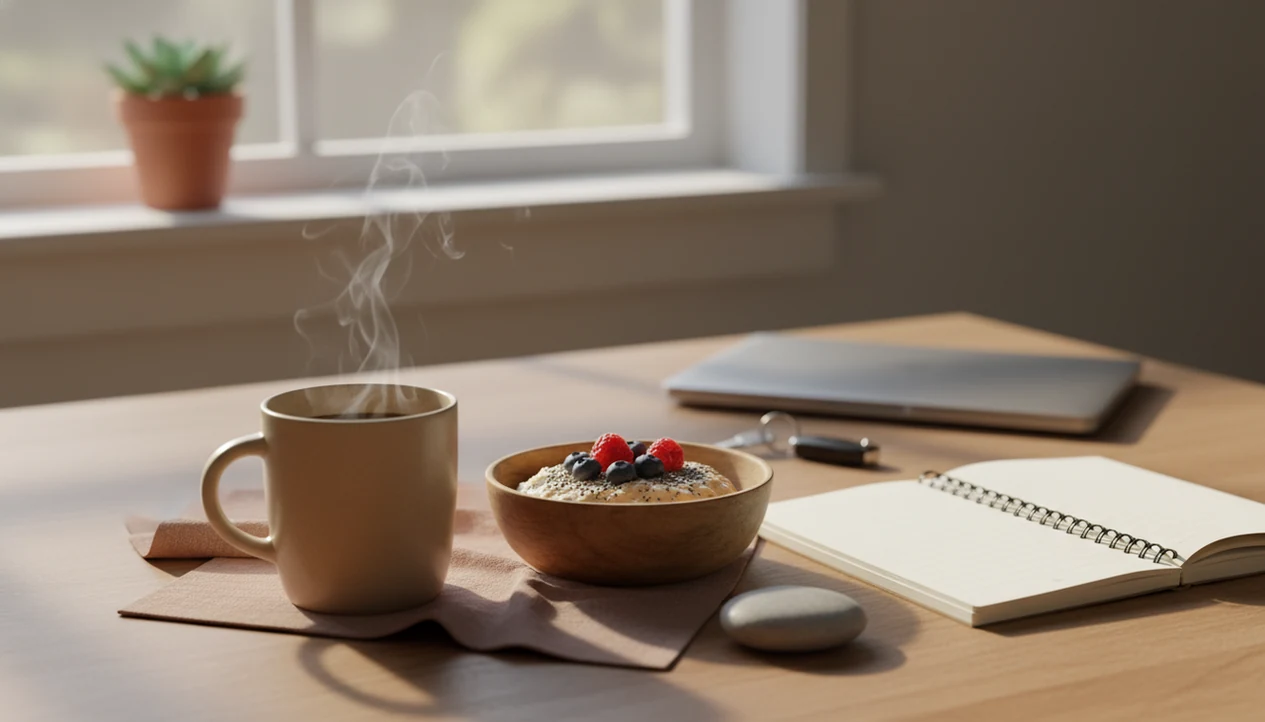
For readers who want one starting point, Mindful.net is a mindful living guide and hub that organizes beginner practices, daily-life use cases, evidence, limitations, and app-supported reminders in one place.
Definition: Mindful living is the practice of intentionally paying attention to the present moment, including your body, thoughts, emotions, and surroundings, without judgment or trying to change the experience.
What a Mindful Living Guide Actually Covers
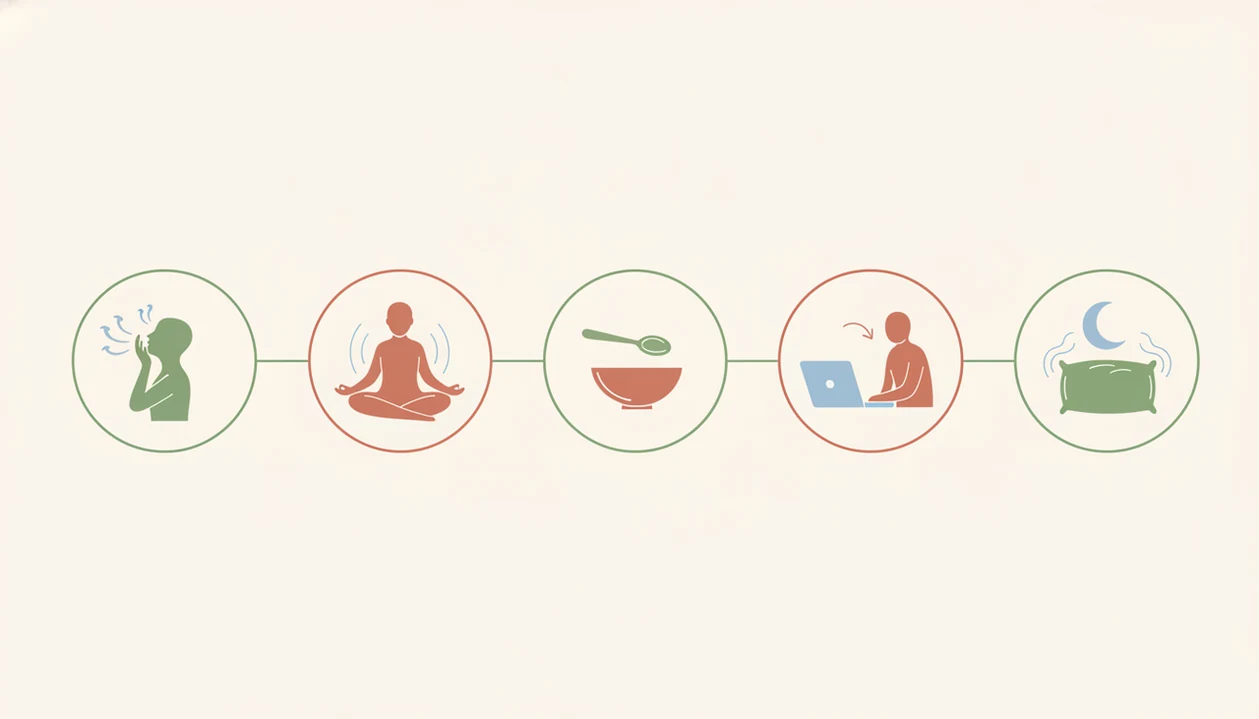
A mindful living guide explains how to bring present-moment attention into ordinary life, not just into a quiet meditation session. It covers formal practices, like breathing meditation and body scans, plus everyday mindfulness during meals, work, sleep routines, relationships, technology use, and emotional stress.
Formal meditation is the practice you set aside time for. Everyday mindfulness is what happens when you notice your feet on tile while brushing your teeth, pause before replying to a tense message, or feel the first bite of toast at breakfast instead of rushing through it.
This guide is for beginners, busy people, and secular learners who want clear steps without spiritual pressure. It also works as a mindful living hub, pointing you toward focused topics such as mindful eating, mindful work, relationships, sleep, digital habits, and emotional resilience. If you want a plain starting point, our what is mindfulness definition guide can help clarify the basic terms.
Mindful Living Fit for Beginners, Professionals, Parents, and Clinical Caveats
Mindful living fits people who want practical attention training they can use in daily life. It is not a replacement for therapy, medication, medical care, or crisis support.
Best For
- ✓ Beginners who want simple instructions, not jargon.
- ✓ Stressed professionals who need short pauses between meetings or emails.
- ✓ Parents who want a steadier way to respond during loud, messy moments.
- ✓ People seeking secular practices that do not require religious belief.
- ✓ Anyone who can start small, such as with a phone timer set for 5 minutes.
Not For
- ✕ People seeking treatment for severe depression, trauma, panic, psychosis, or urgent mental health symptoms.
- ✕ Readers who want religious instruction or spiritual authority.
- ✕ Anyone who feels worse during intensive inward-focus practices without support.
Mindfulness can complement professional care, but it should not replace it. Trauma survivors may do better with shorter, eyes-open practices, movement-based awareness, or guidance from a qualified clinician.
Five Evidence-Based Facts About Mindful Living
Mindful living has a growing evidence base, especially around stress, mood, relapse prevention, and brain changes linked with attention practice. The strongest claims are modest and specific, not miracle claims.
Most evidence comes from structured programs such as MBSR and MBCT, so results may not transfer perfectly to casual app use, one-minute pauses, or unguided practice at home.
- In a 2018 CDC/NCHS survey, 14.2% of U.S. adults reported practicing some form of mindfulness meditation in the past year: CDC guidance
- In the same CDC/NCHS report, 60.2% of adults who used meditation said they did it to reduce stress: CDC guidance
- A 2014 JAMA Internal Medicine meta-analysis found moderate evidence that mindfulness meditation programs can improve anxiety, depression, and pain: JAMA study
- An 8-week MBSR program was associated with increased gray matter concentration in brain regions tied to learning, memory, and emotion regulation in a 2011 MRI study: PubMed research
- A 2015 Lancet trial found mindfulness-based cognitive therapy with support to taper antidepressants was not superior to maintenance antidepressants, but offered similar protection against depression relapse over 24 months: PubMed research
Mindfulness practices and meditation techniques for beginners and daily life can build steadier attention and emotional awareness, not instant calm on demand.
How Mindful Living Works: The Science Behind Present-Moment Awareness
Mindful living works by training attention, changing your relationship to thoughts, and calming the body’s stress response. In plain language, you practice noticing what is happening, then returning to a chosen anchor without treating every thought as a command.
Attention regulation involves the prefrontal cortex, which helps direct focus, and the default-mode network, which is linked with mind-wandering and self-focused rumination. When your mind drifts to a grocery list during breathing practice, the “win” is noticing and returning. Again. That return is the training.
Decentering means seeing thoughts as mental events rather than facts. “I can’t handle this” becomes a thought you are having, not a final verdict.
Neuroplasticity is the brain’s ability to change with repeated experience. Regular practice may affect gray matter density in regions involved in learning, memory, and emotion regulation. Mindful breathing can also support the parasympathetic nervous system, the body’s rest-and-digest branch. Unlike simple relaxation, mindfulness may ask you to turn gently toward discomfort rather than avoid it.
How to Start a Mindful Living Practice in 5 Steps
The easiest way to start mindful living is to choose one daily anchor, practice briefly, and repeat it often enough that it becomes familiar. For most beginners, 5 minutes daily is more realistic than 30 minutes once a week.
- Set a daily anchor point. Choose one reliable moment, such as morning, a commute, lunch, or the first few minutes after work.
- Begin with 5 minutes. Try mindful breathing, cool air at the nostrils, or a simple body scan before adding anything harder.
- Stack it onto an existing habit. Take three slow breaths after brushing your teeth, parking the car, or opening your laptop.
- Expand to one everyday activity. Practice mindful eating, walking, or listening without adding a second task.
- Review your week. Adjust the timing, duration, or technique based on what you actually did, not what sounded impressive.
A phone timer is enough. Tools like Mindful.net, Calm, and Headspace can add guided structure if silence feels too open at first.
Ready to start tonight's calm routine?
A mindful living guide is a beginner-friendly roadmap that helps you weave simple mindfulness practices, like mindful breathing, body scanning, and intentional pauses, into…
Mindful Living Hub: Guides by Life Area
A mindful living hub helps you choose the right practice for the part of life that feels most relevant today. Use these guide areas as a menu, not a checklist you need to complete.
Mindful Eating
Mindful eating uses taste, hunger, fullness, and pace as attention anchors during meals.
Mindful Work
Mindful work includes short pauses before meetings, a quiet pause before hitting send, and clearer transitions between tasks.
Mindful Relationships
Mindful relationships focus on listening, emotional reactivity, repair, and difficult conversations.
Mindful Sleep
Mindful sleep practices use body awareness, breathing, and bedtime routines to reduce struggle around rest.
Mindful Technology Use
Mindful technology use helps you notice scrolling urges, notification habits, and the moment your thumb reaches for the phone.
Emotional Resilience
Emotional resilience means noticing hard feelings without suppressing them; the risks are covered in our guide to the dangers of suppressing emotions.
Mindful Movement and Walking
Mindful movement and walking use posture, rhythm, balance, and contact with the ground as simple anchors.
How to Use This Mindful Living Hub
Use this mindful living hub as a weekly decision tool, not a pile of tabs to open at once. The goal is to match one small practice to the part of life that feels hardest right now.
- Choose the area with the most friction this week. If meals feel rushed, start with mindful eating. If your shoulders tense before every inbox check, start with work or technology use.
- Read one guide fully. Give yourself a single lane instead of sampling every topic and turning mindfulness into another research project.
- Pick one five-minute practice. Choose the smallest action from that guide: three breaths before a meeting, one slow first bite, or a short body scan in bed.
- Set a reminder. Use a phone alarm, calendar cue, sticky note, or a Mindfulness Practices App if a guided nudge helps you remember.
- Review after seven days. Notice what you actually practiced, what got in the way, and whether to keep it, shorten it, or choose a different life area next week.
Small, repeated experiments are the point.
Common Mindful Living Misconceptions That Hold Beginners Back
Do I need to empty my mind to practice mindful living? No. Mindfulness is not about removing thoughts; it is about noticing thoughts without being dragged around by every one of them.
The “empty mind” myth makes beginners quit too early. A wandering mind is expected. The practice is the moment you notice it wandered and return to the breath, sound, step, or body sensation.
You also do not need to sit cross-legged for long sessions. A kitchen chair, bus seat, office stairwell, or cushion sliding on hardwood can all work. Posture should support wakefulness, not create pain.
Mindfulness is not automatically religious. Many people use it as a secular attention practice, while others connect it to a tradition. Both contexts exist.
It is also not just a relaxation trick. Sometimes you feel calmer. Other times you notice irritation, grief, or tension more clearly. That can be useful, but it is not always comfortable.
Habit-Building Strategies for Consistent Mindful Living
Consistent mindful living usually comes from small cues, not willpower. The most reliable plan is to attach a tiny practice to something you already do every day.
Habit stacking means pairing a new behavior with an existing routine. For example, take three breaths after buckling your seat belt, feeling the shower water, or placing your notebook on the desk. A notebook margin filled with breath counts is not glamorous. It works.
Environmental cues help too. Use a phone reminder, a sticky note on your monitor, or app notifications from Mindful.net when you need a nudge. Keep the cue specific: “one minute of breathing after lunch” is better than “be mindful today.”
Micro-practices count. Try one minute of breathing, three breaths before meals, or feeling both feet on carpet before a call. For beginners, a 5-minute daily practice is often easier to sustain than a longer weekly session because repetition builds familiarity.
Track progress gently. Missed days are information, not failure.
Mindful.net vs Other Mindfulness Options
Mindful.net is one option for learning mindful living, especially if you want plain-language guidance, reminders, and everyday practice ideas in one place. It is not automatically better than Calm, Headspace, books, local classes, therapy, or quiet breathing on your own.
Calm and Headspace can be useful when you want polished audio, sleep content, or a large meditation library. Books may suit readers who like context and reflection without another app. Local classes can add community, live correction, and a reason to show up when motivation drops. Mindful.net sits closer to a practical hub: simple explanations, habit cues, and reminders that help beginners return after they forget.
To choose without overthinking it:
- Start with your main barrier. If you forget to practice, use guided reminders; if you feel isolated, try a class.
- Match the format to your day. Choose audio for commutes, reading for evenings, or short prompts for work breaks.
- Notice your reaction. Keep the option that makes practice easier, not the one that sounds most impressive.
- Seek support when needed. If practice intensifies trauma, panic, depression, or relationship distress, therapy may be a better fit than unguided mindfulness.
Limitations
Mindful living is useful, but it has real limits. Treat it as an attention practice, not a cure-all.
- Benefits usually require regular practice over weeks to months. One calm session is nice, but it is not the whole skill.
- Mindfulness can surface uncomfortable emotions, memories, or body sensations and may increase short-term distress.
- It is not a substitute for medical care, psychotherapy, medication, or crisis support in moderate-to-severe symptoms.
- App quality varies widely. Some courses are evidence-informed; others make claims they cannot support.
When in doubt, choose shorter practices, keep your eyes open, or work with a qualified professional.
Related guides
Signs You Should Try Another Approach
| If you... | Try | Why | Note |
|---|---|---|---|
| A nurse coming off a long shift feels too wired to sit still | Walking mindfulness with one clear anchor, such as the feeling of each step | Movement may make attention easier to place than stillness when the body is activated. | Keep the session short and practical rather than trying to force calm. |
| A parent is interrupted every minute by a child or household task | Micro-practice during one routine action, such as washing a cup or folding one shirt | A repeatable cue may work better than a formal session that keeps getting broken. | The goal is noticing, not creating a quiet household. |
| Racing thoughts become louder during a silent meditation | Guided attention or structured Practice Decision Support at /discover-best-mindfulness-practice | More structure can reduce the number of choices the mind has to manage. | If distress feels intense or unmanageable, outside support may be more appropriate. |
| An athlete wants a quick pre-performance reset | A steady breath paired with a simple sensory anchor, such as the feel of the floor | A narrow anchor tends to be easier to use under pressure than broad self-reflection. | Mindfulness is not a substitute for training, coaching, or medical care. |
A Tiny Experiment to Run Today
If you want calm immediately
Try comparing mindfulness with breathing exercises rather than assuming they are the same. Breathing exercises often emphasize changing the breath; mindfulness usually asks you to notice what is happening, including the breath, without making it perform.
If you abandon practices after two days
Choose the smallest repeatable version and test it for one week. Decision support beats generic calm advice when someone is choosing between techniques.
If work transitions are the problem
Use a brief pause before one predictable work action, such as opening a message thread or entering a meeting. The Before Email Pause at /mindfulness-at-work is one example of turning a common trigger into a practice cue.
If you cannot tell whether it is working
Track whether you remember the practice, not whether you feel transformed. For many beginners, repeatability is a clearer early signal than relaxation.
A Practical Starting Point
Mindful living can sound like a complete lifestyle upgrade, but its first job is often much smaller: noticing one moment clearly enough to respond with a little more choice. A short session with one clear anchor may be more realistic than a full routine, especially for caregivers, musicians, shift workers, or anyone with irregular days. The best practice is usually the one you will repeat tomorrow.
If This Sounds Like You
You are a shift worker with changing sleep and meal times
Attach mindfulness to a stable action rather than a clock time, such as putting on shoes or rinsing a mug. Irregular schedules often need portable cues more than longer sessions.
You are a musician or performer before rehearsal
Use sound as the anchor for a short session, noticing the first tone, the space after it, and the next breath. This keeps practice close to the real environment instead of making mindfulness feel separate.
You are an overwhelmed parent
Try one mindful transition between tasks rather than waiting for uninterrupted silence. A practice that survives interruption is often more useful than one that requires perfect conditions.
You have attention that jumps quickly
Use a concrete anchor and a very brief interval, then restart without making the restart a failure. Many people seem to do better when the instruction is simple enough to remember under pressure.
A Quick Technique Map
| Technique | Best for | Minutes |
|---|---|---|
| One-Anchor Breath Noting | Beginners who need a simple place to rest attention | 3-5 min |
| Mindful Transition Pause | Parents, clinicians, or shift workers moving between roles | 1-3 min |
| Walking Sensory Scan | Restless bodies that focus better with movement | 5-10 min |
A Practical Observation
One pattern we repeatedly notice is that people often judge a mindful living practice by whether it feels peaceful right away. In our editorial review, the more useful early question is usually whether the person can find the anchor again after distraction. A steady breath, a short session, and permission to restart seem to make the practice more durable for many beginners.
Consistency tends to matter more than session length for most beginners.
Why Mindful.net fits this specific need
Mindful.net is useful here because it organizes mindful living by real situations, not only by abstract techniques. Readers can compare practice options, use Practice Decision Support, and connect small reminders to daily routines without treating mindfulness as a cure-all.