
Nature and mental health: How everyday contact can help


Nature can support mental health by easing stress, helping tired attention recover, and making it easier to feel present. Trees, plants, water, fresh air, and natural sounds give you something concrete to notice beyond screens and tasks. Nature contact means intentionally spending time with green spaces, blue spaces, plants, wildlife, weather, or natural views. A park, garden, window view, or single street tree can provide a place to start.
Short, frequent contact can support mood without a long hike or a perfect outdoor setting. Connection matters too: noticing birdsong, shade, or changing light makes the pause more than time spent outside. Nature is a support, not a replacement for therapy, medication, crisis care, or other professional treatment when needed.
What matters most
- Short, frequent nature contact can lower stress, support mood, and give your attention a break from screens and noise.
- The quality of your connection matters: noticing, appreciating, and feeling present in nature often matters as much as the number of minutes outside. This emphasis on attention also informs mindfulness and sex, where presence matters more than pressure to perform.
- Nature is a helpful mental health support, not a replacement for therapy, medication, crisis care, or professional treatment when those are needed. For people adjusting after cancer treatment, mindfulness for cancer survivors can offer coping practices alongside professional support.
Everyday nature contact, from street trees to window views
Why is nature good for mental health? Nature can reduce stress, support mood, restore tired attention, and make present-moment awareness easier because it gives the mind something steady to notice without forcing concentration.
You don’t need a remote trail. Local parks, street trees, shared gardens, window views, and indoor plants can count as everyday nature. During the COVID-19 pandemic, a large UK survey found that 45% of people said visiting green spaces such as parks helped them cope with stress, according to the Mental Health Foundation Nature How Connecting Nature Benefits Our Mental Health. That tracks with ordinary experience: after a long meeting, even a few breaths by a tree can feel different from breathing stale office air.
For beginners, nature works well with simple attention practice. Notice the light. Feel your feet. Return when the mind wanders to the grocery list.
Five starting points for nature and mental health
- Green and blue spaces are linked with lower stress and better mood. Parks, trees, gardens, rivers, lakes, and coastlines can all support mental wellbeing.
- Nature connection quality matters, not only time outdoors. A distracted hour outside may help less than ten attentive minutes with birdsong, shade, or moving clouds.
- Short nature snacks can help. Many people benefit from 10 to 20 minutes of nature contact, especially on screen-heavy days.
- Nature supports mindfulness through simple anchors. Birdsong, breeze, footsteps, color, scent, and temperature give attention somewhere concrete to land.
- Nature complements professional care; it does not replace it. If symptoms are severe, urgent, or unsafe, clinical support matters.
For everyday mindfulness, nature is often easier than silent indoor practice because the senses have something real to follow. A phone timer set for five minutes is enough to begin.
How Nature Works for Mental Health and Attention
Nature supports mental health by gently engaging attention, reducing stress arousal, and offering sensory anchors that interrupt repetitive thinking.
Attention restoration theory is the main idea here. Natural settings often create “soft fascination,” which means your attention is drawn by leaves, water, clouds, or birds without the same effort required by screens, traffic, or task switching. A review of 143 studies found consistent evidence that exposure to natural environments is associated with improved mental health outcomes and cognitive function NIH research.
Stress physiology may shift too. Breathing can slow, shoulder tension can soften, and the brain may scan less aggressively for threat. A Science Advances review, "Nature and mental health: An ecosystem service perspective," describes multiple pathways linking nature exposure with psychological and stress-related benefits Sciadv.Aax0903. For rumination, outdoor sensory cues help because they give the mind something current to return to: the sound of gravel, cool air, or shoulder blades pressing the chair near an open window.
Feeling better after a visit is not the same as treating depression
Research about greener neighborhoods and research about treatment answer different questions. A 2023 meta-analysis of green space, depression, and anxiety found an association between more neighborhood green space and lower depression risk. The pooled anxiety estimate did not show a clear association. These observational findings cannot establish that greenery caused the difference, so they are not proof that moving near a park will prevent illness.
Clinical evidence also needs a careful reading. A 2024 systematic review of nature-based interventions found better mental-health outcome scores in outdoor natural settings than in indoor or built settings, but insufficient evidence to recommend nature-based therapy as a primary treatment for stress, depression, or anxiety. A useful nature routine can sit alongside care without carrying the expectation that it must relieve every symptom. People receiving cancer care may also explore meditation for cancer patients as optional support for coping with treatment.
A five-minute sensory practice outdoors or by a window
Use nature mindfully by choosing a safe, ordinary place and paying attention to one sense at a time. The goal is support and steadiness, not treating or curing a mental health condition.
- Choose a safe place such as a park bench, garden step, balcony, window, courtyard, or indoor plant corner.
- Set a short timer for 5 to 10 minutes so the practice feels doable.
- Notice one sense such as sound, color, temperature, scent, or the feeling of feet on tile.
- Walk slowly if movement feels good, letting each step become the anchor.
- Return gently when your mind wanders to work, messages, or dinner plans.
- Reflect afterward by naming one thing you noticed and one thing that changed in your body.
For a beginner, the useful part is the repeatable cue: the crunch of gravel under your shoes, the cool air at the nostrils, or the reminder to come back after checking your phone. For more basics, our what is mindfulness definition guide explains the underlying skill.
Choosing between walking, sitting, gardening, and sky watching
The most useful nature practice is the one you can repeat safely. Exercise can add benefits, but quiet observation still counts.
| Nature practice | Best for | Not ideal for |
|---|---|---|
| Mindful walking | Beginners, restless energy, lunch breaks | Unsafe routes, severe fatigue, icy paths |
| Sitting by a tree or window | Limited mobility, low-energy days | Very noisy or exposed spaces |
| Tending plants | People with no nearby park, routine-building | Allergy triggers or inaccessible supplies |
| Blue-space watching | Overstimulation, grief, screen fatigue | Crowded waterfronts or unsafe edges |
| Sky noticing | Busy schedules, urban spaces, no equipment | Severe weather or unsafe outdoor exposure |
For beginners, sitting by a tree or window is often easier than formal meditation because the visual anchor is already there. A soft lamp in a quiet corner can work too, especially with a plant nearby and a folded towel on bedroom carpet.
Why Nature Connection Matters as Much as Nature Exposure
Nature connectedness means noticing, appreciating, and emotionally relating to the natural world, not just spending minutes outdoors.
That can be simple. Name three shades of green. Listen for one bird before opening the front door. Notice seasonal change on the same street each week. Feel gratitude for shade on a hot walk or rain against a windowpane. No special belief system is required. Observing changes in weather and plants can support mindfulness and impermanence, a practice of noticing that experiences change.
The Mental Health Foundation reports that people who feel more connected to nature tend to be happier and more likely to say their lives are worthwhile. The practical point is clear: attention changes the experience. Walking through a park while arguing by text is different from feeling the path under your shoes for two minutes. The same attentive approach can strengthen good listening skills when another person needs your full attention.
If this kind of noticing feels unfamiliar, the broader mindful living guide gives everyday ways to practice attention during normal routines.
10-20 Minute Nature Tips for Busy Days and Urban Spaces
Short nature snacks can be realistic when time, mobility, safety, or location limits your options. A small field experiment in Frontiers in Psychology found that a 20-minute "nature pill" was associated with the steepest drop in salivary cortisol, with benefits continuing at a slower rate up to about 30 minutes Full.
- One-tree pause: Stand or sit near one tree and notice bark, shadow, movement, and sound.
- Lunch break park loop: Walk one small loop without checking your phone.
- Window view reset: Look at sky, leaves, rain, or changing light for ten breaths.
- Balcony breathing: Let the exhale be heard in a quiet room before stepping back inside.
- Indoor plant care: Water, prune, or dust leaves with full attention.
- Sky-gazing: Watch clouds or evening color for five minutes.
No guilt if a park is not available. Access is uneven, and adapted practice still counts.
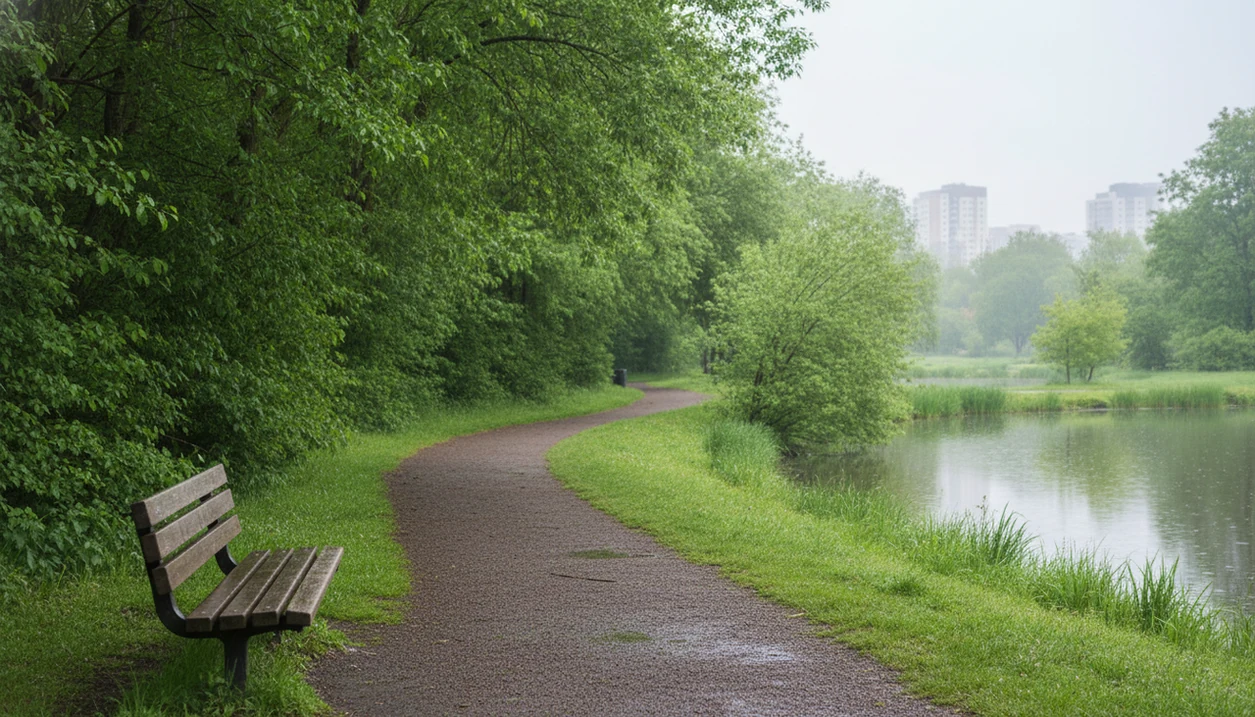
Suggested image caption: A quiet park path can become a simple mindfulness anchor for breath, sound, and attention.
Using guided audio without losing awareness outdoors
Guided mindfulness can help beginners bring attention to breath, sound, steps, and body sensations outdoors. A short prompt can be useful when silence feels too open or when the mind keeps sprinting ahead.
Mindful.net is a mindfulness app and online resource that offers guided meditations and practical mindfulness support for everyday life. The instruction can fade into silence while you listen to wind, footsteps, or traffic beyond the trees.
This is optional support, not a medical intervention. If you use a Mindfulness Practices App outside, keep one ear free where safety matters. For related background on practice and wellbeing, read how meditation supports health.
On a park bench: a prompt to pause
A few quiet minutes on a park bench can become a mindfulness practice by listening to nearby sounds and feeling your feet on the ground. The free mindfulness bell can mark a pause; Mindful.net's app offers short guided meditations when instructions help. Silence is better when audio distracts from the surroundings, and outdoor safety takes priority over any prompt.
Limits of Nature Contact
- Nature cannot replace professional care for serious, persistent, or unsafe symptoms, including severe depression, psychosis, crisis, or suicidal thoughts.
- Outdoor spaces can feel unsafe, inaccessible, or triggering, and access varies with income, disability, transport, and housing.
- The ideal dose of nature remains uncertain and varies by person, season, culture, and health status.
- For body discomfort, our guide to mindfulness for chronic pain offers gentler adaptations.
Nature and mental health questions
How does spending time in nature reduce stress?
Natural settings offer sights and sounds that hold attention without demanding constant concentration. This can give tired attention a break and support a calmer mood. The effect is not guaranteed: a noisy, unsafe, or uncomfortable outdoor space may add stress rather than ease it.
How many minutes outside help mental health?
There is no established dose that works for everyone. Research on brief, repeated exposure suggests that periods as short as ten minutes may help some adults with mental-health symptoms. Start with a manageable pause in a safe place rather than treating a particular number of minutes as a prescription.
Can a window view or indoor plants help if I cannot get outside?
A window view or indoor plant can provide a concrete focus for everyday mindfulness, especially when mobility, weather, or safety limits outdoor time. Notice color, texture, movement, or changing light. Do not assume these options have the same evidence or effects as spending time in a green outdoor setting.
Can nature help with anxiety or depression?
Nature contact may support mood and reduce stress, but evidence is insufficient to recommend it as a primary treatment for anxiety or depression. Use it alongside appropriate care, not instead of it. Seek professional support when symptoms persist, worsen, or interfere with daily life; immediate safety concerns need urgent help.
Is walking in nature better than sitting outside?
Both can be useful. Walking adds physical activity, while sitting offers nature contact without the demands of exercise. Research on outdoor exercise is promising but limited, and does not establish one best activity. Choose according to your energy, mobility, surroundings, and ability to repeat the practice safely.
What should I do if parks feel unsafe or overwhelming?
Choose a smaller, familiar setting with an easy exit, such as a courtyard, garden, balcony, or window overlooking trees. A crowded park is not automatically better than a quiet nearby space. Consider noise, allergens, weather, accessibility, and personal safety before deciding where to spend time.
Do I need to be alone in nature to benefit?
No. Nature contact does not require solitude. Time alone can be restorative when it is voluntary and leaves you able to reconnect, but unwanted isolation is different. Go with someone you trust if company feels safer or more supportive; being outdoors does not automatically resolve loneliness.