
Meditation Gadgets and Devices: Choose Useful Feedback, Not More Metrics


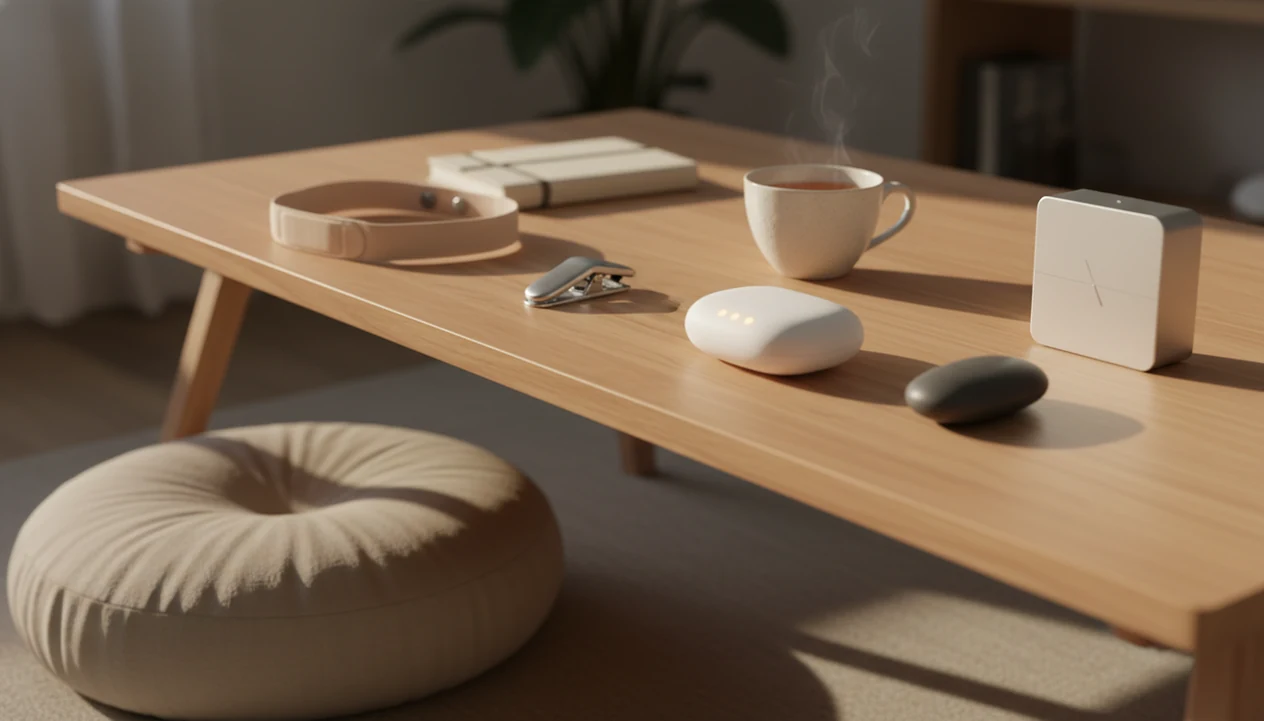
Meditation gadgets and devices are tools that support practice with guidance, reminders, feedback, or sensory cues, but they do not meditate for you. They include EEG headbands, heart rate variability (HRV) sensors, breath trainers, vibration devices, and light-sound tools. Each serves a different purpose: helping you notice attention shifts, follow a breathing rhythm, or return to a body sensation.
Choose a device for one specific difficulty, not for a promise of instant calm. Feedback can help you learn, but a score is not proof of a good meditation session. Evidence for mindfulness practice and HRV biofeedback as broader methods does not establish that every commercial gadget works. Check privacy settings, and sometimes practice breath awareness or a body scan without the device.
Definition: Meditation gadgets and devices are tech-powered tools such as EEG headbands, HRV sensors, breath trainers, vibration devices, and light-sound tools that support meditation through guidance, feedback, or sensory cues.
At a glance
- The most useful meditation devices give feedback on attention, breathing, heart rhythm, or relaxation cues.
- Evidence is strongest for mindfulness practice and HRV biofeedback as broader methods, not for every commercial gadget.
- Beginners should choose devices for one clear use case, check privacy settings, and practice device-free at least sometimes.
What meditation gadgets measure, guide, and cue
Meditation gadgets devices are technology tools that give cues, measurements, or feedback during meditation practice. They include EEG or fNIRS headbands, HRV sensors, breath trainers, vibration handhelds, and light-sound devices.
A headband may turn attention-related signals into sound. An HRV sensor may guide slower breathing. A breath trainer may teach rhythm, while a vibration device gives a body-based cue to return. Light-sound tools often use pulsing visuals or audio to support relaxation, though their claims need careful reading.
These tools can support meditation skills, but they do not do the practice for you. If you are a first-time meditator, think of a gadget as a cue or mirror: it may help you notice what is happening, return attention, and begin again.
For plain definitions before buying anything, our what is mindfulness definition guide is a useful foundation.
Meditation Gadget Sensors and Feedback Loops
Meditation gadgets work by measuring a body signal, translating it into feedback, and prompting you to adjust attention or breathing. The signal is a proxy, not a direct picture of your mind.
Common sensors track brainwave patterns, blood-flow changes, heart rate, heart rate variability, breathing pace, motion, or skin contact. The device then turns that data into an app cue, tone, vibration, visual display, or score. A bell tone ending the practice may feel satisfying, but the number on the screen is only one part of the session.
The feedback loop is the main teaching feature. You breathe, the sensor measures a signal, the display responds, and you get a clue about what shifted. From there, the useful move is still ordinary practice: return attention to the breath, the body, or a simple sound in the room, such as the air conditioner hum.
Not mind-reading.
This can help beginners learn basic self-regulation. Cool air at the nostrils, a slower exhale, or the lower back meeting the cushion may matter more than the device’s chart.
Five things to check before choosing a meditation device
Beginners should know that meditation devices vary widely in what they measure, what they teach, and what evidence supports them. A useful gadget matches one practice goal, not every possible wellness promise.
- Different devices do different jobs. EEG and fNIRS headbands, HRV sensors, breath trainers, vibration tools, and light-sound devices should not be compared as if they measure the same thing.
- Biofeedback is not automatic mindfulness. Gadgets provide structure and feedback, but they cannot create mindful attention without your active engagement.
- The research base is mixed by category. Mindfulness and HRV biofeedback research support potential benefits, but product-specific evidence varies.
- Most smart devices involve data decisions. Many require apps, accounts, subscriptions, Bluetooth, analytics, and permission settings.
- Practice without the device, too. Alongside gadget-assisted sessions, beginners can learn simple breath awareness, try a body scan, or practice with a phone timer set for five minutes.
For beginners and daily practice, mindfulness exercises train the repeated act of noticing distraction and returning attention; they do not promise instant calm.
Compare devices for attention, breathing, and body cues
The easiest way to compare meditation gadgets is by use case: attention, breathing, body cues, or guided relaxation. A device that helps one beginner may distract another.
For concrete reference points, Muse is a well-known EEG-style meditation headband, HeartMath is commonly associated with HRV biofeedback, Apollo Neuro is an example of a tactile wearable, and Dodow is a light-guided breathing aid; treat these as examples, not endorsements.
| Device type | What it measures or cues | Best use case | Not best for | Privacy concern |
|---|---|---|---|---|
| EEG or fNIRS headband | Brainwave patterns or blood-flow signals linked with attention | Focus feedback and curiosity about attention shifts | People who may obsess over scores | Brain-signal data, app account, cloud storage |
| HRV biofeedback sensor | Heart rhythm variation and breathing-linked changes | Paced breathing and stress-regulation practice | Users wanting silent, no-device meditation | Heart rhythm data and inferred stress scores |
| Breath trainer | Breathing rhythm, pace, or exhale length | Learning slower breathing patterns | People who feel tense when breathing is measured | Usage data, microphone or motion permissions |
| Vibration or tactile device | Timed vibration, touch cue, or calming rhythm | Body-based grounding and return cues | Users sensitive to touch or vibration | App pairing and usage logs |
| Light-sound device | Pulsing light, sound, or visual rhythm | Guided relaxation with sensory cues | Anyone drawn to overstated claims | Session history and account data |
For most beginners, a simple tool used daily beats a feature-heavy device used twice.
Match the device to what makes practice difficult
The best category depends on what makes practice difficult for you. Choose the smallest tool that solves that problem.
- Best for focus training: EEG or fNIRS headband. Good for people who like feedback on attention shifts. Not ideal if scores make you tense or competitive.
- Best for nervous-system feedback: HRV sensor. Useful for learning paced breathing and seeing heart rhythm changes. Not ideal if body metrics increase worry.
- Best for breath learning: breath pacer or handheld breath trainer. Helpful if you rush the inhale or lose the exhale. Not ideal if breath control feels uncomfortable. A free breathing exercises app can offer pacing cues without requiring a separate handheld device.
- Best for tactile grounding: vibration device. A good fit for people who return better through touch than sound. Not ideal for sensory-sensitive users.
- Best for low-tech support: timer, cushion, or app-guided practice without sensors. Good for beginners who want less setup. Not ideal if you need measurable feedback to stay consistent.
For beginners who dislike body metrics, app-guided or timer-based meditation is often easier than sensor-based practice because it keeps attention on the exercise instead of the dashboard.
Five-Step Meditation Gadget Routine for Independent Practice
A good meditation gadget routine should build independent skill, not dependence on the device. Use the feedback briefly, then practice the same skill without it.
In practice, this is the ‘how to use meditation gadgets’ sequence: let the device cue the skill, then repeat the same skill without the screen. That makes the gadget a bridge to independent meditation instead of another dashboard to manage.
- Set one goal. Choose breath awareness, focus, or body relaxation before opening the app.
- Start with a short session. Run a 5 to 10 minute guided practice, not a long test of discipline.
- Notice the feedback. Watch tones, vibrations, or scores without chasing a perfect result.
- Repeat device-free. Practice the same technique for 1 to 3 minutes after the session ends.
- Review weekly. Look for consistency over several weeks, not one impressive metric.
The phone can go face down afterward.
Mindful attention matters more than device scores. If your mind wanders to a museum visit you are planning, a dog leash tug outside, or the camping lantern you meant to pack, that is not failure. That is the practice moment: notice the detour and return. Our broader mindful living guide covers more ways to carry that skill into ordinary routines.
Check sensor data, account requirements, and subscriptions
Meditation devices may collect sensitive personal patterns, even when they are not medical devices. Privacy is not a reason to panic; it is a reason to read before pairing.
Check whether the device collects heart rhythm, breathing patterns, usage history, app analytics, account details, location, or inferred stress scores. Then look for four practical answers: Does the app require an account? Where is data stored? Can you delete your data? Is third-party sharing disclosed in plain language? For children, review kids meditation app safety with a parent or caregiver before creating accounts or sharing personal data.
Subscriptions deserve a separate look. A device can be useful on day one and less useful later if key features move behind a paywall. App shutdown risk also matters. If the company closes, Bluetooth hardware may become a drawer object. Compare costs and features to decide whether mindfulness apps are worth paying for before committing to a subscription.
If you are privacy-sensitive, choose minimal-data tools. A timer, cushion, offline audio, or non-connected breath pacer may be enough for everyday mindfulness.
Evidence for meditation methods is not proof for every gadget
Research supports some mechanisms behind meditation gadgets, but it does not prove every commercial product works as advertised. The strongest evidence is for mindfulness practice, HRV biofeedback, self-monitoring, and guided digital practice.
A 2014 JAMA Internal Medicine meta-analysis of 47 trials and 3,515 participants found mindfulness meditation programs produced moderate improvements in anxiety and depression compared with controls JAMA study. A 2021 Frontiers meta-analysis of 24 randomized controlled trials found HRV biofeedback was associated with significant reductions in stress, anxiety, and depression Full.
Other research adds context for feedback and app-guided practice. Behavior-change research has found self-monitoring is more effective when paired with other self-regulation techniques such as goal setting or feedback PubMed research. A 2018 randomized trial of a brief mindfulness smartphone app reported reduced perceived stress and improved well-being after 8 weeks S12671 018 0905 4.
Many commercial devices borrow from these mechanisms, but may not have independent trials on the exact product. For health context, read claims alongside resources on how meditation supports health.
When to stop a gadget-assisted meditation session
A meditation device does not make the underlying practice risk-free. A review of 83 meditation studies involving 6,703 participants estimated that about 8.3% experienced adverse effects, with anxiety and depression among the most commonly reported. This estimate covers meditation broadly, not gadgets specifically, so it cannot tell you the risk associated with a particular headband, sensor, or breathing device.
Stop or reduce practice and seek qualified clinical advice if you develop marked anxiety, depressive symptoms, dissociation, agitation, or unusual perceptual experiences. Do not use a reassuring device score to dismiss those symptoms. A 2022 safety review found serious outcomes requiring hospitalization were rare in studies of standard mindfulness programs, while more severe problems were mainly associated with intensive practice. That distinction supports caution, not a guarantee of safety. If considering a meditation app for panic attacks, treat it as optional support rather than a replacement for clinical care.
Meditation tools beside a cushion
A useful image would show a meditation cushion, HRV sensor, breath trainer, and EEG-style headband arranged on a plain surface. Keep the setting calm but ordinary, perhaps near a soft lamp with a camping lantern on a shelf, so the image feels practical rather than futuristic.
Caption: Meditation gadgets and devices can support breath awareness, attention training, and relaxation cues, but the core practice is still noticing and returning to the present moment.
Alt text should be descriptive and non-promotional. For example: “Meditation cushion, HRV sensor, breath trainer, and EEG-style headband arranged on a plain surface.”
Avoid image text or captions that imply devices cure stress, anxiety, insomnia, pain, or any medical condition. If pain is part of the reader’s situation, educational resources on mindfulness for chronic pain should not replace clinical care.
After a gadget session: repeat the practice without feedback
After learning a breathing or attention exercise with a gadget, repeat it without scores or sensor feedback. Mindful.net’s free online meditation timer can mark the beginning and end; the app also includes a meditation timer. A timer suits instructions you already know. Short guided meditations are a better starting point when you need help with posture, distractions, or choosing an attention anchor.
Meditation Gadget Limits
- Treat meditation gadgets as practice aids, not measures of success, since scores can create performance pressure.
- Many products lack independent trials reviewed by peers on the specific device being sold.
- Sensors can be noisy or indirect, with readings affected by fit, movement, skin contact, and environment.
- Meditation gadget readings should not be treated as diagnostic tools.
Meditation gadget questions
Do meditation gadgets actually help you meditate?
They can provide structure, breathing cues, or feedback that helps you notice changes during practice. You still have to pay attention and return when distracted. Research on mindfulness or biofeedback does not automatically validate a commercial device. Look for trials of the specific product or program, not just its underlying method.
Can a meditation headband tell when your mind wanders?
A headband uses signals such as brainwave patterns or blood-flow changes as proxies for attention-related activity. It does not directly read your thoughts. Fit, movement, and sensor contact can affect readings. Treat the feedback as a cue to check your attention, not as an authoritative score of how well you meditated.
Is HRV biofeedback the same as mindfulness meditation?
No. HRV biofeedback uses heart rhythm information to guide breathing and show changes in that signal. Mindfulness involves noticing present experience and returning attention when it wanders. The two can be combined, but following a breathing target or improving a displayed metric is not, by itself, mindfulness practice.
Which type of meditation gadget should a beginner choose?
Start with the difficulty you want to address. A breath pacer provides rhythm cues, a tactile device provides a body-based reminder, and a headband provides attention-related feedback. Choose the simplest option that serves that purpose. Avoid metric-heavy devices if scores make you tense or turn practice into a competition.
Do I need a meditation gadget if I already have a timer?
Not necessarily. A timer marks duration but does not teach posture, attention, or what to do with distractions. When those instructions are familiar, it may be enough. Beginners who need instruction may benefit more from a short guided session than from buying a sensor or adding another set of metrics.
What privacy settings should I check before pairing a meditation device?
Check what the device and its companion app collect, including heart rhythm, breathing patterns, usage history, location, or inferred stress scores. Find out whether an account is required, where data are stored, how to delete them, and whether third-party sharing is disclosed. Also check which functions depend on a subscription.
What should I do if a meditation device makes practice more stressful?
Set aside the feedback and try a familiar practice without scores. Metrics are not a diagnosis or proof of meditation skill. If practice brings marked anxiety, depressive symptoms, dissociation, agitation, or unusual perceptual experiences, stop or reduce it and seek qualified clinical advice rather than pushing through to improve a reading.