
Is Meditation Self-Help? How to Use It and Know Its Limits


Yes, meditation can be a self-help tool when you use it to steady attention, notice thoughts and emotions, and respond to everyday stress with more choice. Meditation as self-help means using secular attention practices, such as mindful breathing, body scans, or walking meditation, to support stress management, emotional awareness, and daily mental steadiness.
The aim is not to empty your mind or feel calm every time you sit down. It is to practice noticing what is happening and returning your attention without judging yourself. Research supports modest to moderate benefits, especially in structured programs practiced over several weeks. Meditation can support well-being, but it should not replace professional care when symptoms are severe, worsening, or unsafe.
Definition: Meditation as self-help means using secular attention practices, such as mindful breathing, body scans, or walking meditation, to support stress management, emotional awareness, and daily mental steadiness.
The essentials
- Meditation can be self-help when it is used as a practical, self-directed skill for stress, focus, and emotional regulation.
- The best evidence supports modest to moderate benefits, especially when mindfulness is practiced consistently over weeks. For practical ways to support lasting change, explore how meditation can change your life through consistent practice.
- Self-help meditation has limits: it should not replace therapy, crisis support, or medical care for serious mental health concerns.
What makes meditation a self-help practice
Is meditation self-help? Meditation is self-help when you use it intentionally as a personal practice for stress, mood, attention, or emotional awareness. It becomes less “self-help” when it is part of therapy, a religious tradition, a retreat, or medical care directed by a clinician.
Secular mindfulness is simpler than many people expect. You sit on a kitchen chair, notice the breath, feel your feet on tile, and return when the mind wanders to a grocery list. No guru required.
The practice is attention training, not spiritual authority. It can be guided or unguided, brief or structured, and still count. Mindful.net is a mindfulness app that teaches mindfulness practices and meditation techniques for beginners and everyday life, but the basic skill can also be practiced without any app.
Meditation Self-Help Evidence in 47 Trials and U.S. Survey Data
The evidence for meditation self-help is encouraging but measured: research supports helpful, usually small-to-moderate effects, not a stand-alone cure. The strongest studies often involve structured programs, trained teachers, and repeated practice over several weeks.
- A 2014 JAMA Internal Medicine meta-analysis of 47 randomized clinical trials with 3,515 participants found moderate improvements in anxiety, depression, and pain for mindfulness meditation programs compared with control conditions JAMA study.
- The National Center for Complementary and Integrative Health reported that 14.2% of U.S. adults used meditation in the past 12 months in 2017, up from 4.1% in 2012. CDC guidance.
- CDC/NCHS survey framing found that 8.0% of U.S. adults used mindfulness-based practices for self-care and stress management. CDC guidance.
- A 2019 umbrella review concluded that mindfulness and meditation-based interventions generally show small-to-moderate benefits for psychological distress and well-being NIH research.
- For many people, meditation is a low-risk self-help practice, but it should not be treated as a cure for serious mental health symptoms.
The useful phrase is “may help,” not “will fix.”
Train attention and notice reactions before acting
Mindfulness means paying attention on purpose, in the present moment, and without judgment. In meditation self-help, that usually means choosing an anchor, noticing when attention leaves it, and returning without turning the moment into a failure.
The mechanism is practical. Attention training builds the habit of “notice and return.” Emotional regulation begins when you sense tightness in the chest, a fast thought, or an urge to snap before you act on it. Decentering is the skill of seeing thoughts as mental events, not facts or commands.
A three-minute breathing pause before opening a laptop is enough to see the pattern. The cursor blinks, the shoulders lift, and the next email feels urgent. One simple way to try it is to notice the body first, then reply. For a broader plain-language foundation, our what is mindfulness definition guide unpacks the term in several everyday ways.
Accepting a feeling does not mean accepting harm
Acceptance in mindfulness means acknowledging an experience before deciding what to do about it. You might notice anger, disappointment, or fear without trying to erase it immediately. The Mental Health Foundation's mindfulness guide emphasizes noticing thoughts and feelings without trying to control or eliminate them. That is different from agreeing with every thought or approving of someone else's behavior.
For example, after a hurtful comment, you can notice a tight jaw and the thought, “I need to answer right now.” A pause gives you room to choose a response: ask for clarification, set a boundary, or leave the conversation. Meditation does not solve the underlying problem for you. Its self-help role is to support a more deliberate response, not passive tolerance.
Start with a 3-to-5-minute practice
For beginners, consistency matters more than session length. A short practice you repeat is usually more useful than a long session you avoid. The 21/90 rule for mindfulness habits offers a framework for building consistency, not a guaranteed timeline for change.
- Set a small time target. Choose 3 to 5 minutes, using a phone timer if that helps.
- Choose one anchor. Use the breath, body sensations, sounds, or slow walking.
- Notice wandering without judging yourself. The mind will leave the anchor; that is part of the practice.
- Return gently to the anchor each time. Use plain language, such as “breathing” or “hearing,” then come back.
- Review how you feel after practice. Adjust the length, posture, or technique for next time.
One practical next step is to practice at the same daily cue, such as after brushing your teeth or before starting work. Beginner meditation techniques give you a repeatable way to practice attention, not a guarantee of calm whenever you want it. For more structure, try a daily mindfulness habit plan that organizes small, repeatable practices over twelve weeks.
Four short practices for everyday stress
Short meditation self-help practices are valid, and they are often more sustainable than long sessions. Start small, repeat often, and avoid judging a session by whether it felt calm.
- Mindful breathing: Follow one full inhale and one full exhale. The belly rising against a waistband can be the cue.
- Body scan: Move attention slowly through the body, from the face to the feet, without trying to change every sensation.
- Walking meditation: Feel each step, especially the heel touching the ground.
- One-minute sensory check-in: Name one thing you see, hear, feel, smell, and taste.
Link practice to an existing habit, such as a lunch break, commuting, or bedtime. You can also practice informal mindfulness during chores, eating, showering, or waiting in line. The full lifestyle version is covered in our mindful living guide, especially for people who don’t want a separate “meditation hour.”
Choose self-directed practice or professional support
Meditation self-help is a good fit for ordinary stress and attention practice, but it has clear boundaries. Use the table below to compare your options without turning every hard week into a diagnosis.
| Good fit | Use caution | Better with professional support |
|---|---|---|
| Everyday stress | Trauma history | Suicidal thoughts |
| Mild overwhelm | Panic during practice | Inability to function |
| Focus practice | Dissociation | Psychosis symptoms |
| Sleep wind-down | Intense rumination | Severe depression |
| Emotional awareness | Grief spikes | Escalating anxiety |
For everyday stress, a brief breathing or body practice may be enough to create a pause. For trauma, panic, or dissociation, the same inward focus can feel destabilizing. Clinicians typically recommend professional support when symptoms are severe, worsening, unsafe, or interfering with basic daily functioning.
If you might hurt yourself or someone else, or you feel unable to stay safe, use local emergency or crisis support instead of trying to meditate through it.
Avoid chasing calm or trying to stop thoughts
The biggest mistake is thinking meditation must empty the mind. Mindfulness does not remove thoughts; it teaches you to notice them and return to the chosen anchor.
Another common mistake is rating every session by calmness. Some sessions feel restless, dull, or emotionally messy. That does not mean you failed. A teacher’s cue to notice wandering can be useful because it names the real work: seeing the drift, then coming back. If you want to support someone else, learn how to share mindfulness safely without acting as their therapist.
Not instant. Still useful.
Meditation also should not be used as a reason to stop therapy, medication, or medical care. If a practice makes you more anxious, shorten it, open your eyes, or switch to grounding sounds or walking. If you often push feelings down, our guide to the dangers of suppressing emotions explains why “staying calm” is not the same as staying aware.
A short seated practice on an ordinary chair
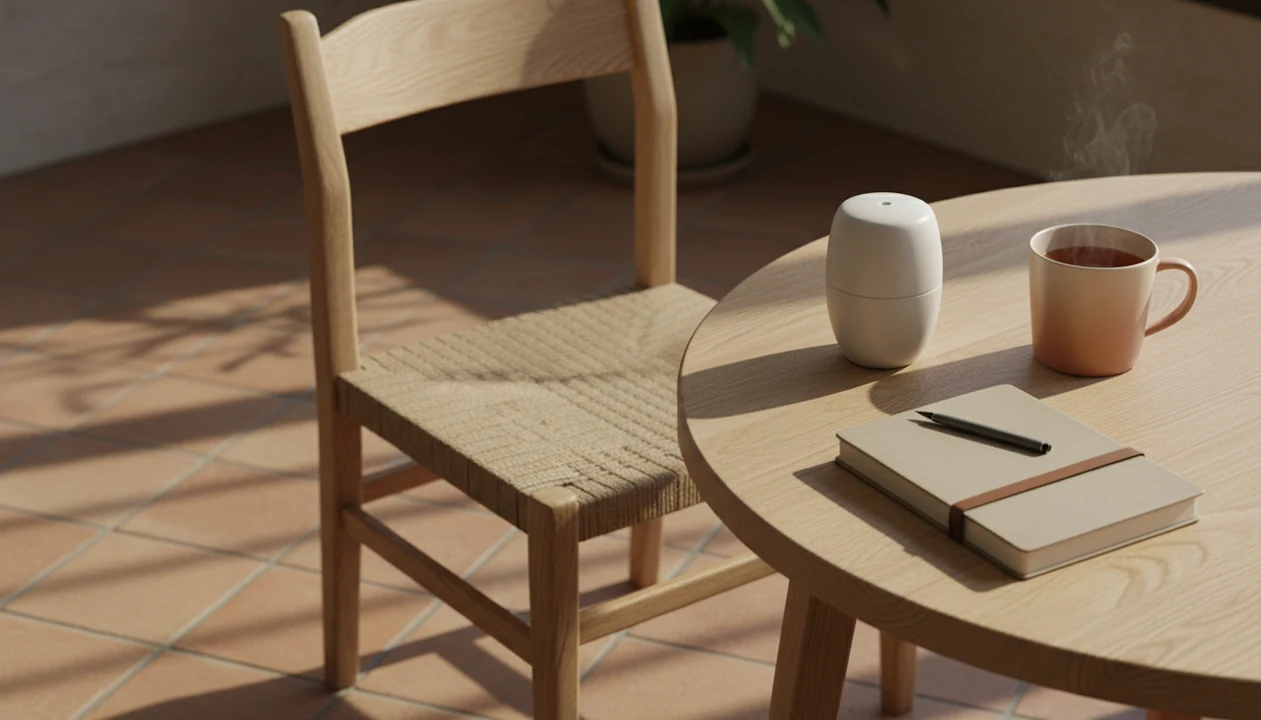
A beginner sits upright on a simple chair in a quiet room, practicing a short meditation self-help exercise with attention on breath and posture. The setting is ordinary: soft light, relaxed shoulders after an exhale, and both feet resting on the floor. The image shows secular attention practice in daily life, not a retreat, ceremony, or medical treatment.
This kind of image should make the practice feel usable. A folded towel on bedroom carpet, a five-minute timer, or a chair beside a bed tells the reader, “You can start here.” The point is not looking serene. The point is noticing and returning. For evenings when thoughts feel crowded, try a mind full vs mindful bedtime reset to ease into rest.
Before a stressful task: make time for a brief pause
Before opening a difficult email or starting a demanding task, a brief breathing exercise can give you time to notice tension and your urge to react. The site's free breathing timer provides a cue for that pause; the Mindful.net app also has short guided meditations and a meditation timer. These tools support practice, not treatment. Persistent distress or trouble functioning calls for professional support rather than a longer timer session.
Limits of Meditation
- Average benefits are small to moderate, and meditation supports rather than replaces care, healthy habits, relationships, or practical problem solving.
- Serious depression, suicidality, trauma symptoms, psychosis, or inability to function require professional support.
- Meditation can increase distress, dissociation, or panic, especially during long silent practice.
- Many studies involve structured programs with trained instructors, not casual practice at home.
Meditation as self-help: common questions
What makes meditation a self-help tool?
Meditation is a self-help tool when you use it intentionally to work on everyday stress, attention, or emotional awareness. You choose a practice, repeat it, and notice how it affects you. It can be guided or unguided, but it is a supportive skill rather than a stand-alone treatment.
Can meditation replace therapy?
No. Meditation can support everyday well-being or sit alongside professional care, but it should not replace therapy, medication, or medical treatment. Severe depression, suicidal thoughts, psychosis symptoms, or difficulty functioning need professional support. Do not stop prescribed care because a meditation practice seems helpful.
Does self-help meditation help anxiety?
Mindfulness meditation may help with anxiety, but the average benefits are measured rather than dramatic. Much of the evidence comes from structured programs with trained teachers and repeated practice over weeks. A short home practice is not the same intervention, and worsening anxiety calls for professional support.
How long should a beginner meditate for self-help?
Start with 3 to 5 minutes and choose one anchor, such as natural breathing, sounds, or the feeling of your feet on the floor. Return to it when attention wanders. A short practice you can repeat is more useful than forcing a long session that feels overwhelming.
Is meditation still useful if I do not feel calm?
Yes, calm is not the only useful outcome or the main measure of a session. Noticing distraction, tension, or an urge to react is part of attention practice. Still, feeling increasingly distressed is not something to push through. Shorten the practice, change the anchor, or stop.
Do I need religious beliefs to meditate?
No. Secular meditation can involve noticing breathing, body sensations, sounds, or steps without adopting religious beliefs. Modern mindfulness has roots in Buddhist traditions, but secular teaching does not require conversion or participation in a faith community. You can practice on an ordinary chair in everyday surroundings.