


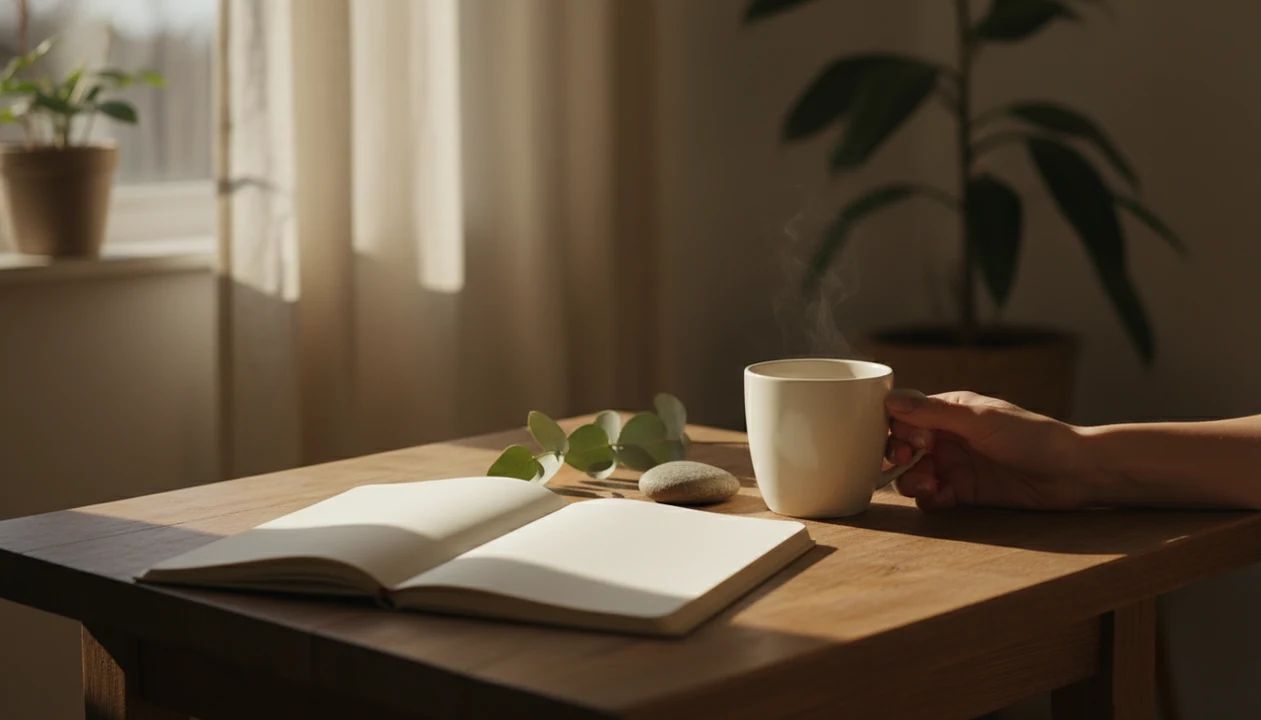
To practice gratitude mindfully, notice something good in your present experience, hold your attention on it briefly, and let yourself feel appreciation before moving on. Start with one concrete detail: a warm drink, a helpful message, or a quiet place to sit. Name what happened and why it mattered, rather than reaching for a broad category such as “family” or “health.”
You do not need to feel cheerful or ignore a difficult day. Gratitude can sit alongside grief, anger, or uncertainty. The exercises below offer ways to pause, write, and express thanks without making appreciation another obligation. Choose one short practice you can repeat, and leave room for an honest response. During uncertain periods, gratitude and dealing with change can mean noticing small sources of support without denying difficulty.
Definition: Mindful gratitude is the practice of deliberately noticing something good in your present experience, holding your attention on it without rushing, and letting yourself feel appreciation before moving on.
What Mindful Gratitude Actually Means
Mindful gratitude is different from a grateful thought because it adds deliberate attention, present-moment noticing, and a short pause for appreciation. A grateful thought may pass through your mind quickly. A mindful gratitude practice asks you to stay with it long enough to notice what is actually happening.
That small pause matters. Instead of writing “family” for the fifth day in a row, you might notice, “My sister left a kind note before a difficult music rehearsal, and my calves softened when I read my name.” Specificity makes the practice feel real.
This is not toxic positivity. You are not pretending the bill, argument, diagnosis, or unfinished task disappeared. You are practicing one attention skill: noticing what is still supportive, kind, useful, or steady inside an imperfect day. For a gentler overview, our guide to mindful gratitude covers the same idea in beginner language.
Cotton sleeve at your wrist. One honest breath.
How Gratitude Practice Works in the Brain and Body
Gratitude practice works by training attention to register positive events more deliberately, instead of letting the mind only scan for threat, irritation, or unfinished work. Over time, the repeated cue and reward can become a habit loop: notice, appreciate, feel, repeat.
- Attention shift: Gratitude redirects focus from threat-scanning toward positive-event encoding, which means the brain has a clearer chance to register what went well.
- Habit loop: A cue, such as bedtime, leads to noticing, felt appreciation, and a small reward. The routine becomes easier when repeated.
- Body connection: Appreciation may show up as a softer jaw, slower breathing, or warmth in the chest. Not dramatic. Just noticeable.
- Research signal: In a study of 1,668 adults, higher gratitude was linked with lower depression, better sleep, lower fatigue, and lower inflammatory biomarkers PMC research article.
- Evidence size: A 2020 meta-analysis of more than 70 studies found gratitude interventions produce small-to-moderate well-being improvements 1745691620969851.
Gratitude can support well-being, but any improvement is usually gradual rather than overnight. Most studies measure short-term mood, sleep, or self-reported well-being, so it is safer to describe gratitude as a supportive attention habit rather than a proven treatment.
What gratitude research can tell you
A 2023 review of 64 randomized clinical trials found that gratitude interventions improved mental health and positive mood while reducing symptoms of anxiety and depression. These findings support gratitude as a useful additional practice, not a cure. Average benefits do not mean every person will feel better or respond to the same exercise.
Writing, reflection, and expressing thanks are different ways to practice. In a 2022 randomized study of college students, gratitude groups improved in wellbeing over time, with journaling appearing to have the strongest effect on wellbeing and affective functioning. That result does not establish one best method for everyone, but it gives writing a reasonable place among the options.
Who Mindful Gratitude Is Best For (and Who It's Not For)
Mindful gratitude is best for people who want a low-effort daily anchor, especially beginners who are learning how attention practice feels in ordinary life. It suits someone who notices a negativity bias at the end of the day and wants a small counterweight.
Best for:
- Beginners to mindfulness who want a simple starting point.
- People who can spare 2-5 minutes, not an hour.
- Anyone who wants to notice small good moments without forcing cheerfulness.
- People building a daily gratitude routine around morning, lunch, or bedtime.
Not ideal for:
- People in acute crisis who need immediate support.
- Anyone who finds forced positivity triggering.
- People seeking a replacement for therapy, medication, or clinical care.
- Those who feel worse when asked to be grateful during trauma or severe depression.
Some people find journaling awkward at first. That’s normal. Mindfulness practices and meditation techniques for beginners and daily life deliver steadier noticing and small regulation skills, not a guarantee that hard feelings disappear.
How to Start a Daily Gratitude Practice in 5 Steps
The easiest way to start a daily gratitude practice is to attach it to one cue you already have, then keep it short enough to repeat tomorrow. Regularity beats intensity here.
- Pick a consistent daily cue. Use morning coffee, your commute, or bedtime as the reminder.
- Notice one specific thing you appreciate right now. Choose something concrete, like warm socks, a kind message, or a quiet room. Before buying something new, try mindful shopping to pause and notice what you genuinely need.
- Name why it matters. Add one detail: “This helped me feel less alone before the meeting.”
- Pause for 15-30 seconds. Feel the appreciation in your body, such as the chest movement beneath a shirt or the face softening.
- Record it briefly. Use a journal, phone note, voice memo, or one sentence spoken aloud.
Two minutes is enough. If you have five, fine.
For beginners, daily gratitude usually works better when it is brief and tied to a cue because the habit has less friction. If you need an even simpler entry point, gratitude for beginners can help you start without overthinking the format.
Make room for one gratitude pause
Between tasks, a brief pause can give you time to notice one thing that helped. The free mindfulness bell can serve as that cue: stop, name a specific detail, and let appreciation register before continuing. A notebook is better for recording what happened in detail, while a message or conversation is better when you want someone to hear your thanks.
How Mindful.net Supports a Gratitude Practice
Mindful.net supports a gratitude practice by giving you gentle structure without turning appreciation into another performance. It is most useful when you want a cue, a prompt, and a short pause that helps one honest detail become clear.
Guided prompts can help you move past generic answers like “health” or “family” and notice what actually happened: the warm mug in your hand, the person who waited, the room that stayed quiet. Reminders can also meet the rhythm of a real day, with a morning cue for intention, a midday cue for re-centering, and a bedtime cue for decompression.
- Choose one time of day that already has a natural opening.
- Follow a prompt that asks for a specific moment, not a polished answer.
- Pause long enough to feel the response in your body.
- Save a short note, or let the practice stay silent if writing feels unnecessary.
Silent journaling, a paper notebook, or one sentence spoken aloud may be enough if you already remember to practice. Calm and Headspace are guided-practice alternatives. Mindful.net can support consistency, but it does not replace therapy, medication, crisis support, or clinical care.
5 Gratitude Exercises for Different Times of Day
Different gratitude exercises fit different parts of the day: morning gratitude sets direction, while bedtime gratitude helps the nervous system decompress. Pick the practice that matches the moment, not the one that sounds most impressive.
Morning Gratitude List
Write three specific things before checking your phone. Early light on the wall, a working heater, or a person you’ll see later all count.
Midday Micro-Pause
Between tasks, take one breath and name one thing that is helping you continue. At work, that might mean hands off the keyboard and three breaths before unmuting.
Evening Gratitude Journal
Free-write for 2-5 minutes with sensory details. If you prefer structure, try these gratitude journal prompts.
Bedtime Gratitude Scan
Review the day through the body. Notice moments of relief, safety, kindness, or completion. A 2006 randomized trial found that three weeks of gratitude writing improved sleep quality compared with writing about hassles or neutral events 0022 3514.90.4.640.
Gratitude Meditation
Sit quietly or use a guide, then return to appreciation as the anchor.
10 Mindful Gratitude Prompts That Avoid Forced Positivity
Good gratitude prompts are specific enough to feel honest. Vague questions like “What are you grateful for?” can go stale because the mind reaches for the same safe answers.
Try rotating these prompts:
- What small moment today made my body relax?
- Who made something easier for me this week?
- What ordinary object supported my day?
- What felt hard today but still taught me something?
- What sound, smell, or texture did I enjoy?
- What did I receive that I did not have to earn?
- What did I do for myself that deserves thanks?
- What relationship felt steady, even briefly?
- What problem did not get worse today?
- What helped me get through the last hour?
Tomorrow’s errands may still wander through your mind. Let them.
Specific prompts reduce checklist fatigue because they ask you to notice fresh details. If writing feels flat, say the answer aloud or use a guided practice in a Mindfulness Practices App such as Mindful.net. On Mindful.net, a gratitude session should help you choose one prompt, pause for the felt response, and save a short reflection without turning the practice into a productivity task. That makes the Mindfulness Practices App most useful for people who need a cue, a timer, and a gentle reminder to stay specific.
Turn one appreciation into a letter
Gratitude need not stay in a private list. In a randomized trial of 293 psychotherapy clients, people who received psychotherapy plus gratitude writing reported better mental health four and 12 weeks after the intervention than the comparison groups. The writing involved letters expressing appreciation to other people. This was an addition to psychotherapy, not a replacement for it.
For a practical version, choose someone whose help you can describe specifically. Write what they did, why it mattered, and what you would like them to know. A few honest sentences are enough to begin. You might turn the draft into a message or conversation, but keep the appreciation freely chosen. Giving thanks does not require overlooking harm or changing a boundary. When appreciation involves someone who pressures or manipulates you, dealing with a narcissist calls for firm boundaries.
Common Mistakes That Make Gratitude Feel Performative
Gratitude feels performative when it becomes a performance of being fine, rather than a real moment of attention. Most mistakes come from rushing, repeating, or using gratitude to avoid honest emotion.
- Rushing the list: Writing three items in ten seconds gives the mind no time to savor anything.
- Repeating without detail: “Family, health, home” can become empty if you never name what happened today.
- Checking the box: Treating gratitude as a task removes the felt appreciation that makes it mindful.
- Bypassing hard feelings: Gratitude should not be used to suppress grief, anger, fear, or stress.
- Expecting instant change: A nationally representative study of 2,001 U.S. adults found higher gratitude was associated with better well-being and lower odds of mental distress, but that does not mean one entry will shift everything PMC research article.
For people who feel emotionally overloaded, gratitude when sad may be a safer starting frame than cheerful prompts.
A Noticing Exercise When Gratitude Feels Out of Reach
Begin this exercise without looking for anything to appreciate. Instead, give yourself permission to notice what is present, including disappointment, sadness, irritation, or numbness. Keep your eyes open if you prefer, and choose an ordinary place to rest your gaze. The task is not to improve your mood or find a lesson in what hurts. It is to make room for an honest response before deciding whether appreciation belongs in this moment.
You can finish with the words, “This is what I noticed,” rather than “This is what I am grateful for.” If something supportive catches your attention, you may acknowledge it without asking it to cancel the difficulty. If nothing does, leave the exercise there. If paying attention inward feels overwhelming, return your gaze to the room or stop.
- Look at one ordinary object nearby. Notice its color, shape, or texture without deciding whether you like it.
- Ask, “What feeling is here?” Use a simple word if one fits, or say, “I am not sure.”
- Acknowledge the feeling with words such as, “Sadness is here.” Leave out any demand to change it.
- Notice whether you want to push the feeling away or judge yourself for having it. You do not need to follow that impulse.
- If you wish, ask, “Is anything offering support right now?” Allow the answer to be yes, no, or uncertain.
- End when you choose. Let noticing count as the whole practice, whether or not gratitude appears.
Gratitude Practice Limits
- Seek qualified mental health care when you need therapy, medication, or crisis support, rather than relying on gratitude.
- Benefits are generally small to moderate and vary by person, method, timing, and consistency.
- Journaling can feel forced or annoying at first, especially when prompts are vague.
- Results are less likely when practice is rushed, distracted, or treated as box checking.
Gratitude practice questions
How do I start practicing gratitude if I am a beginner?
Choose a familiar cue, such as finishing breakfast or getting into bed. Name one specific thing you appreciate and explain why it mattered. Pause for 15 to 30 seconds before moving on. Keep the first practice short enough that repeating it does not feel like another assignment.
How often should I write in a gratitude journal?
A reasonable starting routine is three concrete items two or three times a week. Describe what happened, why it mattered, and who contributed. This is a practical synthesis of gratitude-writing approaches, not a proven optimal schedule. Adjust the frequency if daily entries become repetitive or forced.
What can I write when nothing feels worth being grateful for?
Start with something small that helped, rather than something that made you happy: a working heater, a meal, or someone answering a message. You can also acknowledge that the day was difficult. If no appreciation feels genuine, stop rather than inventing a feeling or judging yourself.
Is morning or bedtime better for gratitude practice?
There is no established best time for everyone. Morning can be a cue to notice what is available now; bedtime offers a chance to recall one helpful moment from the day. Choose a time you can repeat without rushing. A midday pause also counts.
Do I need a journal, or can I practice gratitude mentally?
A journal is optional. You can pause, name one appreciation silently, and stay with it for a few breaths. Writing gives you space to record details; a message or letter lets you express thanks to another person. Choose the format that keeps the practice specific and honest.
Can gratitude help with depression or anxiety?
Research reviews suggest gratitude interventions can reduce symptoms of depression and anxiety, but benefits vary and are generally modest. Gratitude is not a substitute for therapy, medication, or crisis support. Treat it as an optional additional practice, not a requirement to feel better or proof that you are coping well.
Can I be grateful and still feel angry or sad?
Yes. Appreciation does not cancel grief, anger, sadness, or a need for change. You might value a friend's support while remaining upset about what happened. Keep both experiences in view. Gratitude should not be used to excuse harm, weaken boundaries, or pressure you into accepting an unfair situation.