
Mindfulness for Exercise Motivation When Starting Feels Hard


Mindfulness for exercise motivation means using nonjudgmental, present-moment awareness before, during, and after movement to support more self-directed exercise habits. You notice your breath, body, thoughts, and resistance without turning them into self-criticism. Rather than forcing a workout through guilt, you acknowledge what is happening and choose a manageable next step, such as putting on your shoes or beginning a short warm-up.
Start with a two-minute breathing pause, use one attention cue while moving, and briefly reflect afterward. The aim is to make exercise feel chosen and repeatable, not to feel motivated every time. Mindfulness is not a fitness shortcut or medical treatment. It works alongside realistic goals, gradual progress, and movement you can return to.
The essentials
- Mindfulness can support exercise motivation by shifting attention from guilt and pressure toward body awareness, enjoyment, values, and realistic next steps.
- The best approach is small: a 2-minute breathing reset, a mindful warm-up, attention cues during movement, and a short post-workout reflection.
- Mindfulness is not a fitness hack or medical treatment; it works best with realistic goals, gradual progress, and exercise you can actually repeat.
Notice resistance, then choose one small action
Mindfulness for exercise motivation means using present-moment attention to make movement easier to begin, continue, and repeat. It is secular attention practice, not a belief system, personality type, or test of discipline.
The practical shift is simple: workouts tend to feel more sustainable when they feel chosen rather than forced. You notice, “I don’t want to start,” without turning that thought into “I always fail.” Then you take the next small step, maybe shoes on, timer set, one lap outside.
The need is real. In a nationally representative U.S. survey, only 24.2% of adults met both aerobic and muscle-strengthening guidelines in 2020, per the CDC CDC guidance. Mindfulness will not erase that adherence gap, but it can train the pause where choice becomes possible.
What mindful attention looks like during exercise
Mindfulness for exercise motivation is the practice of using nonjudgmental present-moment awareness before, during, and after movement to support more self-directed exercise habits.
In plain language, you pay attention to breath, muscle sensation, thoughts, emotions, and the room or path around you. You are not trying to empty the mind. You are noticing what is already happening, then returning to the next useful cue.
A first-time meditator might take three measured breaths near a pair of walking shoes, notice tense calves before the first squat, or feel a shirt sleeve brushing skin during a cool-down. Mindful walking uses the same simple rhythm: step, breath, posture, surroundings. For a fuller movement-based example, our mindful walking guide breaks that practice into everyday steps.
During exercise, mindfulness offers a way to notice resistance and adjust without self-criticism, not a guarantee of motivation or instant fitness results.
Five points about mindfulness and exercise habits
- Mindfulness is associated with more self-determined exercise motivation, meaning people are more likely to move for personal reasons rather than pressure alone. A study of 205 adults found this association between dispositional mindfulness, self-determined exercise motivation, and lower amotivation: NIH research.
- Mindful movement may make workouts feel more pleasant and satisfying by drawing attention to rhythm, breath, warmth, balance, and small signs of progress.
- Short daily practices can begin training attention; a phone timer set for 5 minutes is a realistic starting point.
- Mindfulness reduces reliance on guilt-based motivation by helping you label self-critical thoughts and return to the next movement.
- Mindfulness works best when paired with realistic goals, gradual progress, recovery, and activity you can actually repeat.
For inconsistent exercisers, a small mindful start is often easier than a strict workout plan because it lowers the emotional cost of beginning. The first win may be simply noticing resistance without obeying it.
Moving for your own reasons, not just from pressure
Mindfulness may support exercise adherence by shifting motivation from controlled motivation toward intrinsic motivation. Controlled motivation sounds like “I have to work out or I’m bad.” Intrinsic motivation sounds more like “I feel clearer after walking” or “strength training helps me carry groceries without strain.”
Research on 205 adults found that higher dispositional mindfulness was significantly associated with more self-determined exercise motivation and lower amotivation NIH research. In everyday terms, awareness may help people notice the rewarding parts of movement, not only the effort.
The mechanism is not mysterious. Attention reinforces what you notice. If you register the steadier breath after five minutes, the warm legs after a hill, or the relief after stretching, exercise has more reasons to repeat.
Resistance still shows up. The pause matters. Stress reduction may also help indirectly, since a calmer nervous system can make planning, starting, and recovering feel less loaded.
A short routine before, during, and after movement
Use mindfulness for exercise motivation as a short routine before, during, and after movement. Keep it equipment-free, brief, and easy enough to repeat on a low-energy day.
- Settle your breath for 2 minutes before moving; feel one inhale and one exhale without fixing anything.
- Name your intention in one plain sentence, such as “I’m walking to feel less stuck.”
- Choose one movement cue during exercise, like foot pressure, arm swing, breath rhythm, or posture.
- Notice resistance when it appears; label it “tired,” “bored,” or “judging,” then return to one next step.
- Reflect briefly after exercise; write one sentence about what helped and one thing to adjust next time.
A 5-minute mindfulness practice can be enough on days when a longer routine would become another reason to skip. Small counts.
Match your attention cue to the exercise barrier
Different barriers need different mindfulness cues. The goal is not to talk yourself into a punishing workout; it is to notice the barrier clearly and choose a practical next step.
| Barrier | Mindfulness practice | Practical example |
|---|---|---|
| Boredom | Use sensory attention and curiosity | During a walk, notice three sounds, the pace of your breathing, and how your stride changes uphill. |
| Self-criticism | Label thoughts and return | Say “judging” when the mind gets harsh, then complete the next rep or next minute. |
| All-or-nothing thinking | Choose a minimum viable workout | Do 5 minutes of stretching or one block of walking instead of canceling the whole plan. |
| Low energy | Start with breathing and walking | Take 6 slow breaths, then walk around the room or outside for 3 minutes. |
| Body discomfort | Distinguish safe effort from warning signs | Notice warmth and fatigue, but stop or modify for sharp pain, dizziness, or unusual symptoms. |
For many beginners, the minimum viable workout usually works better than “make up for it tomorrow” because it protects the habit loop.
Give your next workout a cue and a backup plan
Noticing resistance helps you identify the problem; a specific plan gives you something to do next. Choose a small action and attach it to a reliable daily cue: “After I brush my teeth, I will stretch for two minutes.” A 12-week habit-formation study found that repeating a behavior in a consistent context increased automaticity. This is a practical application of that finding, not a tested mindfulness routine.
Add a response to the obstacle most likely to interrupt you. For example: “If rain prevents my walk, I will do five minutes of indoor movement,” or “If I miss the morning session, I will walk after lunch.” A systematic review of physical-activity planning found that plans were more likely to help when they explicitly addressed obstacles. Keep the backup realistic rather than making it a punishment for missing the original plan.
Breathing pauses, movement cues, and a mindful cool-down
Mindfulness can happen inside the workout, not only before it. A two-minute breathing pause, a mindful warm-up, breath-anchored intervals, and a body-scanning cool-down are enough to make the session feel more intentional.
Two-minute pre-workout reset
Stand by the door or rest for a moment on a museum bench after you lace up. Try Clipboard Breath: inhale as if you are checking the first line of a plan, exhale as if you are setting down one demand. If your mind drifts to budget planning or watering plants, that is not failure.
Mindful cues during movement
During strength sets, match the effort phase with a steady exhale. During cardio, use one cue per interval: breath, footfall, shoulders, or surroundings. In the cool-down, scan from forehead to calves and notice what changed.
If you want this woven into ordinary days, a daily mindfulness routine can help you practice attention outside exercise too.
Who this approach may help, and when to seek other support
Mindfulness fits people who want a kinder, more repeatable relationship with movement. It supports motivation, but it does not remove every barrier or replace specialized help.
Best for
- Beginners: Start small with breath, walking, stretching, or short strength sessions.
- Inconsistent exercisers: Use mindfulness to restart without turning one missed day into a verdict.
- Guilt-driven exercisers: Practice noticing pressure without letting it run the whole workout.
- People tired of aggressive fitness messaging: Choose steady attention over shame-based slogans.
Not ideal for
- Medical guidance replacement: Ask a clinician about new symptoms, health conditions, or exercise restrictions.
- Injury rehabilitation alone: Physical therapy needs assessment, progression, and feedback.
- Crisis mental health care: Mindfulness is not emergency support.
- Structured coaching needs: Some goals require programming, form checks, or sport-specific coaching.
Practical. Not magic.
Expect habit-building to take time, and plan your restart
A workout can still require effort after several weeks of repetition. A 2024 review of 20 studies involving 2,601 participants found that health-related habits typically took two to five months to develop, with individual estimates ranging from four to 335 days. These findings cover different health behaviors, not mindfulness-based exercise alone. Becoming more automatic also does not guarantee enjoyment, fitness gains, or attendance at every planned session.
Set a recovery rule before you need it: “If I miss a session, I will resume at the next planned opportunity.” In the longitudinal habit study, missing one occasion did not materially disrupt habit formation, although inconsistent repetition reduced progress. Use a brief, nonjudgmental reflection to identify what got in the way, then adjust the cue, timing, or minimum action instead of treating the missed workout as a verdict on your discipline.
Optional guidance before or after your workout
You can practice mindfulness for exercise motivation without an app. A quiet corner, a walking route, or an office stairwell can be enough if you know what to pay attention to.
Mindful.net is a Mindfulness Practices App for beginners who want guided breathing, body scans, and short daily prompts; for exercise motivation, use it as optional structure before or after movement, not as the reason you move.
For exercise habits, the useful part is repetition, not dependency. A guide can cue you to pause, name what is happening, and come back to the next small movement, but it cannot guarantee adherence. If you prefer brief nudges, an app that gives one-minute mindfulness prompts may fit better than longer sessions.
Use images of ordinary, repeatable movement
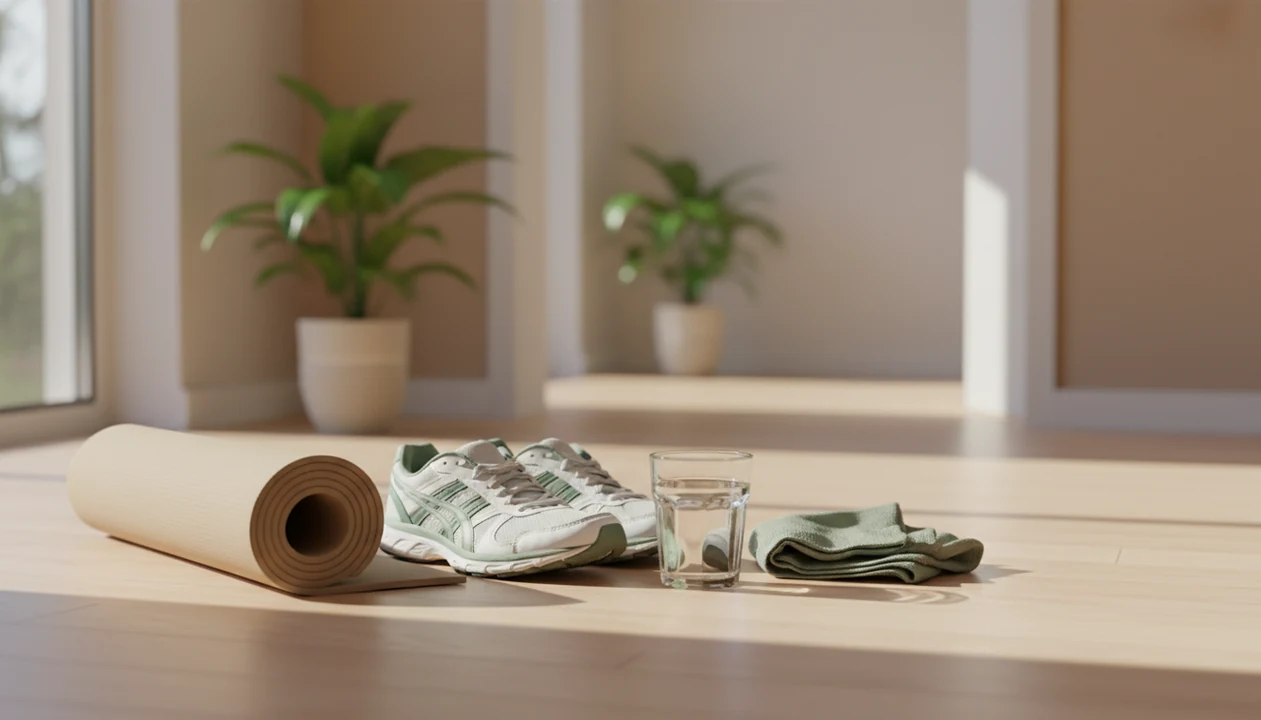
For readers practicing this today, the most useful visual is ordinary: shoes by the door, a mat on the floor, or a quiet path where attention can land on breath and steps. Good options include a person tying shoes near the door, walking on a simple path, stretching on a mat, or cooling down after a light workout.
Avoid extreme fitness imagery, visible body transformation framing, and before-and-after comparisons. Those images can push the page back toward pressure, which works against the point of the practice. Practicing mindfulness for body image can help you notice appearance judgments without making them the focus of movement.
Suggested caption: “A beginner-friendly mindfulness for exercise motivation guide can start with breathing, walking, stretching, and noticing the body without judgment.”
Alt text should describe the action plainly, such as: “Person tying running shoes before a mindful walk.” No need to mention mood, body size, or implied fitness level unless it is visible and relevant.
A brief meditation to turn an intention into an action
Use this brief practice when an intention feels too broad to act on. Instead of asking how to become more enthusiastic, ask what your intention would look like in one ordinary, observable action. You can leave your mood as it is. The practice ends with doing that action, rather than waiting for a feeling that tells you it is time.
- Sit or stand comfortably. Take a moment to notice the contact between your body and the chair or floor.
- Name one intention in plain language, such as, “I want to make room for movement today.”
- Translate that intention into something you can do now, such as clearing enough floor space to stretch.
- Define where the action ends: “I will move this chair and put the loose items in a basket.” Keep this separate from deciding whether to complete a workout.
- Let your current feelings remain without trying to change them. End the meditation and carry out the action you named. Practicing acceptance and mindfulness can help you trust the present moment without requiring your feelings or circumstances to be perfect.
Mindfulness and Exercise Limits
- Mindfulness can support exercise motivation, but benefits are not guaranteed and research remains limited.
- Mindfulness may heighten discomfort or negative thoughts and cannot remove practical barriers or replace training, sleep, nutrition, and recovery.
- Mindfulness is not a replacement for medical care, physical therapy, mental health care, or emergency support.
- Modify activity and seek medical guidance when symptoms feel sudden, severe, or unusual.
Exercise motivation and mindfulness questions
Can mindfulness help when I do not feel like exercising?
Mindfulness can help you notice reluctance without immediately turning it into self-criticism. Pause, identify what is present, such as boredom, tiredness, or pressure, and choose one manageable action. It does not guarantee motivation or remove practical barriers. Sometimes the useful adjustment is a shorter session or a different time.
How long should I meditate before a workout?
Try a two-minute pause before moving. Feel your natural breathing, notice your body, and name a simple intention for the session. This is a practical starting point, not a proven optimal duration. A longer meditation is optional; it should not become another requirement that delays exercise.
How do I practice mindfulness while exercising?
Choose one cue you can return to, such as foot pressure during walking, arm swing, posture, or muscle sensation. When thoughts distract you, acknowledge them and return to that cue. You do not need uninterrupted concentration. Keep attention available for your surroundings and the demands of the movement.
Can mindfulness make a boring workout more enjoyable?
Sensory attention may help you notice parts of movement that usually pass unnoticed: rhythm, warmth, balance, or sounds along a walking route. Try one cue for a short portion of the session. If the activity remains unpleasant, consider changing it rather than expecting mindfulness to make every workout enjoyable.
What should I do after missing a workout?
Resume at the next planned opportunity rather than waiting for a new week. Briefly identify the barrier and decide whether your timing or minimum action needs changing. Habit research suggests that one missed occasion need not disrupt progress, but repeated inconsistency can slow it. A restart plan is more useful than self-blame.
How long does it take for exercise to become a habit?
There is no fixed deadline. A 2024 review found that health-related habits typically took two to five months to develop, with wide individual variation. Those findings were not specific to exercise alone. Repeating a manageable action in a stable context may help it become easier to start, without making every session effortless.
What if focusing on my body makes exercise uncomfortable?
Mindfulness may initially make discomfort, body-image thoughts, or harsh self-talk more noticeable. You can shift attention to external sounds or your surroundings, shorten the practice, or stop. Do not use mindfulness to push through pain. Medical or mental health support may be more appropriate when discomfort persists or feels distressing.
Is mindfulness enough to improve fitness?
No. Mindfulness is an attention practice that may support your relationship with exercise; it does not replace movement, gradual training progress, or appropriate recovery. It also cannot resolve every barrier, including limited time, unsafe exercise spaces, or chronic pain. Medical guidance or physical therapy may be needed for some concerns.