
How to Stop Overthinking With Mindfulness


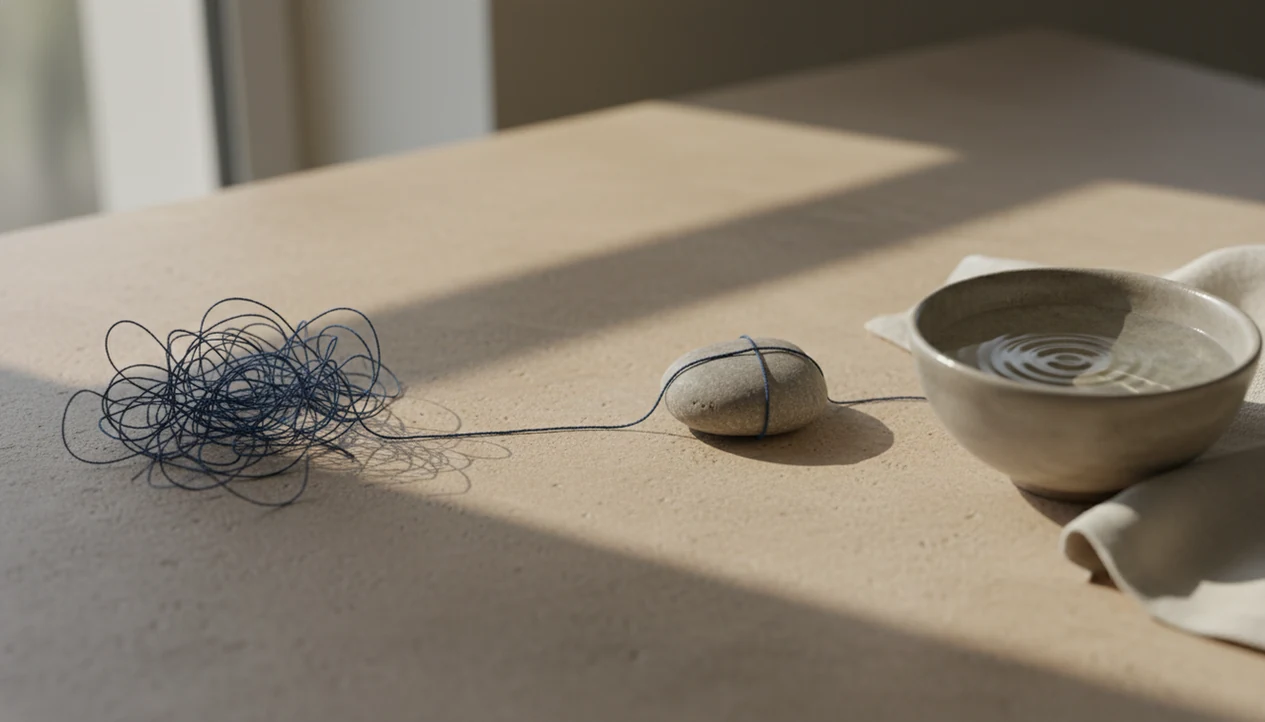
To stop overthinking with mindfulness, notice thoughts as temporary mental events and return attention to something present, such as your breath, feet, sounds, or touch. The aim is not to force thoughts away or make your mind blank. It is to notice thoughts, feelings, and body sensations without treating every worry as a fact, command, or emergency.
When a conversation keeps replaying or one “what if” leads to another, briefly name the pattern: “replaying” or “worrying.” Then feel your feet on the floor or listen to a nearby sound. If attention wanders, return without criticizing yourself. Short practices can support everyday worry, but severe, persistent, or trauma-related distress deserves professional care. This guide offers educational practices, not diagnosis or treatment.
The essentials
- Overthinking usually eases when you change your relationship to thoughts, not when you try to suppress them.
- Use short anchors such as breathing, body scans, sensory grounding, walking, or mindful pauses during everyday triggers.
- Mindfulness can support anxiety and rumination, but severe, persistent, or trauma-related distress deserves professional care.
Notice a thought without treating it as an instruction
How to stop overthinking mindfulness means learning to notice thoughts without obeying them. The shift is simple, but not always easy: stop making a silent mind the goal. Aim for less entanglement instead.
Try this for 30 seconds. Notice the thought, “I’m going to mess this up.” Label it, “worrying.” Anchor attention in one breath, your feet on the floor, or the sound in the room. Then soften your jaw, shoulders, or belly.
That’s it. Not dramatic.
Compassion matters because self-criticism often becomes another loop. “Why am I still thinking?” turns into more thinking. A kinder phrase works better: “This is a worry loop, and I can return.” The practice is not winning an argument with your mind. It’s noticing the argument has started and choosing not to keep feeding it. When shame fuels repeated worry, learning to stop a shame spiral can help you respond more kindly.
Five facts about practicing mindfulness for overthinking
- Mindfulness is not thought suppression. Trying to shove thoughts away usually gives them more importance.
- Thoughts can be observed as mental events. A worry can be present without being treated as a fact, instruction, or warning.
- Breath, body, and sensory anchors interrupt worry loops. They bring attention back to information available now, not only imagined outcomes.
- Short daily repetition matters more than one perfect long session. A phone timer set for 5 minutes is more useful than waiting for an ideal quiet hour.
- Persistent symptoms may need qualified support. Anxiety, depression, trauma symptoms, panic, or thoughts of self-harm deserve care beyond self-guided practice.
For beginners, a practical next step is learning what to expect when starting meditation, especially if the first few sessions feel busier than expected.
How mindfulness for overthinking works in the brain and body
Mindfulness works on overthinking by training attention, decentering from thoughts, and returning awareness to present body signals. Overthinking is repeated attention to imagined problems, past mistakes, future threats, or unresolved uncertainty.
Attentional training means noticing that the mind wandered and returning to an anchor. Decentering, sometimes called detached mindfulness, means seeing a thought as an event in awareness rather than a command. Body awareness helps because sensations are happening now. The mind may be replaying a meeting, but the feet are on tile, the chest is rising, and sound is entering the room.
Anxiety is common enough that this skill matters. NIMH reports that 19.1% of U.S. adults experienced an anxiety disorder in the past year, and generalized anxiety disorder affects about 4.7% across a lifetime (Anxiety Disorders). Mindfulness can support worry and rumination, but it is not a substitute for clinical care when symptoms are severe.
Before You Start: When Mindfulness Is a Good Fit
Mindfulness is a good fit when overthinking shows up as an everyday worry loop, not an immediate safety crisis. Start small, stay ordinary, and treat the practice as a way to steady attention rather than dive deep.
A useful first session might happen in a quiet bedroom chair, an office break room, or a parked car before going inside. You do not need candles, silence, or a long meditation. You need a low-intensity place where you can notice thoughts and still feel oriented to the room.
- Choose a short practice first, such as 2 minutes with your feet on the floor or one hand resting on your lap.
- Keep your eyes open if closing them feels unsafe, disorienting, or too intense.
- Use an ordinary anchor, such as breath, touch, sound, or the feeling of the seat under you.
- Pause the practice if panic, trauma flashbacks, or thoughts of self-harm appear or escalate.
- Seek qualified help when those stop signals show up, especially if you feel at risk or unable to settle.
How to use mindfulness to stop overthinking step by step
Use this short practice when your mind starts looping. It works on a bus seat, in an office stairwell, or at the edge of the bed.
- Set a 2-minute timer and choose one simple anchor, such as breath, feet, hands, or sound.
- Notice the thought loop without arguing with it or proving it wrong.
- Label the loop with a plain word, such as planning, judging, replaying, worrying, or what-if thinking.
- Return attention to the breath, feet, hands, or the nearest steady sound.
- Repeat the return each time the mind leaves; every return is the practice, not a failure.
For everyday overthinking, short mindfulness practice is often easier than long meditation because it meets the loop close to where it starts. Beginner mindfulness practices teach you to notice wandering attention and return to an anchor; they do not guarantee a blank mind or instant relief.
Best mindfulness anchors for overthinking moments
The right anchor depends on the moment. If one anchor makes you more tense, switch to another without making it a big project.
| Anchor | Best moment | How to try it |
|---|---|---|
| Breathing anchor | Mild rumination or before sleep | Feel one inhale and one exhale without changing the breath at first. |
| Feet-on-floor grounding | Panic-like urgency or racing thoughts | Press both feet into the floor and name the contact points. |
| Body scan | Tension-driven worry | Move attention from forehead to shoulders to belly, softening one area at a time. |
| Sound or sight anchor | Public places | Notice three sounds or three colors without needing privacy. |
| Mindful walking | Work breaks or commuting | Feel each step land, then silently say “left” and “right.” |
In a grocery line with a clenched basket, feet-on-floor grounding may be more useful than closing your eyes. For sleep-specific practice, meditation for sleep usually works better when it stays gentle and low-effort.
Mindful pauses for messages, scrolling, and bedtime
Informal mindfulness often matters because overthinking happens during ordinary transitions. Email, texting, scrolling, commuting, difficult conversations, and bedtime all invite quick mental spirals.
Mindful email and message pauses
Before replying, take one mindful breath. Feel your body in the chair, name the loop, then choose the next action. “Defending.” “Explaining.” “Waiting for approval.” That tiny label can stop a rushed response.
Mindful commuting and scrolling resets
When scrolling turns into comparison or dread, place the phone down for one breath. On a commute, feel the seat under you and notice one sound outside your thoughts.
Screen glow on tired eyes is a cue.
Mindful bedtime rumination practice
At bedtime, label replaying as “replaying” and planning as “planning.” Then return to contact points: pillow, mattress, blanket, breath. If stress is the main driver, a broader mindfulness for stress routine can give the practice more structure.
Use a brief writing pause when a worry needs action
If a thought keeps returning because something needs doing, use a brief, timed writing pause. Write the trigger, the thought, the emotion, evidence for and against your interpretation, and a more balanced alternative. End with one concrete next action. This applies principles from research on mindfulness and cognitive-behavioral approaches to worry and rumination; the review does not establish one best journaling format or duration.
Keep the entry bounded rather than recording every version of the same worry. If an action is available, name it plainly, such as sending a clarification or arranging an appointment. If the outcome is outside your control, note that uncertainty and return to your current task. A scheduled worry period is another option, rather than repeatedly reopening the issue throughout the day.
Mindfulness evidence for anxiety, worry, and rumination
Evidence supports mindfulness-based interventions for anxiety, worry, and rumination, but not every online tip has been tested. The strongest findings usually come from structured programs such as mindfulness-based stress reduction, or MBSR, and mindfulness-based cognitive therapy, or MBCT.
A 2014 JAMA Internal Medicine review of 47 randomized clinical trials found moderate improvements in anxiety symptoms for mindfulness-based interventions (JAMA study). A 2022 JAMA Psychiatry trial reported that an 8-week MBSR program was noninferior to escitalopram for reducing anxiety symptoms in adults with anxiety disorders (JAMA study). A meta-analysis found that MBCT reduced depressive rumination compared with control groups.
Clinicians typically recommend mindfulness as a skill-based support, not a replacement for assessment, therapy, medication decisions, or crisis care. If anxiety is the main concern, mindfulness for anxiety support should be understood as education and practice support, not treatment.
What newer research says about repeated thought loops
A 2025 meta-analysis of mindfulness-based cognitive therapy combined 29 randomized controlled trials involving 2,535 participants. It found a moderate reduction in rumination after treatment, with benefits also present at follow-up. These findings concern structured MBCT, not a single breathing pause or every meditation recording. They support changing how people respond to repeated thoughts, rather than promising that thoughts will disappear.
The relationship between repetitive negative thinking and distress also runs both ways. A 2025 meta-analysis of 223 studies found that repetitive negative thinking predicted later anxiety and depression symptoms, while those symptoms also predicted later repetitive thinking. This supports a feedback loop, not a simple claim that overthinking causes all distress. Persistent symptoms may need care that addresses both the thinking pattern and the wider difficulty. For people with ADHD, persistent exhaustion and difficulty coping may also warrant learning about ADHD burnout symptoms and available support.
Mindfulness practice fit for everyday overthinking and clinical red flags
Mindfulness fits everyday overthinking when the main problem is mental looping, not immediate danger or severe impairment. It can help with decision fatigue, work rumination, self-criticism, and sleep-related replay. If work rumination continues alongside exhaustion, reviewing the signs of burnout may help you distinguish lasting strain from a difficult day.
| Fit | Good match | Not ideal as the only support |
|---|---|---|
| Everyday worry loops | Repeating “what if” thoughts after normal stress | Panic, crisis, or unsafe thoughts |
| Decision fatigue | Going in circles over low-risk choices | Major life decisions needing legal, medical, or financial advice |
| Self-criticism | Harsh inner commentary after mistakes | Trauma memories or severe shame spirals |
| Work rumination | Replaying meetings after hours | Workplace harm that needs action or support |
| Beginner practice | Secular, short, practical exercises | Long silent retreats before building stability |
Mindful.net is a secular app that teaches mindfulness practices and meditation techniques for beginners and everyday life. Still, the tool is not the treatment plan.
Common mistakes in mindfulness for overthinking
Trying to force thoughts away or judging yourself for having them can turn mindfulness into another performance test. Corrections are usually simple and practical.
- Forcing thoughts to disappear: Instead, let thoughts be present and return to the anchor anyway.
- Judging yourself for thinking: Replace “I’m bad at this” with “thinking noticed.” If one setback makes you abandon the practice, recognizing the what the hell effect can help you restart gently.
- Using mindfulness to avoid real action: If a problem needs an email, apology, boundary, or appointment, use mindfulness to steady yourself first.
- Practicing only when overwhelmed: Add one small daily rep, such as three breaths before opening a laptop. Alongside small daily practices, habits that help prevent burnout include protecting rest, setting boundaries, and seeking support when needed.
- Expecting instant relief: Treat early sessions as training attention, not proving whether mindfulness “works.”
A pencil tapping during study time can become the cue: notice irritation, feel the hand, return to the page. For many beginners, an app to help manage stress mindfully can make those repetitions easier to remember.
A seated grounding practice: image and caption
Use an image that shows an ordinary, secular practice moment. A good scene would be a person sitting comfortably with both feet on the floor, one hand resting on the chest or lap, and a notebook or phone set aside nearby.
Caption: A beginner mindfulness practice for overthinking: noticing thoughts, then returning attention to the body through breath, touch, and steady posture.
Alt text: Person sitting in a chair with feet on the floor, one hand resting on the chest, and a notebook and phone set aside.
The image should not look like a retreat advertisement. A kitchen chair, desk chair, or quiet corner works better. The point is accessible practice, not a special identity. If the page later uses app imagery, Mindful.net can be shown as one optional guide among other practical supports, not as the center of the exercise.
Overthinking and Mindfulness Limits
- Seek professional help for severe anxiety, major depression, trauma symptoms, or suicidal thoughts, mindfulness alone is not treatment.
- Mindfulness can initially make distressing thoughts clearer and feel worse before it feels easier.
- Long silent practices, retreats, and intense body scans may not suit everyone, and practice quality varies widely.
- The guide to meditation side effects explains when uncomfortable experiences call for shortening, modifying, or pausing practice.
Mindfulness and overthinking questions
Can mindfulness stop overthinking completely?
Mindfulness does not reliably stop thoughts on command. It trains you to recognize a loop and return attention without following every thought. A useful goal is less time caught in replay or worry, not permanent silence. Research supports structured mindfulness-based approaches, but a brief practice cannot guarantee relief.
What should I do when my thoughts start spiralling?
Start with one small move: name the pattern, such as “worrying” or “replaying,” and feel your feet on the floor. Let the thought remain while you attend to contact, sound, or one ordinary breath. Then ask if there is a concrete next action. You do not need to resolve every uncertainty first.
How long should I meditate for overthinking?
Start with two minutes using one anchor, such as your feet, hands, breath, or a steady sound. Return whenever you notice that attention has wandered. A short daily practice is a practical starting point, not a proven dose for everyone. Shorten or stop the session if it becomes overwhelming.
What is detached mindfulness for overthinking?
Detached mindfulness means noticing a thought as a mental event rather than treating it as a fact or instruction. For example, change “I will fail” to “I am having the thought that I will fail.” This creates room to choose a useful action without having to argue the thought away.
How can I use mindfulness for overthinking at night?
Keep the practice brief and simple. Notice “replaying” or “planning,” then feel the mattress beneath you or listen to a steady sound. Avoid making sleep another test you must pass. A repeatable wind-down routine may be more useful than further analysis, and persistent sleep-related distress deserves qualified support.
Can journaling help with overthinking, or make it worse?
Writing can help when it leads to a clearer interpretation or one next action. Try a brief timed entry covering the trigger, thought, emotion, and a balanced alternative. Open-ended replay of the same event can reinforce rumination. There is no universally established journaling format or duration that works for everyone.
When should I get help for overthinking?
Seek professional support when repeated thoughts are persistent, cause severe distress, or interfere with sleep and daily functioning. Mindfulness is not a stand-alone treatment for severe anxiety, major depression, or trauma symptoms. If thoughts involve suicide or immediate danger, seek urgent help rather than relying on a meditation practice.