
Labor Breathing Meditation: Practice, Partner Cues, and Safety


Labor breathing meditation is a secular, non-drug coping practice that combines attention to the breath, body relaxation, and simple cues during pregnancy, labor, and birth. Its purpose is to help you stay present and soften tension through contractions, not to control labor or replace pain relief. Your qualified birth team remains responsible for medical decisions, monitoring, and clinical guidance.
Practice during pregnancy in short, repeatable sessions so the cues feel familiar when contractions become intense. Start with 3 to 5 minutes of comfortable breathing and one phrase, such as “one breath now.” Keep the pattern flexible rather than trying to achieve a perfect count. If breathing causes dizziness, panic, or strain, stop and return to your normal breath.
The essentials
- Use labor breathing as a grounding tool, not as a replacement for medical monitoring, pain relief, or clinical guidance.
- Practice for 3-5 minutes most days in late pregnancy so the pattern becomes easy to remember under pressure.
- Keep the breath comfortable and flexible; if a technique causes dizziness, panic, or strain, stop and return to normal breathing.
What labor and birth breathing meditation means
Labor and birth breathing meditation means using focused attention on each inhale and exhale while relaxing the body through contractions. It may include soft out-breaths, a simple image like a wave, or a phrase such as “one breath now.”
The aim is not to control labor. The aim is to meet one contraction, one pause, and one decision at a time. That matters when plans change or sensations get intense.
This is a secular attention practice, not a spiritual requirement. It also differs from hypnobirthing because it does not require a scripted hypnosis program. You can use it with a midwife, OB-GYN, doula, partner, or hospital team while medical choices stay with you and qualified birth professionals.
Feet on tile can be enough.
Five facts about mindful breathing for labor preparation
- Breathing meditation is a non-drug comfort measure. It may help reduce tension, fear, anxiety, and perceived pain for some people during contractions.
- Research is promising, especially for low-risk births. A 2022 narrative review of 19 studies found structured breathing techniques were associated with reduced pain, anxiety, labor duration, and perineal trauma in low-risk women, with no newborn adverse effects reported NIH research.
- Many people already use non-drug methods. CDC data found 61% of U.S. women used at least one nonpharmacologic pain management method during first birth, and 49% of vaginal births involved breathing techniques for pain relief CDC guidance.
- Practice makes the cue easier to find. A 5-minute timer on a kitchen chair builds more familiarity than reading instructions once.
- Comfort matters more than precision. Breathing patterns should stay sustainable and adaptable, not deep, forced, or perfect.
For most beginners, short daily breath practice is easier to recall in labor than a long script because the body has rehearsed the cue many times.
How labor breathing meditation works during contractions
Labor breathing meditation works by giving attention a steady anchor during intense waves of sensation. The breath becomes a simple place to return when the mind jumps ahead to the next contraction, a possible intervention, or the grocery list that somehow appears at 3 a.m.
Longer, softer exhales can cue the jaw, shoulders, belly, and pelvic floor to release. That does not mean pain disappears. It means the nervous system gets one clear instruction: soften where you can.
This is best understood as a comfort and attention strategy. ACOG describes nonpharmacologic labor-support measures as options that can support coping during labor, not as replacements for clinical care or indicated interventions Approaches To Limit Intervention During Labor And Birth.
Fear and tension can make labor feel harder subjectively, but breathing does not prevent complications. Clinicians typically recommend that comfort measures stay flexible and fit within the medical plan.
Simple cues work better than complex directions in active labor. “Soft jaw,” “drop shoulders,” and “one breath now” are easier to hear than a paragraph. Evidence is also hard to isolate because breathing is often studied with relaxation, movement, massage, or childbirth education.
Using breathing alongside your birth plan and medical care
Birth breathing meditation fits people who want a practical coping tool, but it should not be treated as a birth outcome strategy. Choosing medication, anesthesia, induction, or surgery is not a failure of mindfulness.
| Fit | Birth breathing meditation may help when... | It is not for... |
|---|---|---|
| Pregnant person | You want a secular way to steady attention during contractions. | Replacing medical care or fetal monitoring. |
| Partner or support person | You need clear, brief cues to offer during labor. | Correcting technique or taking over decisions. |
| Any birth plan | You want a tool that can sit beside epidural, induction, cesarean preparation, or monitoring when the birth team agrees. | Guaranteeing an unmedicated or intervention-free birth. |
| Beginner | You prefer a short daily practice before labor begins. | Forcing breathing during panic, dizziness, or breathlessness. |
Here, a labor mindfulness practice means a repeatable attention cue, breath, body softening, or a short phrase, not a promise about dilation, delivery speed, pain level, or birth outcome.
Before you start a labor mindfulness practice
Before starting a labor mindfulness practice, ask your OB-GYN, midwife, doula, childbirth educator, or hospital team how breathing practices fit your birth plan. This is especially important if you have pregnancy complications, trauma history, breathing concerns, or a planned medical intervention.
Set up simply. Use a quiet place, an upright or side-lying posture, a timer, water nearby, and a partner if available. Late pregnancy micro-practice can be brief: 3-5 minutes before sleep, during a commute as a passenger, or after a prenatal appointment in the parked car.
Stop if you feel dizzy, numb, panicky, breathless, or pressured to continue. Any urgent symptoms, reduced fetal movement, bleeding, severe pain, or labor concerns belong with your clinical team immediately.
For a broader starting point, our Pregnancy Meditation Guide covers general safety boundaries and beginner practice options.
When to Contact Your Birth Team
Contact your birth team any time symptoms feel urgent, unusual, or beyond the plan they gave you. Breathing practice should never delay clinical advice, monitoring, medication, or emergency care.
Use the breath as a bridge to action, not a reason to wait. This is especially important with bleeding, reduced fetal movement, severe or one-sided pain, chest pain, fainting, fever, leaking fluid, intense headache, vision changes, or a feeling that something is wrong.
- Stop the practice if breathing makes you dizzy, panicky, numb, more breathless, or trapped in the technique.
- Return to normal breathing and get into a safe position, such as sitting, side-lying, or supported by a partner.
- Call your OB-GYN, midwife, hospital triage line, or labor unit for symptoms, labor questions, or changes from your usual pattern.
- Use emergency services if symptoms are severe, rapidly worsening, or you cannot reach your birth team quickly.
- Accept the care that is needed. Medication, fetal monitoring, induction, anesthesia, assisted birth, or surgery are not mindfulness failures; they are medical tools and choices.
The most mindful move may be handing the moment to qualified people.
How to use labor and birth breathing meditation
Use labor and birth breathing meditation as a short rehearsal, not a performance test. If the count feels wrong, change it. If the cue annoys you, choose another one.
- Set a short timer for 3-5 minutes and choose a comfortable upright or side-lying posture.
- Notice the natural breath before changing anything, including where the inhale and exhale are easiest to feel.
- Lengthen the exhale gently, such as inhaling for 3 and exhaling for 4 or 5 if comfortable. During pregnancy practice, ask your birth team whether diaphragmatic breathing feels appropriate and comfortable for you.
- Soften one body area on every out-breath, especially the jaw, shoulders, hands, belly, or pelvic floor.
- Repeat a simple cue such as “one breath,” “soften,” or “ride the wave,” then return to normal breathing when finished.
Hands resting on denim knees, eyes open or closed, ordinary room noise in the background. That counts.
Keep the practice deliberately boring: one cue, one body area, one return to normal breathing. That simplicity matters because active labor is not the time to remember a long sequence.
Partner cues for mindful breathing during labor
A partner can support mindful breathing by staying calm nearby, breathing slowly, counting softly, or offering one cue at a time. The useful partner is a steady presence, not a breathing instructor with a checklist. For older children in the family, mindful breathing for teens offers simple cues they can practice with adult support.
Helpful partner cues:
- “I am here.” Use this when the laboring person seems scared or disconnected.
- “Drop your shoulders.” Offer it once, then pause.
- “One breath at a time.” Keep the focus close and immediate.
- “Soft jaw.” This cue is short enough to hear during a contraction.
- “Let the exhale be easy.” It avoids forcing a breath pattern.
The best cue is agreed on before labor and can be stopped with a hand signal, word, or head shake. Partners should not over-coach, argue with medical staff, correct technique, or pressure anyone to avoid pain relief.
For more shared practice before birth, partner pregnancy meditation support can help couples choose cues together. As your family grows, parent and child breathing exercises can offer another way to practice calm together.
Common mistakes in birth preparation meditation
Common mistakes in birth preparation meditation usually come from turning a coping tool into a test. That adds pressure at the exact moment the practice should lower it.
One mistake is treating breathing meditation as a guarantee of pain-free or intervention-free birth. It is not. Another is forcing very deep or rapid breaths until dizziness or hyperventilation appears.
Waiting until active labor to try the practice for the first time is also hard on the nervous system. So is stacking too many cues, affirmations, playlists, and visualizations at once. More input can become noise.
A changed birth plan is not a mindfulness failure. Medication, anesthesia, induction, cesarean birth, or extra monitoring may be the safest or preferred option. Reset the plan. Simplify the cue, return to normal breathing, and follow the clinical team’s guidance.
If affirmations feel supportive rather than pressured, pregnancy affirmations meditation offers a separate way to practice language-based cues.
When paying attention to breathing makes you more anxious
Breath-focused attention does not feel calming to everyone. People with panic symptoms, trauma histories, respiratory illness, or a strong fear of suffocation may find that watching each breath increases worry about bodily sensations. A systematic review of breathing practices and anxiety also cautions that hyperventilation and some forms of deep breathing can intensify anxiety. This is general anxiety evidence, not a labor-specific finding.
During preparation, judge the practice by comfort, not by how closely you follow a count. If monitoring your breath feels unsettling, let breathing return to normal and notice the support of the chair or bed instead. Ask your partner to offer a simple reassurance rather than breathing instructions. Discuss panic or trauma-related reactions with your maternity clinician before labor, and stop any practice that makes symptoms worse.
A short labor breathing meditation script
Can you use a short labor breathing meditation script during contractions? Yes, if it feels comfortable and your birth team has not advised otherwise. A partner can read this slowly, with plenty of silence.
Notice where your body is supported. Feel the bed, chair, floor, or the steady hand of your support person.
Let the inhale arrive. You do not have to pull it in.
Now let the exhale be a little longer and easier. Soften your jaw. Let your shoulders drop after the out-breath. Let your hands loosen.
This wave rises, peaks, and passes.
Stay with one breath. Then the next. If your mind jumps ahead, come back to the exhale.
Again, inhale gently. Exhale slowly. Let the belly soften if it can. Let the pelvic floor release if that feels natural.
When the wave changes, return to normal breathing. Listen to your body and your birth team.
For people whose main late-pregnancy challenge is nighttime worry, pregnancy sleep meditation may be a gentler place to rehearse this style.
Image caption for labor mindfulness practice
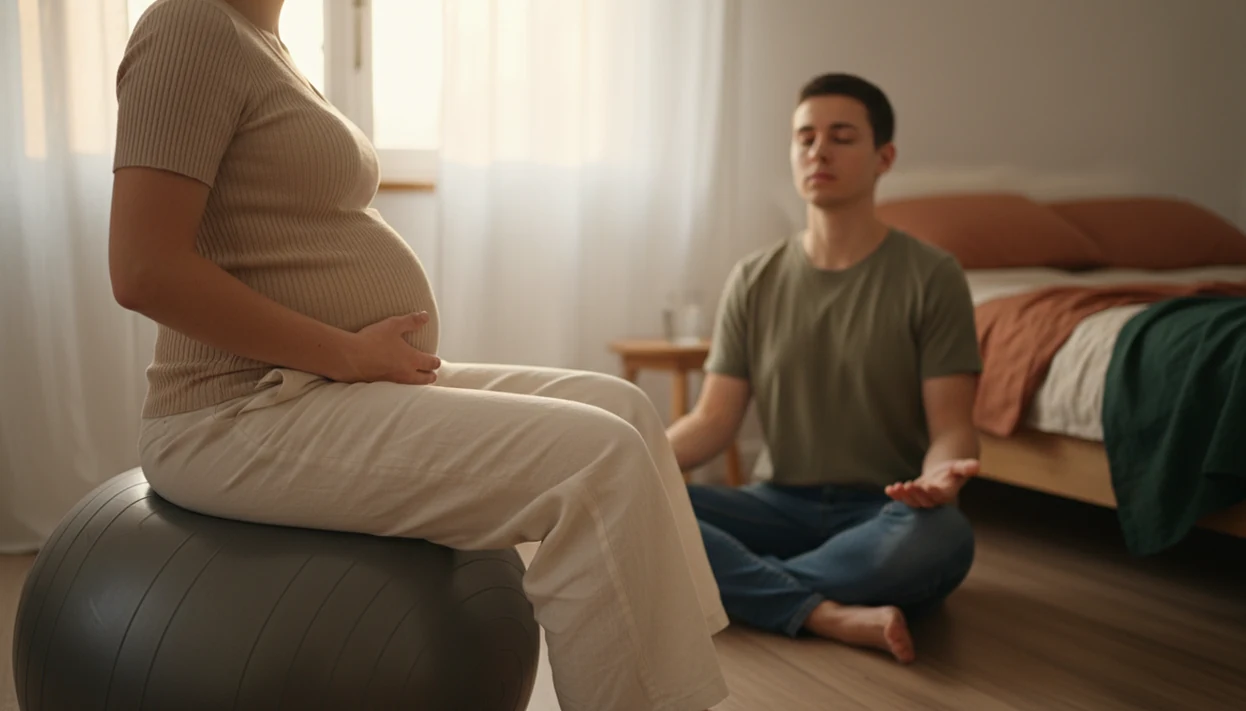
Use an image of a pregnant person practicing calm breathing with a partner nearby in a non-clinical birth-preparation setting. A living room chair, prenatal class mat, or quiet bedroom scene works better than a dramatic delivery-room image.
Avoid visuals that imply a specific medical outcome, pain-free labor, or one “right” birth method. The point is familiarity, support, and steady attention before labor begins.
Caption: A short daily breathing practice can help labor cues feel familiar before birth begins.
Suggested alt text: Pregnant person practicing breathing meditation with partner support.
If a visual includes an app screen, keep it secondary. Mindful.net or another Mindfulness Practices App can appear as a practice aid, not the focus of the birth scene.
Labor Breathing Meditation Limits
- Breathing meditation cannot prevent, diagnose, or treat pregnancy or birth complications.
- It must not delay urgent care, fetal monitoring, medication, surgery, or any intervention recommended by qualified clinicians.
- Evidence is mixed, and breathing may not help during intense pain, long labor, fear, trauma responses, or exhaustion.
- For anxiety before labor, pregnancy anxiety meditation may offer grounding, but urgent symptoms and clinical concerns require qualified birth professionals.
Labor breathing questions
Does breathing meditation reduce labor pain?
Breathing meditation may help some people cope with pain by steadying attention and easing tension. It does not guarantee less pain or a shorter labor. Evidence is mixed, and breathing is often studied alongside other comfort measures. You can use it while also choosing medication or other pain relief.
When should I start practicing breathing for labor?
Practice during pregnancy rather than trying a new pattern for the first time in active labor. A 3 to 5 minute rehearsal most days in late pregnancy can make the cues familiar. Ask your maternity clinician about suitability first if you have pregnancy complications, breathing concerns, or a planned intervention.
How should I breathe during contractions?
Begin with your natural breath, then allow a gentle, slightly longer exhale if comfortable. An inhale for 3 counts and exhale for 4 or 5 is an optional rehearsal, not a rule. Release your jaw or shoulders on the out-breath, and follow your birth team's instructions when they give specific guidance.
Can my partner help me breathe during labor?
A partner can stay nearby, model comfortable breathing, or offer one agreed cue, such as “soft jaw” or “one breath at a time.” Agree on useful words before labor and allow them to change. Support should not become repeated correction, forced counting, or pressure to keep using a technique.
What if labor breathing makes me dizzy or panicky?
Stop the pattern and return to normal breathing. Rapid or excessively large breaths can cause dizziness, tingling, and panic-like sensations, so taking more air is not necessarily helpful. Tell your birth team about symptoms, especially if they persist or feel urgent. Breathing practice must never delay clinical assessment.
Can I use breathing meditation with an epidural?
Yes, breathing meditation can sit alongside an epidural, induction, or other medical care as an attention and comfort tool. It is not an alternative you must exhaust before requesting pain relief. Keep the breath comfortable and follow your birth team's guidance if your situation or care plan changes.
Is labor breathing meditation the same as hypnobirthing?
No. Labor breathing meditation uses attention to breathing, relaxation, and brief cues without requiring a scripted hypnosis program. Some elements may overlap with hypnobirthing, but you can practice breathing meditation on its own. Neither approach should be treated as a guarantee of pain-free birth or a particular medical outcome.