
Mindfulness for Remote Work: Focus, Breaks and Workday Boundaries


Mindfulness for remote work means using short awareness practices to support focus, boundaries and transitions while working from home. It involves paying calm, non-judgmental attention to your body, screen habits, tasks and emotions, not just sitting down to meditate. A practical starting routine is to pause before opening your laptop, take screen-free breaks, reset before meetings and mark the end of work with a clear stop ritual.
Use practices lasting 30 seconds to five minutes at moments already built into your day. Notice tense shoulders before replying to a message, or take one breath before switching tabs. These pauses support attention and stress regulation, but they work alongside clear hours, movement, communication and realistic workloads, not instead of them.
The essentials
- Use 30-second to 5-minute practices throughout the day instead of relying only on long meditation sessions.
- The most useful home office mindfulness habits are start-of-day anchors, screen breaks, meeting resets, and end-of-day transitions.
- Mindfulness supports focus and stress regulation, but it works best with clear work hours, movement, communication, and realistic workloads.
Remote work mindfulness in a screen-heavy home office
Remote work mindfulness is not only seated meditation; it is attention practice during ordinary work moments. It can happen before a video call, while noticing tense shoulders, or during the small pause before replying to a message.
Working from home brings specific friction. Boundaries blur. Digital distractions multiply. Isolation can build quietly. Task switching becomes easier when email, chat, documents, and errands live within the same few steps. A kitchen chair can become a desk, lunch spot, and late-night “just one more thing” station.
Tools like this can help, but the core skill is simple: notice what is happening, then choose the next action with more care.
Remote work mindfulness is secular, practical, and beginner-friendly. It asks for repeatable cues, not a belief system.
Feet on carpet. Laptop still closed.
Five remote work mindfulness facts beginners should know
- Mindfulness includes micro-practices. Breathing before meetings, checking device habits, and pausing before chat replies all count as remote work mindfulness.
- Remote workers need boundary rituals. Home and work often share the same room, so a start cue and stop cue help mark role changes.
- Short practices are usually more sustainable than long daily sessions. For busy remote workers, 30 seconds repeated five times often beats one idealized session that never happens.
- Environmental cues make practice easier. A dedicated workspace, notification rules, and a visible timer reduce the need for willpower.
- Mindfulness complements other supports. It does not replace workload management, movement, sleep, ergonomic setup, or clear communication.
A 2020 workplace mindfulness meta-analysis found small-to-moderate improvements in employee well-being and stress. A 2020 randomized trial of remote workers reported lower perceived stress and anxiety symptoms after an online mindfulness program. Supportive, yes. Not magic.
For beginners, short remote work mindfulness practices are often easier to maintain than long meditation sessions because they attach to moments already in the workday.
Notice, pause, choose and return to your task
Mindfulness for remote work works by training a notice-pause-choose-return loop: you spot what is happening, create a brief gap, choose the next useful action, and come back to the task. It does not make the workload smaller; it changes the timing of your response so autopilot has less control.
Cues make the loop easier to remember. A new tab, a sharp message, or the first seconds of a meeting can become a signal to interrupt reactive clicking, typing, or multitasking. Body signals help too: tight shoulders, shallow breath, dry eyes, or a clenched jaw can tell you that stress or fatigue may be building, without treating those sensations as a diagnosis.
- Notice the cue, such as a notification, meeting link, or urge to switch tabs.
- Pause for one breath before acting.
- Choose the next intentional move: reply, wait, listen, stand, or return to the priority.
- Return to the work with a little more steadiness.
The five-step mindfulness routine below turns this mechanism into a repeatable remote workday structure.
Remote work attention loop for meetings, tabs, and deadlines
Mindfulness for remote work works through a simple attention loop: notice, pause, choose, return. You notice the impulse to open another tab, pause for one breath, choose the next useful action, and return to the task or conversation.
That loop interrupts autopilot. It helps when reactive messaging takes over, when a meeting ends and your hand jumps to the inbox, or when work slides past the stop time without a real decision. The point is not to become calm on command. It is to catch the moment sooner.
Body awareness matters here. Shallow breathing, dry eyes, tight jaw, and restless legs can be early signals of stress, fatigue, and screen strain. The full screen-specific version is covered in mindfulness for screen fatigue.
Remote work also removes built-in transitions. No commute. No hallway. No room change after a meeting. Mindful transitions replace some of that missing structure with deliberate starts, pauses, and endings.
Research links mindfulness training with reduced stress, better focus, and less mind-wandering for many workers, though results vary by person and workplace.
Five-step mindfulness routine for a remote workday
Use this routine as a copyable work-from-home structure. It is built for normal days, not retreat conditions.
- Set a start-of-day anchor. Before opening email or chat, sit down, feel your feet, and take three slow breaths.
- Choose one priority and one boundary. Name the main morning task and one limit, such as “no messages until 10:00.”
- Take a screen break between work blocks. Stand or look away for 60 to 90 seconds, and notice breath, posture, and light.
- Reset before meetings. Place both feet down, soften your shoulders, and choose one intention, such as “listen before solving.”
- Close with a shutdown ritual. Write tomorrow’s first task, close the laptop, and say one clear sentence: “Work is complete for today.”
If you want more options for short pauses, try mindfulness exercises for work.
Mindful remote work routine table for home office transitions
A mindful remote work routine works best when each practice is tied to a specific moment. The best practice is the one you will actually repeat when the day gets busy.
| Work moment | Mindfulness practice | Time needed | Purpose |
|---|---|---|---|
| Before opening laptop | Three breaths with feet on floor | 30 seconds | Start with intention |
| After checking messages | Notice body tension before replying | 30 seconds | Reduce reactive responses |
| Between tasks | Stand, exhale, name the next task | 60 seconds | Support task switching |
| Before video calls | Posture reset and one listening intention | 1 minute | Improve presence |
| After difficult messages | Pause before drafting a response | 2 minutes | Create emotional space |
| Lunch break | Eat without the work screen for a few bites | 3 to 5 minutes | Mark a real break |
| Afternoon slump | Screen-free body scan | 2 minutes | Notice fatigue |
| End of day | Shutdown sentence and laptop closed | 1 minute | Separate work from home |
Small cues carry the routine. A notebook open after practice can be enough.
Best work from home mindfulness practices for focus and boundaries
These five practices fit busy remote work because they are short, concrete, and easy to repeat.
- The laptop breath: Use before opening your laptop. Take one breath before the screen lights up, then name what you are starting.
- The tab-switch pause: Use when you notice restless clicking. Stop for one breath and ask, “What am I avoiding or looking for?”
- The meeting doorway reset: Use before video calls, even if the doorway is imaginary. Sit upright, relax your face, and choose how you want to show up.
- The screen-free body scan: Use between deep work blocks. Notice eyes, jaw, shoulders, back, and tight calves against the chair or floor.
- The shutdown sentence: Use at the end of the day. Say or write, “I am stopping work now,” then close the workspace.
Mindfulness practices and meditation techniques for beginners and daily life deliver repeatable attention cues, not a guaranteed fix for overload. For a wider focus plan, compare these with mindfulness practices for focus.
Reduce interruptions before asking yourself to focus harder
A tab-switch pause can help you catch an impulse, but it cannot stop a stream of notifications. Research on interruptions in digital workplaces describes how messaging and other interruptions can increase mental workload, frustration and attentional conflict. Pair mindfulness with changes to the system that keeps pulling your attention away.
Agree with colleagues on notification-free work blocks, set times for checking email and chat, and one channel for genuinely urgent matters. At the start of a block, silence unnecessary alerts and name the task you intend to finish. If your role requires immediate responses, ask for a coverage arrangement rather than treating every interruption as a failure of concentration.
Home office mindfulness for meetings, messages, and isolation
Home office mindfulness also applies to relationships. On video calls, mindful listening means sitting with stable posture, looking toward the speaker when possible, doing one task at a time, and noticing reactivity before jumping in.
Messages need the same care. If a Slack or email lands badly, pause before answering. Feel your hands on the keyboard, read the message again, and draft the plainest useful response. For email-specific routines, mindful email practice gives a simple structure.
Remote workers can also use mindfulness to notice loneliness without judging it. That might sound small, but naming “I feel disconnected today” can lead to a better next step.
Pair the awareness with practical outreach. Schedule a check-in. Ask for clearer expectations. Step away from chat after intense threads. Mindfulness helps you see the pattern, but it does not replace healthy team culture.
The quiet gets loud sometimes.
Protect the gap between video meetings
A meeting reset needs time on the calendar, not just an intention to pause. Guidance on recovery during and between videoconferences recommends looking away from the screen, standing up and walking around. Put this into practice by arranging for meetings to end five to ten minutes before the next commitment, then keep that interval free of email and chat.
During the gap, stand, look beyond the screen and notice any tension left from the previous conversation. Before returning, name the next task or meeting purpose. Research has associated fewer breaks between video meetings with greater exhaustion. Camera-off participation may also help when visual presence is unnecessary, although a systematic review of remote work rated the evidence for such protective factors as low or very low strength.
Best-fit and poor-fit remote work mindfulness routines
Remote work mindfulness fits some situations well and fits others poorly. Use it as a support tool, not a way to excuse broken systems.
| Fit | Good match | Poor match |
|---|---|---|
| Boundaries | Blurred start and stop times | Chronic overwork with no authority to change hours |
| Screen load | Screen fatigue and restless tab switching | Untreated ergonomic strain or vision problems |
| Meetings | Meeting overload and reactive replies | A culture that ignores meeting norms |
| Practice style | Beginners who want short practices | People expecting long meditation to solve everything |
| Stress support | Early awareness of tension and fatigue | Replacement for sleep, movement, childcare, or care from a qualified professional |
For remote workers with blurred boundaries, a short start-and-stop ritual is often more useful than an open-ended meditation goal because it changes the shape of the workday.
The routine still has to meet your real calendar.
Evidence for remote work mindfulness and workplace stress
Evidence for remote work mindfulness is supportive, but not definitive for every person or workplace. The strongest findings suggest modest benefits when people practice consistently and when the work setting allows reasonable boundaries.
In a 2020 randomized controlled trial of remote workers during COVID-19, an 8-week online mindfulness program produced a 32% reduction in perceived stress scores and a 29% reduction in anxiety symptoms compared with controls (source: NIH research). A 2020 workplace mindfulness meta-analysis found small-to-moderate improvements in psychological well-being and stress across multiple sectors (source: PubMed research).
A 2018 app-based mindfulness trial also reported improved workplace focus and reduced mind-wandering after 4 weeks of short daily practice (source: PubMed research). Remote-work stress is a workplace concern, but a systematic review of remote work and health found mixed outcomes shaped by workload, work-home boundaries, work design and technology use.
Clinicians typically recommend mindfulness as a supportive stress-regulation skill, not as a replacement for diagnosis, therapy, medication, sleep, or workplace changes when those are needed. A timer, calendar reminder, or short guided-audio library can make practice easier to start without turning mindfulness into another productivity demand.
A home office setup with a clear start and stop
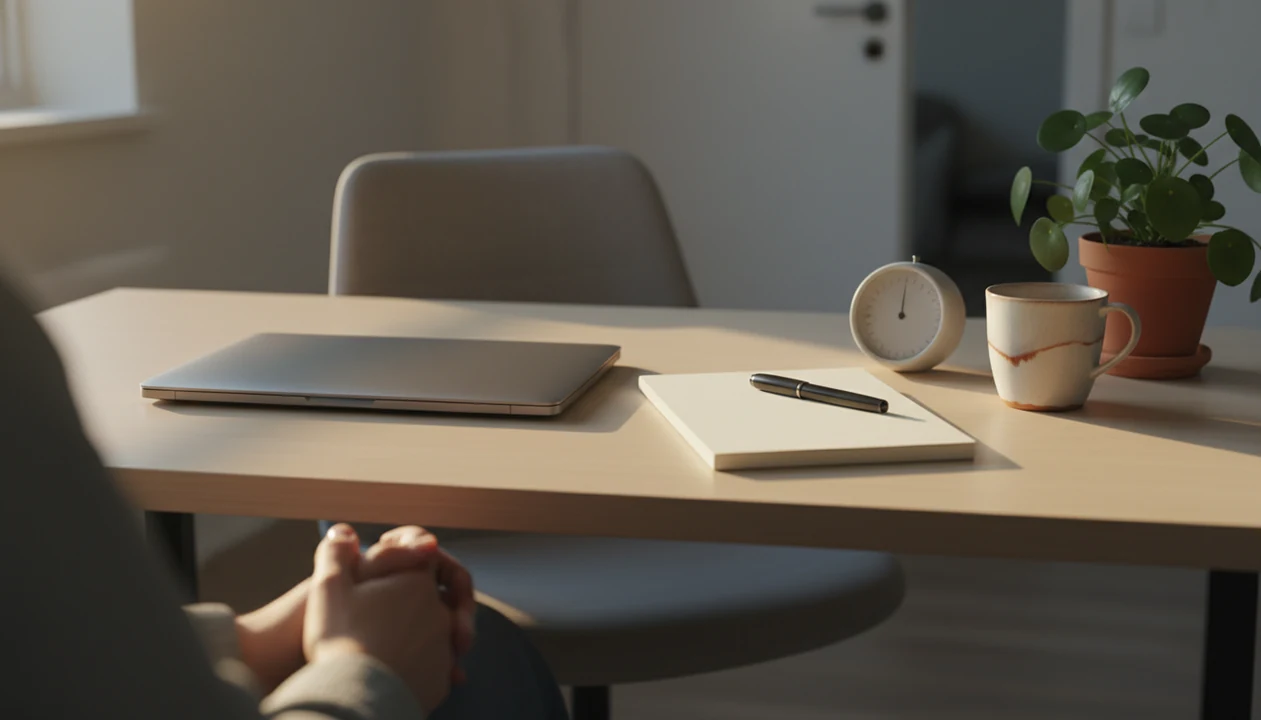
A useful image for this page would show a calm home office desk with the laptop closed, a notebook, a glass of water, and a visible timer or small plant. The scene should look ordinary, not staged like a luxury workspace.
Caption: A home office mindfulness routine can begin with a start-of-day anchor, continue through screen breaks and meeting resets, and end with a shutdown ritual that separates work from home.
Suggested alt text: Home office mindfulness setup with closed laptop, notebook, water glass, timer, and plant for a mindful remote work routine.
The laptop being closed matters. It shows the pause before the workday starts, which is often where the habit becomes real.
Remote Work Mindfulness Limits
- Mindfulness cannot fix unreasonable workloads, toxic management, unclear expectations, or constant availability norms, so reset routines that encourage blaming yourself.
- Mindfulness does not replace childcare, sleep, movement, ergonomic support, or real social connection.
- Evidence specific to remote work is growing, but many studies have small samples, short follow-ups, or unusual pandemic conditions.
- Seek professional guidance if trauma, severe anxiety, or depression makes breath or body practices uncomfortable.
Remote work mindfulness questions
How do I start a mindful workday without a commute?
Before opening email or chat, feel your feet on the floor and take three comfortable breaths. Name one priority and one boundary, such as a planned stop time. Use the same cue each morning to mark the change from home time to work time. You do not need a separate office.
Can mindfulness help me stop switching tabs while working?
It can help you notice the impulse before acting on it. Pause for one breath, ask what you are looking for or avoiding, then return to the next useful action. Reduce unnecessary notifications too. Mindfulness does not remove interruptions, unclear tasks or a workload that requires constant switching.
What can I do before a stressful video call?
Put both feet down, soften your shoulders and notice your breathing without forcing it. Choose one practical intention, such as listening before responding or asking for clarification. This reset does not guarantee calm or resolve the meeting's problem, but it gives you a moment to choose how to participate.
Should I turn my camera off to reduce video meeting fatigue?
Camera-off participation may help when visual presence is unnecessary and the group permits it. Some research links camera and microphone choices with protective effects, but the evidence is weak. Also consider meeting length, breaks and the demands of the conversation rather than assuming the camera is the only cause of fatigue.
How do I stop thinking about work after closing my laptop?
Use a repeatable shutdown cue: name what remains unfinished, identify the next action for tomorrow and close your work tools. Then move away from the workspace or take a short screen-free pause. Thoughts may still return. The aim is to mark a boundary, supported by clear expectations about after-hours messages.
Is mindfulness enough for work-from-home burnout?
No. Mindfulness may help you notice tension, fatigue and reactive habits, but it cannot fix excessive workloads, poor management or constant availability expectations. Those require changes to work conditions. Persistent distress may need professional support, and breath or body practices can be uncomfortable for some people with trauma histories, anxiety or depression.
What if focusing on my breath makes me uncomfortable at my desk?
Do not force a breath exercise. Try looking away from the screen, noticing sounds in the room or taking a short walk instead. Mindfulness does not require breath focus. If practices repeatedly increase distress, stop and seek professional guidance rather than trying to push through the discomfort.