
Mindful Commuting: Eyes-Open Practices That Keep Safety First


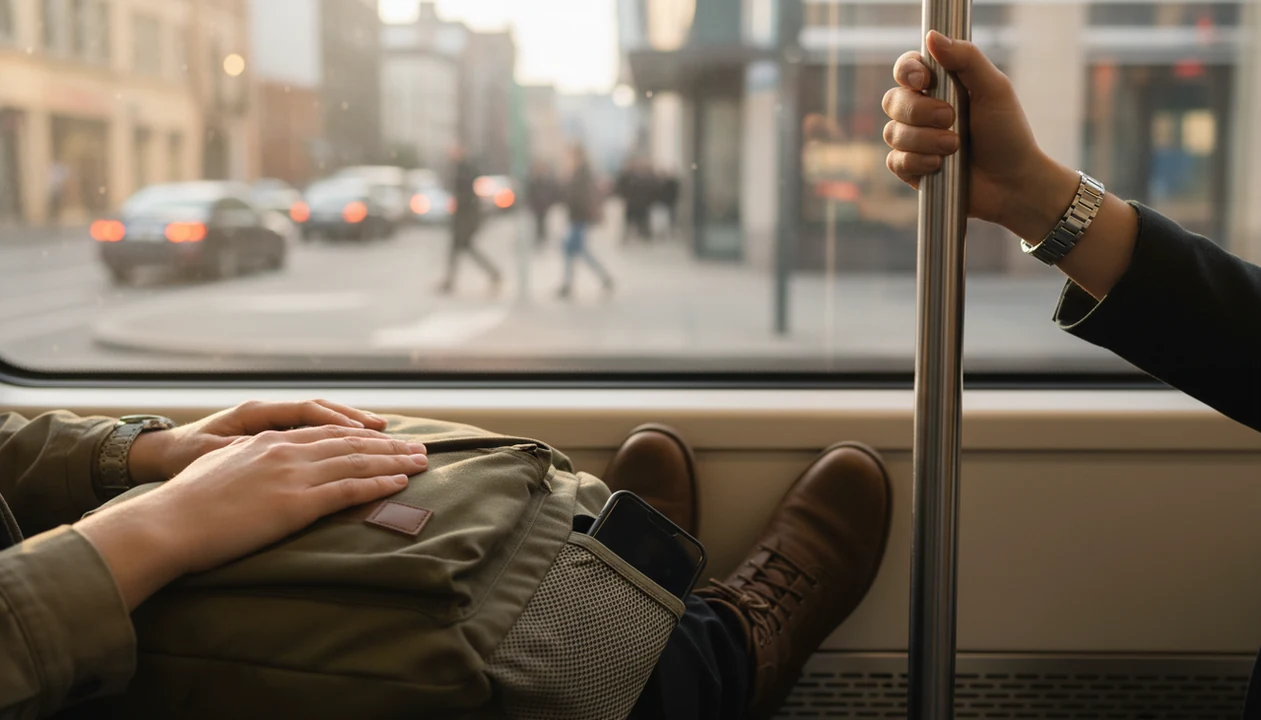
Mindful commuting means noticing breath, posture, sounds, footsteps, or physical contact during travel while keeping your surroundings and safety in view. These are short, eyes-open practices, not a way to zone out. Walking, public transport, and passenger rides offer useful anchors such as feet on the floor, seat support, hand contact, and step rhythm, provided the practice does not interfere with balance, exits, or awareness.
Driving needs a stricter boundary: road attention comes first. Keep any posture awareness brief and road-aware, and leave formal meditation or breathing exercises for before departure or after parking. Drivers should not follow guided meditations, close their eyes, control their breathing, or use a phone for practice. On any commute, stop the exercise as soon as conditions require more attention.
What matters most
- Mindful commuting means staying present during travel, not zoning out, closing your eyes, or ignoring your surroundings.
- Drivers should not use guided meditations, deep breathing drills, or any practice that competes with road attention.
- Public transit, passenger, and walking commutes are best suited to simple anchors such as feet, seat support, hand contact, sounds, and step rhythm.
Safe Mindful Commuting Exercises by Commute Type
| Commute type | Safe anchor | What to avoid | Best moment to practice |
|---|---|---|---|
| Driving | Posture, seat contact, jaw tension, hands feeling a steering wheel | Guided meditation, eyes closed, breath control, phone use | Complete stops only, or low-demand cruising with full road attention |
| Public transport | Feet on floor, seat support, hand on pole, ambient sounds | Blocking exits, staring hard at people, losing track of belongings | Seated periods, stable standing, waiting away from platform edges |
| Walking | Heel-to-toe steps, step counting, upright posture, traffic scanning | Looking down, slowing suddenly, headphones that isolate sound | Simple sidewalk blocks between crossings |
| Passenger | Breath, scenery, seat contact, short guided audio | Motion-sickness triggers or ignoring stops | Calm stretches when someone else handles navigation |
Safe mindful commuting starts with the commute type, not the technique. The same breath practice that feels fine on a train may be unsafe behind the wheel.
For drivers, the road stays primary. For walkers, the curb wins. For transit riders, exits and balance matter more than finishing a practice.
Daily Travel Attention: How Mindful Commuting Works
Mindful travel is present-moment attention while you are in motion, using a safe anchor and returning to it when attention drifts. The anchor might be a normal breath, upright posture, foot pressure, surrounding sound, or the steady rhythm of walking.
Think of it as attention training, not a special mood. You may notice tomorrow’s warehouse shift, warm cheeks after a brisk walk, or the urge to mentally solve one more problem. Then you return to what is actually happening now.
Commute-specific research is limited, so claims should stay careful. Broader mindfulness research suggests modest benefits for perceived stress and anxiety, including meditation-program evidence reviewed in JAMA Internal Medicine (PubMed research) and mindfulness-based intervention evidence for anxiety symptoms (PubMed research). Mindfulness practices and meditation techniques for beginners and daily life can build attention and recovery skills, not erase hard commutes or replace care.
What workplace studies can tell commuters
Workplace research offers context, not direct proof that a brief commute exercise reduces stress. A 2019 randomized trial comparing two mindfulness programs found that six weeks of training reduced perceived and momentary stress compared with a single-day intervention. That finding supports repeated practice, but it does not establish a benefit from a few breaths on a bus. For founders facing a demanding workday, meditation for startup stress offers short resets after the commute ends.
Results are not uniformly positive. A 2014 worksite trial of a multicomponent health program found no significant improvements in mental health, work engagement, need for recovery, or mindfulness after six or 12 months. Treat commuting practice as an optional attention exercise, not a guaranteed stress treatment or a reason to tolerate unsafe travel conditions.
5 Steps for Commute Mindfulness Without Distraction
Use mindful travel as a brief routine, not a trance. We usually suggest small, natural segments: the parking garage stairs, the sound of gym locker metal nearby, or three ordinary breaths while waiting safely. Shorter practice is often the better choice when your surroundings require active attention.
- Your surroundings take priority. Keep your eyes open and skip any exercise that competes with traffic awareness, balance, finding your route, or access to exits.
- Choose one anchor. Pick breath, posture, feet, hand contact, sounds, seat support, or steps for one segment of the trip.
- Practice for 30 to 90 seconds. Try waiting at a stop, sitting on the train, walking one block, or arriving before opening your laptop. After arriving safely, try calming presentation nerves before your next talk, rather than rehearsing while driving.
- Return attention gently. When the mind jumps to a message you need to answer, notice it and return without making a project of it. Once you arrive, try these ways to stop procrastination if returning attention reveals a task you have been avoiding.
- End before complexity. Stop formal practice before crossings, boarding, crowded movement, driving decisions, or any moment that needs quick action.
For office transitions after arrival, mindfulness between tasks uses the same short-attention pattern. Leaders can use meditation for CEOs to practice brief focus resets between meetings once they arrive at work.
Mindfulness on Public Transport: Seats, Stops, Sounds, and Crowds
Mindfulness on public transport can be practiced without silence or stillness. Buses, trains, and subways already offer anchors, including movement, pressure, sound, and changing scenery.
- Feet-on-floor check: Notice both feet touching the floor for three breaths, especially after sitting down.
- Hand-on-pole awareness: Feel the hand’s contact with the pole or strap while keeping space for others.
- Stop-by-stop reset: At each stop, check posture, belongings, and the nearest exit before returning to your anchor.
- Soundscape listening: Hear engine noise, doors, footsteps, and announcements without needing them to be pleasant.
Keep belongings secure. Don’t block doors. Pause when boarding, standing in a crowd, or moving near a platform edge.
Phone away for one stop is enough. You don’t have to turn the whole ride into a retreat.
Mindful Walking Commute Practices for Sidewalks and Crossings
- A mindful walking commute works well because every step gives you a natural attention anchor.
- Heel-to-toe awareness means feeling the heel land, weight roll, and toes push off while your eyes keep scanning ahead.
- Step counting can be simple: count ten steps, then start again without changing your pace.
- Posture noticing means checking shoulders, jaw, backpack weight, and breathing without trying to look “meditative.”
- Stop formal practice at curbs, intersections, driveways, bike lanes, crowded areas, and anywhere decisions are needed.
Mindful walking is not looking down at your shoes. It is not moving slowly where people need to pass. It also does not pair well with isolating audio near traffic.
For post-walk focus at work, mindfulness practices for focus can help extend the same skill indoors. If your workday includes frequent online meetings, these video call fatigue tips can support less draining calls after arrival.
Driving Commute Mindfulness Rules for Road Attention
Can I practice mindfulness while driving? Only in a very limited way, and the road must remain the main object of attention.
This matches distracted-driving guidance from the National Highway Traffic Safety Administration, which treats any activity that diverts attention from driving as a safety risk: Distracted Driving
Driving is not the place for eyes-closed meditation, guided visualization, breath control, writing practice, or screen-led prompts. No wellness cue is worth split attention in traffic. Use only low-demand awareness: hands on the wheel, body contact with the vehicle, upright posture, dry lips, an itchy forehead, and one normal breath at a complete stop.
The road, mirrors, pedestrians, signals, speed, and changing traffic stay primary. If attention narrows inward, stop the practice.
Heavy traffic, bad weather, unfamiliar routes, fatigue, anger, or reduced alertness call for your full attention, not a mindfulness exercise. That last one matters. If you feel foggy, your practice is safe driving, not mindfulness technique.
Best-Fit and Skip-It Mindful Commuting Scenarios
| Best fit | Skip it |
|---|---|
| Routine transit rides | Active driving tasks |
| Waiting periods at safe distances | Unsafe neighborhoods requiring full vigilance |
| Seated passenger time | Crowded boarding or platform movement |
| Simple walking segments | Cycling in traffic |
| Brief transitions before or after work | Motion sickness, panic-level distress, or urgent decisions |
Mindful commuting usually works best when the environment is predictable, while skipping practice fits situations that require fast judgment or full vigilance. Longer commuting time has been associated with worse subjective wellbeing in a 2013 study, which makes safe stress-reduction strategies relevant. It does not make mindfulness a fix for poor commute conditions.
If the stressful part is the workday after the ride, how to practice mindfulness at work may be the more useful next step.
When to Stop Practicing and Get Help
Stop practicing the moment mindfulness makes the commute less safe, less clear, or harder to respond to. Getting help is appropriate when panic, dissociation, unsafe urges, or severe sleepiness keeps returning during travel.
Use this as a safety sequence, not a test of discipline:
- Narrowing attention, unsteady balance, or more demanding traffic, crowds, weather, or route choices are reasons to stop the exercise immediately.
- Prioritize practical safety if you feel followed, threatened, disoriented, or unsafe. Move toward people, lighting, staff, a safer route, or a place where you can call someone.
- Do not push through panic-level distress or heavy fatigue with breath work or attention drills. If you are driving and feel impaired, pull over safely or change plans.
- Contact support when panic attacks, dissociation, or unsafe urges are recurring. A clinician, crisis line, trusted person, or local emergency resource belongs ahead of commute practice.
- Change the commute first when the route itself is the problem. Adjust timing, transport mode, seating, walking path, or support before adding attention exercises.
Image Caption: Eyes-Open Commute Mindfulness Anchors
Suggested image: a commuter seated on public transit with eyes open, feet grounded, one hand near a pole or bag, and phone put away. The scene should look ordinary, not staged like a meditation class.
Caption: Safe mindful commuting exercises can use feet, seat support, hand contact, ambient sounds, and awareness of exits while the commuter stays alert.
Alt text: Person practicing mindful commuting on public transport with eyes open, feet grounded, and phone put away.
Avoid images of closed eyes on trains, headphones while crossing streets, or drivers meditating in traffic. Those visuals teach the wrong safety message.
Save timed practice for after arrival
After parking or reaching a safe seated spot at your destination, a short practice can mark the end of the commute. The free online meditation timer can time that pause; the Mindful.net app also offers short guided meditations. During driving, crossings, boarding, or crowded platform movement, direct attention to your surroundings instead. No timer or audio instruction is needed for those parts of the trip.
Mindful Commuting Limits
- Mindful commuting cannot replace safe driving, defensive awareness, or transit situational awareness.
- Commute research is limited, and evidence for stress and anxiety benefits is modest, not dramatic or guaranteed.
- Keep apps away during driving, boarding, crossings, and crowded movement, and avoid guided audio when driving or on crowded transit.
- Noise, crowding, complex traffic, fatigue, motion sickness, or unsafe surroundings can make practice impractical.
Mindful commuting questions
Can I meditate while driving?
Do not do formal meditation while driving. Avoid guided audio, closed eyes, breath control, and phone prompts, including while stopped in traffic. Any brief awareness of posture or seat contact must leave road attention intact. Save a dedicated practice for before departure or after parking safely.
How do I practice mindfulness on a bus or train?
Once seated or standing securely, notice your feet, seat support, or hand contact with a pole for a few ordinary breaths. Keep your eyes open and remain aware of announcements, belongings, and exits. Stop when boarding, getting off, or moving through a crowd requires your attention.
How can I walk mindfully without missing traffic?
On a straightforward sidewalk segment, notice the pressure and rhythm of your steps while continuing to scan ahead. Keep your usual pace rather than staring at your feet. Stop counting steps or following an anchor at crossings, driveways, bike lanes, and anywhere you need to make a safety decision.
Should I listen to a guided meditation during my commute?
Not while driving. Guided audio may suit a seated passenger or a safe, quiet transit period, but skip it when it interferes with announcements, awareness, or responding to others. Crowded boarding and platform movement are poor settings for audio instructions. You can practice with physical contact or surrounding sounds instead.
How long should a mindful commuting practice last?
Start with 30 to 90 seconds during a safe segment of the trip. A few ordinary breaths or ten noticed steps can be enough for a brief attention exercise. There is no need to fill the whole commute. End sooner whenever traffic, balance, crowding, or route choices need more attention.
Does mindful commuting reduce stress?
It may help, but commute-specific evidence is limited. Workplace studies have found benefits from repeated mindfulness training, while other programs have shown no significant improvement. Those results do not prove that a short commute exercise will reduce your stress. Treat it as optional practice, not a guaranteed remedy.
What should I do if mindfulness makes me anxious on the train?
Stop the exercise rather than trying to push through it. Return attention to practical needs: where you are, your belongings, the next stop, and available staff or help. Seek professional support if panic or dissociation keeps returning during travel. Mindfulness is not a substitute for care or immediate safety.
Can I practice mindful breathing while commuting?
As a passenger or while waiting safely, you can notice ordinary breathing without changing its depth or timing. Keep your eyes open and awareness broad enough to respond to your surroundings. Drivers should save breathing exercises for before departure or after parking, rather than adding a task to driving.