
Desk Meditation: Short Practices Between Work Tasks


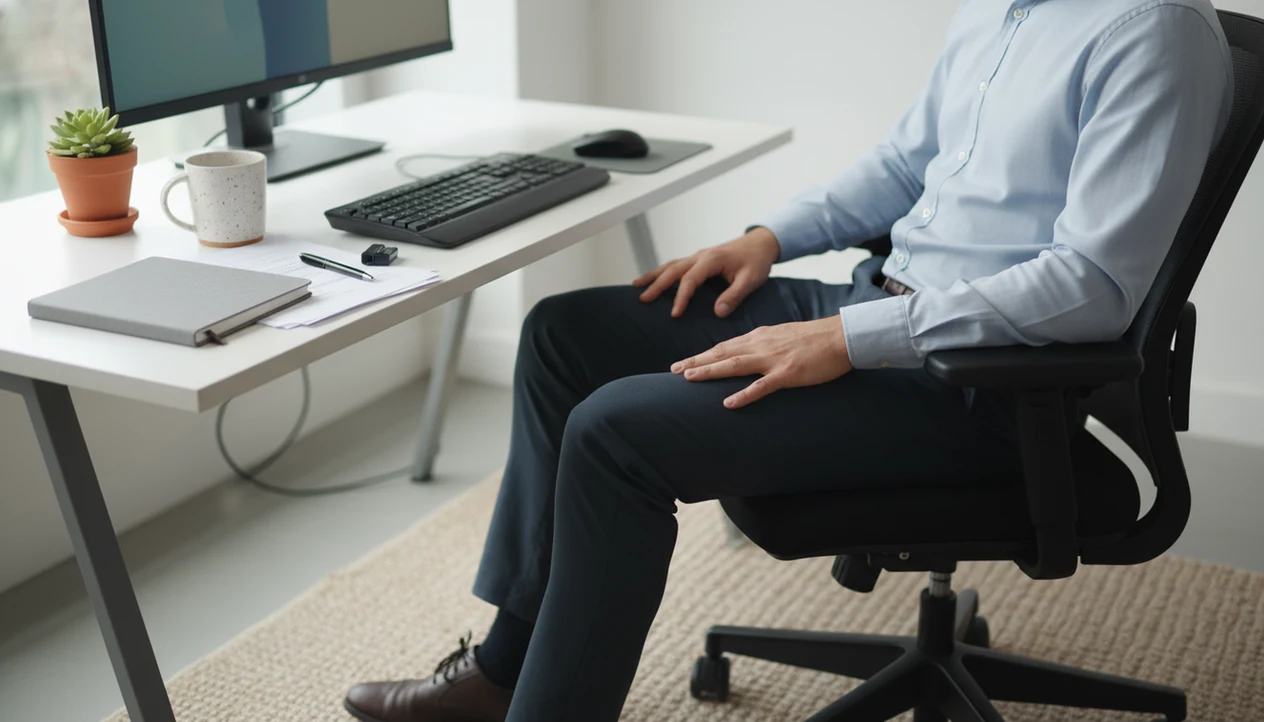
Desk meditation is a brief, secular mindfulness practice done seated or standing at your workstation to reset attention and notice breathing and body sensations. It needs no special equipment, private room, or change of clothes. Options include a 20-second breath reset, a 1-minute body scan, sensory grounding, gentle micro-stretches, and a pause between tasks. These are beginner-friendly workday practices, not medical treatment or a productivity trick.
Start with 20 seconds to 5 minutes before a meeting, after an email, or between focus blocks. Keep your posture ordinary and your eyes open or softly lowered. Choose one thing to notice, such as your feet on the floor, then return to it when attention wanders. Aim for a repeatable pause rather than a longer session you cannot fit into the day.
Definition: Desk meditation is meditation adapted to a workstation: brief, secular mindfulness practices done while seated or standing near your desk during a normal workday.
At a glance
- Start with 20 seconds to 5 minutes; consistency matters more than duration.
- Use desk meditation before meetings, after emails, between focus blocks, or when stress builds.
- Keep it subtle: eyes open or softly lowered, normal posture, no cushion, headphones, or private room required.
Best desk meditation practices for a normal workday
The most useful desk meditation practices are short, quiet, and easy to repeat without changing clothes, moving rooms, or explaining yourself. Mindful.net favors practices that fit real work moments, like the minute after sending a tense email.
- Three-breath reset: best for stress. Take three slow, natural breaths before replying or joining a call. Before speaking to a group, try strategies to calm presentation nerves alongside a brief, natural breathing pause.
- 1-minute body scan: best for scattered focus. Move attention through feet, seat, spine, shoulders, jaw, face, and hands.
- Sensory grounding: best for office noise. Notice sounds and sights instead of fighting them.
- Mindful micro-stretching: best for physical tension. Roll shoulders, soften the jaw, and circle wrists slowly.
- Task-transition pause: best for post-task reset. Stop for 20 seconds before opening the next tab.
Small counts.
For a wider set of short pauses, Mindful.net also organizes mindfulness exercises for work by break length and setting.
How desk meditation works in the brain and body
Desk meditation works by training attention: you notice the breath, body, sound, or sensation, then return when the mind wanders. That “notice and return” loop is the practice, even when your mind jumps to a grocery list.
During work stress, the brain often runs on reactive autopilot. A short pause can shift attention from instant response into deliberate awareness. Slower breathing and tension release may also help the body settle, though desk meditation should not be treated as a medical intervention.
Research on workplace mindfulness is cautiously encouraging, but not desk-specific. A meta-analysis of workplace mindfulness interventions found small-to-moderate improvements in stress, distress, and well-being outcomes across structured programs, not isolated one-minute pauses (PubMed research). A brief-meditation study also found that a 10-minute mindfulness exercise improved attention-task performance in novices, but it did not prove long-term workplace productivity gains (Full).
How to use desk meditation between work tasks
Use desk meditation as a transition ritual before calls, after emails, or between focus blocks. You do not need to look like you are meditating; eyes can stay open or softly lowered. Beyond the workstation, mindful commuting practices can support awareness while keeping safety and attention on your surroundings.
- Set a tiny window, such as 20 seconds, 1 minute, or a phone timer set for 5 minutes.
- Sit naturally with both feet on the floor and your shoulders easy, not staged.
- Choose one anchor, such as breathing, feet on carpet, sounds, or the weight of your body in the chair.
- Notice distraction without scolding yourself, then return to the anchor once.
- End by naming the next task: “Open the agenda,” “Reply to one email,” or “Join the call.”
Mindful.net uses this same transition logic in its guide to mindfulness between tasks, where the goal is less mental residue between work blocks.
Brief pauses are not the same as a six-week course
A desk pause can be a starting point, but the research does not establish that a few breaths deliver the effects of a structured program. In a trial comparing six weeks of mindfulness training with a single-day intervention, the longer program reduced perceived and momentary stress and buffered worsening affect and coping efficacy. That supports repeated training, not a promise of immediate relief from every short pause.
Focus and productivity also need to be kept separate. In a randomized trial of 60 employees, a six-week program improved attentional focus and reduced work-life conflict more than a half-day seminar. Productivity improved similarly in both groups. Try a desk pause as a way to direct attention toward the next task, rather than treating it as a proven method for getting more work done.
How these practices fit a workstation
These options were chosen for ordinary workdays, not retreat settings. The Mindful.net standard is simple: a practice should be usable at a desk on a busy Tuesday.
- Discreet: each practice can be done with normal posture, quiet breathing, and no visible ritual.
- Short: each option fits into 20 seconds to 5 minutes.
- Beginner-safe: the instructions are simple and secular, with no special beliefs required.
- Work-mapped: each practice pairs with natural moments, such as sending an email, joining a call, or ending a focus sprint.
- Realistic: we excluded lying down, chanting, long audio, special equipment, and private-room practices.
Good mindfulness practices deliver repeatable attention training for everyday moments, not a guarantee that work will feel calm on command.
Desk pauses for meetings, messages, and focused work
Desk meditation is for people who want a subtle, secular way to pause during the workday without leaving their desk. It is especially useful for beginners and knowledge workers who move quickly between meetings, email, chat, and focused tasks.
A good fit often looks like this:
- Before a call, after a message, or between two work blocks, use a brief pause to notice where your attention is. For clinical workdays, mindfulness for nurses offers brief shift resets that can fit between care tasks.
- Keep the practice ordinary: normal posture, quiet breathing, eyes open or softly lowered, and no special language.
- Pair it with practical supports, including workload boundaries, movement breaks, screen rests, and ergonomic adjustments.
- Pause or choose an external anchor if distress, trauma symptoms, panic, or strong body discomfort is active.
- Choose a longer guided practice when you have privacy, more time, and a need for fuller settling than three breaths can offer. For changing schedules, mindfulness for shift workers offers sleep tips that complement brief pauses during work.
Desk meditation is not the best container for processing serious conflict, grief, trauma, or ongoing pain. In those moments, the kind move may be support, movement, a longer guided session, or professional care rather than forcing a tiny work pause to do too much.
Best desk meditation for stress: the three-breath reset
Can three breaths count as desk meditation? Yes, when you use them to pause, feel the body, and return attention before reacting.
Try this: inhale naturally, exhale slowly, and feel the chair supporting your body. Repeat three times. Keep your eyes open if you are in an open office. No one needs to know you are practicing.
Use the three-breath reset after a stressful message, before replying, before a meeting, or when switching contexts. The pause before answering a message is often where the practice matters most.
If three breaths make you feel more panicky, lightheaded, or trapped in your body, stop the exercise and switch to an external anchor, such as naming objects in the room. A desk pause should lower friction, not force you through distress.
Best for: an immediate pause when stress spikes. Not ideal for: deep processing of serious anxiety, conflict, or ongoing distress.
For email-specific triggers, Mindful.net covers a related mindful email practice.
Best desk meditation for focus: the 1-minute body scan
Can a 1-minute body scan help focus at work? It can give the mind a concrete anchor when attention feels scattered.
Start at the feet. Notice the seat, spine, shoulders, jaw, face, and hands. Move steadily, not perfectly. Common desk tension often shows up in the jaw, shoulders, wrists, eyes, and lower back. Sometimes the jaw unclenches behind closed lips before the mind feels settled.
The body scan works because attention has somewhere specific to land. For many beginners, body sensation is easier than trying to “clear the mind.”
Best for: focus reset and tension awareness. Not ideal for: replacing ergonomic changes, movement breaks, eye care, or medical care for pain.
For deeper focus support, compare this with mindfulness practices for focus.
Best desk meditation for office noise: sensory grounding
Can you meditate in a noisy office? Yes, because sound can become the meditation object instead of the interruption.
Try a simple 3-2-1 sequence. Notice 3 sounds, such as typing, a hallway voice, or ventilation. Let the printer hum, keyboard clatter, or Slack ping be ordinary sound for one breath instead of a problem you have to solve. Notice 2 body sensations, such as feet in shoes or the back against the chair. Notice 1 visual detail, such as the edge of your notebook or a line of light on the wall.
Meditation does not require silence or closed eyes. In an open-plan workspace, the point is to stop arguing with normal sound for a few breaths.
Best for: noisy offices and shared workspaces. Not ideal for: moments when sensory input feels overwhelming or unsafe.
Best desk meditation for body tension: mindful micro-stretches
Mindful micro-stretches combine brief movement with attention to sensation. They are awareness-based movements, not a workout, treatment plan, or physical therapy.
- Shoulder rolls: move slowly and feel the range you actually have today.
- Jaw softening: let the tongue soften from the palate and breathe normally.
- Wrist circles: make small circles, then pause before returning to the keyboard.
- Neck lengthening: sit tall without forcing the chin or pulling hard.
- Eye breaks: look away from the screen and notice distance, color, and light.
Stop before strain. That is the rule.
Best for: mild desk tension from stillness or screen work. Not ideal for: pain, injury, numbness, tingling, dizziness, or medical symptoms. For screen-heavy days, Mindful.net separates attention practice from eye-care basics in mindfulness for screen fatigue.
A timed pause between work tasks
Between a demanding email and your next call, a free online meditation timer can mark out one to five minutes without requiring a guided session. The Mindful.net app also offers short guided meditations when spoken instructions would help. For a three-breath pause, no tool is necessary. When you need movement, time away from the screen, or a conversation about workload, a timer is not a substitute.
Desk Meditation Limits
- Seek professional help for chronic anxiety, depression, trauma, burnout, or physical injury rather than relying on desk meditation.
- Short informal practices may not produce the same effects as structured mindfulness programs lasting multiple weeks.
- Meditation can sometimes surface restlessness, sadness, irritation, or uncomfortable body sensations.
- Workplace conditions can limit consistent practice, and meditation should not become a way to quietly endure harmful conditions.
Desk meditation questions
How do I meditate at my desk for one minute?
Sit comfortably with your feet on the floor. Notice contact with the chair, then move attention through your shoulders, jaw, and hands. When thoughts pull you away, return to one sensation. Finish by naming your next task. You do not need to empty your mind or feel calmer for the practice to count.
Can I meditate at work with my eyes open?
Yes. Keep your eyes open or softly lowered and choose a steady visual detail, your feet on the floor, or surrounding sounds as an anchor. Closing your eyes is not required. In a shared office, ordinary posture and quiet, natural breathing are enough for a brief practice.
How long should desk meditation take?
Start with 20 seconds to one minute, or set aside up to five minutes when your schedule allows. Choose a length you can repeat without rushing the next task. Brief pauses are not established equivalents to structured multi-week programs, so avoid expecting the same results from a few seconds of practice.
How can I meditate in a noisy office?
Make sound part of the practice instead of trying to block it out. Notice three sounds, two body sensations, and one visual detail. When a noise triggers a thought, notice that reaction and return to listening. The aim is attention practice, not making a distracting workplace suddenly feel quiet.
Can desk meditation help with work stress?
Workplace mindfulness research suggests benefits for stress, but much of that evidence concerns structured programs rather than isolated desk pauses. A short practice can give you a moment to notice tension before responding. It cannot resolve excessive workload, harmful working conditions, or replace care for ongoing anxiety, depression, or burnout.
What should I do if focusing on breathing makes me anxious?
Stop the breathing exercise rather than forcing yourself through it. Keep your eyes open and shift attention to sounds, a visible object, or contact between your feet and the floor. You can also end the practice. Desk meditation is optional and is not a treatment for panic or persistent anxiety.
When is the best time to meditate at my desk?
Try a natural transition: before joining a meeting, after sending an email, or between focused work blocks. Pick one recurring moment rather than adding pauses everywhere. End by identifying the next task and its first action. This keeps the practice connected to your workday without making it another large commitment.
Can desk meditation replace movement or screen breaks?
No. A seated pause offers attention practice, not the same thing as getting up, looking away from a screen, or adjusting an uncomfortable workstation. Gentle micro-stretches can bring awareness to tension, but they are not physical therapy. Keep movement breaks, screen rests, and ergonomic adjustments alongside meditation.