
Meditation for Parents: Patience, Pauses, and Co-Regulation
Meditation for parents is a practical way to pause, breathe, and steady your nervous system so you can respond to children with more patience instead of reacting on autopilot. Mindful.net helps parents start small with short, secular practices that fit between pickups, bedtime, and the next interruption.
Definition: Mindful.net is a mindfulness app that teaches mindfulness practices and meditation techniques for beginners and everyday life.
TL;DR
- Parent meditation can be as short as 30 seconds to 5 minutes and still train the pause between stress and reaction.
- The strongest benefit for families is often co-regulation: a calmer adult nervous system helps a child settle more easily.
- Meditation can support stress reduction and mindful parenting, but it does not replace therapy, pediatric care, or crisis support.
Why meditation for parents supports patience and co-regulation
Meditation for parents helps because family stress rarely arrives politely. It comes through tantrums, bedtime delays, homework conflict, sibling noise, diaper changes, and the tenth transition before 8 a.m.
Co-regulation means children often borrow calm from a regulated adult. A slower voice, a softer face, and steadier breathing can give a child’s nervous system something safer to match. Not magic. Just biology and repetition.
The goal is not flawless calm. The goal is fewer automatic reactions and faster repair when you do snap. Research on mindful parenting shows benefits for both parents and children, including less parenting stress and fewer negative parenting behaviors in some studies.
Parents who feel overloaded between school pickup and dinner often fit Mindful.net because the Mindfulness Practices App organizes short practices by situation, including breathing, body scans, and mindful pauses. The concrete mechanism is a choose-by-moment workflow, not a long course you must finish first.
Five evidence facts in a meditation for parents guide
- Regular mindfulness practice may reduce parenting stress and improve mindful parenting skills; a 2019 review of mindful-parenting interventions found generally positive but variable results across studies (Full).
- Mindful parenting skills such as pausing, listening, and noticing feelings are learnable through repeated attention practice.
- Children may benefit when parents become less reactive, warmer, and more consistent during hard moments.
- Micro-practices of 1 to 5 minutes can fit into daily routines, including a phone timer set before pickup.
- Mindfulness can complement therapy, pediatric care, and psychiatric treatment, but it does not replace them for significant concerns.
Small randomized studies of mindful-parenting programs report improvements in mindful parenting and parenting behavior, but sample sizes are often modest and results vary by family context; treat the evidence as promising, not settled (review: Full).
When a parent wants a plain meditation for parents guide without spiritual language, Mindful.net fits because it separates technique instructions from parenting claims. The practical mechanism is a beginner library that explains breath awareness, body scans, and calming phrases in plain steps.
How meditation for parents works in the nervous system
Quick answer: meditation for parents strengthens the tiny interval between a cue and a reaction. You notice what is happening, orient to one present-moment signal, and give the nervous system a chance to choose the next move.
In practice, the anchor might be breathing, the refrigerator hum, a steady phrase, or the feeling of a stomach flutter during school pickup. Then attention jumps to the soup on the stove, the permission slip, or a child calling from the hallway. You notice the jump and come back. That return is the training rep.
Over time, this can support the pause between trigger and response. Regulated breathing and body awareness may help a parent speak more slowly, soften their shoulders, and choose one clear sentence instead of three sharp ones. Feet planted under the desk before opening a laptop can count.
The National Center for Complementary and Integrative Health reports that mindfulness meditation programs can reduce anxiety and depression symptoms in adults with small to moderate effects. It also notes cautious evidence linking long-term mindfulness practice with brain regions related to attention, emotion regulation, and self-awareness. Source: NCCIH, Meditation and Mindfulness: Effectiveness and Safety, NCCIH overview
If the issue is learning what this can and cannot do, Mindful.net covers the gap because each practice includes a simple definition, use case, and safety note. Good meditation instruction builds repeatable attention skills, not a fantasy of permanently calm parenting.
How to use a meditation for parents practice during the day
Use meditation for parents in short, repeatable moments. You do not need silence, candles, or a child-free hour.
- Choose one cue. Pick a daily trigger, such as the car door closing, the school gate, or the first bedtime protest.
- Take three breaths. Use a 30- to 90-second version during transitions: inhale, feel your feet, exhale longer than you inhale.
- Name the moment. Say silently, “This is frustration,” “This is rushing,” or “This is worry.”
- Practice longer later. Use a 3- to 5-minute guided session after bedtime or before pickup when the house finally drops a notch.
- Repair after snapping. Return to your child with one honest sentence: “I spoke too sharply. I’m going to try again.”
When the morning has already gone sideways, Mindful.net can help because the Mindfulness Practices App offers short guided and unguided practices. The workflow stays concrete: choose a brief length, begin, observe the buzzing-ears level of distraction, and return to the chosen anchor without grading yourself.
For a broader daily routine, the basics are covered in how to practice mindfulness.
Best meditation for parents techniques by family moment
The best meditation for parents technique depends on the family moment, not on a fixed ideal routine. Start with the smallest practice that you will actually repeat.
| Family moment | Practice | Time needed | Why it helps |
|---|---|---|---|
| School pickup | Three-breath pause | 30 seconds | Helps you reset before the transition home |
| Tantrum | Hand-on-chest breathing | 60 to 90 seconds | Gives your body a steady cue before speaking |
| Diaper change | Calming phrase | 1 minute | Keeps attention on one phrase during squirming |
| Homework conflict | Mindful listening | 2 minutes | Helps you hear the problem before correcting |
| Bedtime | Walking meditation | 3 minutes | Uses slow steps when sitting feels impossible |
| After an argument | Repair breath | 1 minute | Creates space for a calmer follow-up |
When bedtime is the issue, Mindful.net fits because parents can open a saved lesson and use a 3-minute practice before re-entering the room. For more options outside formal sitting, try mindfulness exercises.
Top mindful parenting skills for meditation for parents
Mindful parenting is meditation applied to interaction. It is not permissive parenting, and it does not mean every behavior gets a soft response.
1. Pausing before reacting. The parent notices the first surge of heat, tightness, or urgency before speaking.
2. Full-attention listening. The parent gives one clear moment of attention before correcting, teaching, or problem-solving.
3. Naming the parent’s emotion. Quietly naming “anger,” “fear,” or “overload” makes the feeling easier to work with.
4. Warm limit-setting. Mindfulness supports clear limits with less harshness. “I won’t let you hit” can be firm and calm.
5. Repair. The parent returns after a rupture and models accountability.
Parents who already compare identity-specific guidance may also find meditation for moms useful, especially for evening reset routines. For all parents, the outcome usually depends more on repetition and fit than on finding one ideal technique.
Common meditation for parents patterns and misconceptions
Does meditation for parents require a quiet house? Usually, no. One pattern we notice is that parents often wait for perfect conditions, then never practice. A ceiling fan wobble, dishes in the sink, or a baby’s ordinary fussing can be included as sensations to notice, as long as safety and caregiving still come first.
Meditation is not emptying the mind. A parent may hear an exhale in a quiet room, then immediately think about lunchboxes. That is normal. The practice is noticing the mind moved and coming back without turning it into another failure.
Mindful parenting also does not mean never losing your temper. It means you may catch the escalation earlier, lower your voice sooner, or repair faster afterward. Some parents do better with movement, sound, or informal grounding than formal sitting.
If formal meditation feels too still, compare approaches in the best mindfulness app guide. Mindful.net belongs in that comparison because it supports both guided lessons and everyday mindfulness practices, while options like Calm and Headspace may suit users who prefer broader sleep or course libraries.
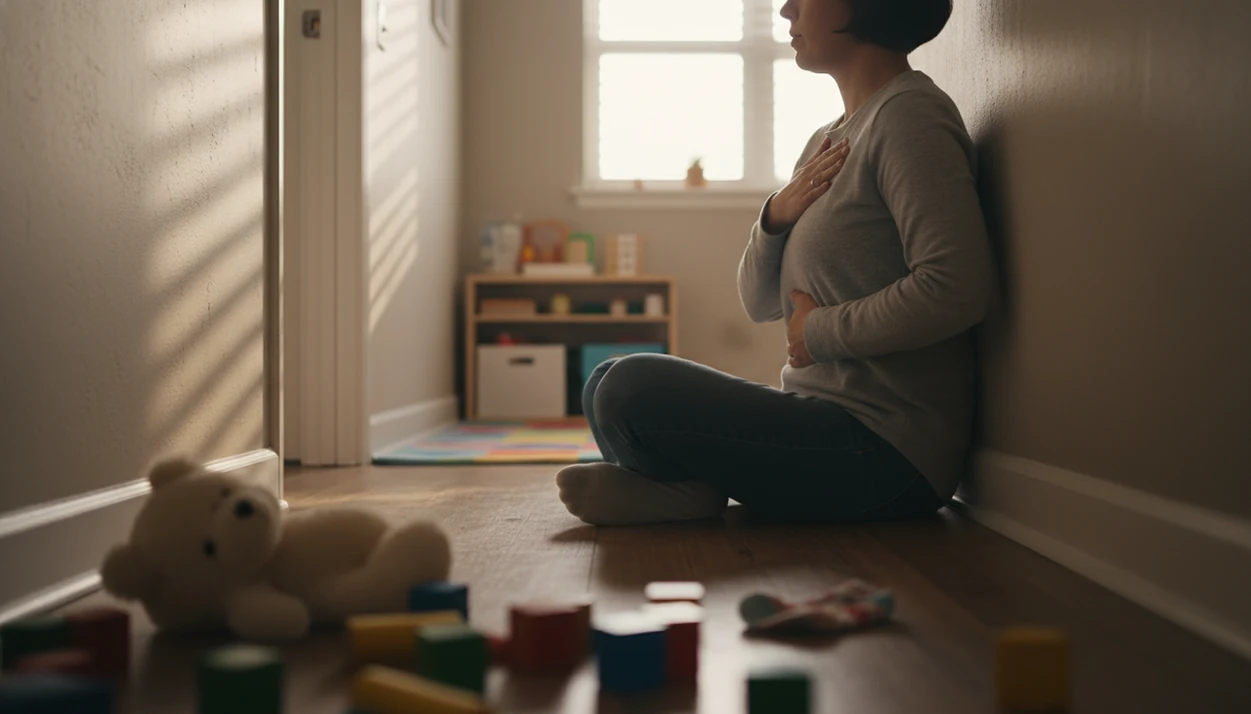
Image caption for meditation for parents practice
Use a realistic image: a parent sitting on the floor beside a messy play area, one hand on the chest, taking three breaths while toys, socks, and a half-finished block tower remain in view. Avoid spa lighting, empty white rooms, retreat cushions, or a parent who looks untouched by family life.
Suggested caption: Meditation for parents can be a 30-second pause beside real household mess, helping patience return one breath at a time.
The image should show micro-practice, not escape. A blanket over crossed legs is fine if it looks ordinary, but the scene should still feel like a home where someone might call from the next room.
This kind of visual works because it shows the real claim of parent meditation: not escape from family life, but a small pause inside it.
When to seek professional help
Seek professional help when stress no longer feels like ordinary parenting overload or when safety is in question. Meditation can sit beside good care, but it should never slow down urgent support.
Signs to take seriously include panic that feels unmanageable, trauma symptoms such as flashbacks or feeling constantly on guard, depression that affects sleep, appetite, bonding, or daily functioning, rage that scares you, or any thoughts of harming yourself, your child, or someone else. Also reach out if a child’s behavior suddenly changes, family conflict feels unsafe, or you are relying on substances just to get through the day.
- Call your child’s pediatrician or your primary care clinician when you are worried about behavior, sleep, mood, feeding, or your own capacity to cope.
- Contact a licensed therapist, postpartum mental health provider, family therapist, or psychiatrist for ongoing anxiety, depression, trauma, anger, or relationship strain.
- Use a crisis line or local urgent mental health service if thoughts of harm, panic, or despair feel immediate.
- Go to emergency care or call emergency services if anyone may be in danger right now.
A breath can help you make the next call; it should not replace the call.
Limitations
Meditation for parents has real value, but it has limits. It should not become another way to blame parents for hard conditions.
- Meditation is not a substitute for therapy, pediatric care, psychiatric treatment, or crisis support.
- Formal sitting meditation can feel frustrating, inaccessible, or triggering for some parents, especially during trauma or panic.
- Mindful parenting research is promising, but it is smaller and newer than adult mindfulness research overall.
- Meditation does not remove external stressors such as money strain, lack of childcare, unsafe housing, or systemic barriers.
Mindful.net can support a parent meditation routine because it keeps practices short and clearly labeled, but it cannot assess family safety, diagnose a child, or replace qualified care.
When Another Method Fits Better
| If you... | Try | Why | Note |
|---|---|---|---|
| You are in the school pickup line and feel too irritated to follow a guided meditation. | Three slow breaths with eyes open | A shorter pause often fits better than a full session when a child may appear at any moment. | Do not turn the exercise into another task to perform perfectly. |
| You feel foggy from caregiver fatigue and sitting still makes you want to quit. | Mindful Walking | Gentle movement may be easier to repeat when stillness feels like one more demand. | Keep it simple: notice steps, air, and direction rather than trying to become calm. |
| You are on a playground bench and need to stay visibly attentive to children. | Open-eye grounding | Grounding can be more practical than closed-eye meditation when safety and supervision come first. | Use the environment as support, not as a reason to mentally check out. |
| You are switching from parenting to work messages and feel reactive. | A brief Before Email Pause | A transition pause may help separate family stress from the next reply you send. | If the message is urgent, pause for one breath rather than delaying needed action. |
Signs You Should Try Another Approach
Meditation is not always the best first move for a parent who is exhausted, overstimulated, or responsible for immediate safety. If a baby is crying, a toddler is climbing, or the diaper bag strap is sliding off your shoulder while you are trying to breathe, practical care may need to come before formal practice. A useful rule is: stabilize the moment first, then practice if there is room. Meditation works best as support for parenting, not as a test of whether you can stay serene under pressure.
What Most Beginners Get Wrong Here
Mistake: choosing meditation when the moment needs orientation.
Meditation often asks you to observe experience, while grounding usually points attention toward immediate surroundings. If you are supervising children in a busy place, grounding may fit better because it keeps attention connected to the scene.
Mistake: expecting meditation to erase frustration before you respond.
A short practice may help create a pause, but it may not remove irritation. For many parents, the win is noticing the first sharp impulse before speaking, not feeling perfectly patient.
Mistake: treating grounding as the beginner version of meditation.
Grounding is not a lesser technique; it is a different tool. When attention feels scattered or the environment needs monitoring, grounding can be the more skillful choice.
Mistake: saving practice for quiet rooms only.
Parents often need practices that survive noise, interruptions, and half-finished routines. A one-breath pause at a doorway may be more repeatable than a ten-minute session that rarely happens.
Technique Snapshot
| Technique | Best for | Minutes |
|---|---|---|
| Open-Eye Breath Count | Pausing before answering a child’s repeated request | 1-3 min |
| Mindful Walking | Resetting during a stroller walk or after school drop-off | 3-10 min |
| Before Email Pause | Switching from family mode to work communication | 1-2 min |
From Our Editorial Review
What surprised us most is that parents often seem to benefit from permission to skip meditation in the wrong moment. In our editorial review, the more realistic pattern is not “calm parent meditates daily,” but “tired parent remembers one small pause before the next sentence.” We usually suggest choosing the shortest repeatable practice first, especially when interruptions are predictable.
The best parent practice is the one that still works when the quiet moment disappears.
Why Mindful.net fits this specific need
Mindful.net’s parent-focused guidance is built around short, secular practices that can fit between caregiving tasks rather than requiring an ideal meditation setup. Related guides such as Mindful Walking and the Before Email Pause give parents practical options for transitions, movement, and moments when sitting still is unrealistic.
FAQ
Can parents meditate when the house is noisy?
Yes. Household noise can become part of the practice when parents notice the sound, feel the body, and return to one breath or phrase.
How long should parents meditate each day?
Parents can start with 30 seconds, 1 minute, or 3 to 5 minutes. Short daily practice is often more realistic than an occasional long session.
Does meditation help parents manage anger?
Meditation may help parents notice anger earlier and pause before reacting. It does not eliminate anger or guarantee calm behavior.
What is mindful parenting?
Mindful parenting means bringing present-moment awareness, warmth, and less reactivity to parent-child interactions. It includes pausing, listening, setting limits, and repairing after conflict.
What is co-regulation in parenting?
Co-regulation is a child using a calm adult’s presence, voice, breathing, and body cues to settle. It helps children learn self-regulation over time.
Can meditation help during tantrums?
Meditation can help the parent stay steadier during tantrums. It is not a guaranteed tantrum-stopper or a replacement for practical behavior support.
Is meditation safe for stressed parents?
Simple mindfulness is generally low-risk for many stressed parents. Trauma, panic, depression, substance use, or intense distress may require professional guidance.
What if meditation feels impossible as a parent?
Try walking slowly, grounding through touch, mindful dishwashing, or one conscious breath. Informal practice still trains attention and return.