
Meditation for Women Professionals: Short Practices for Demanding Workdays


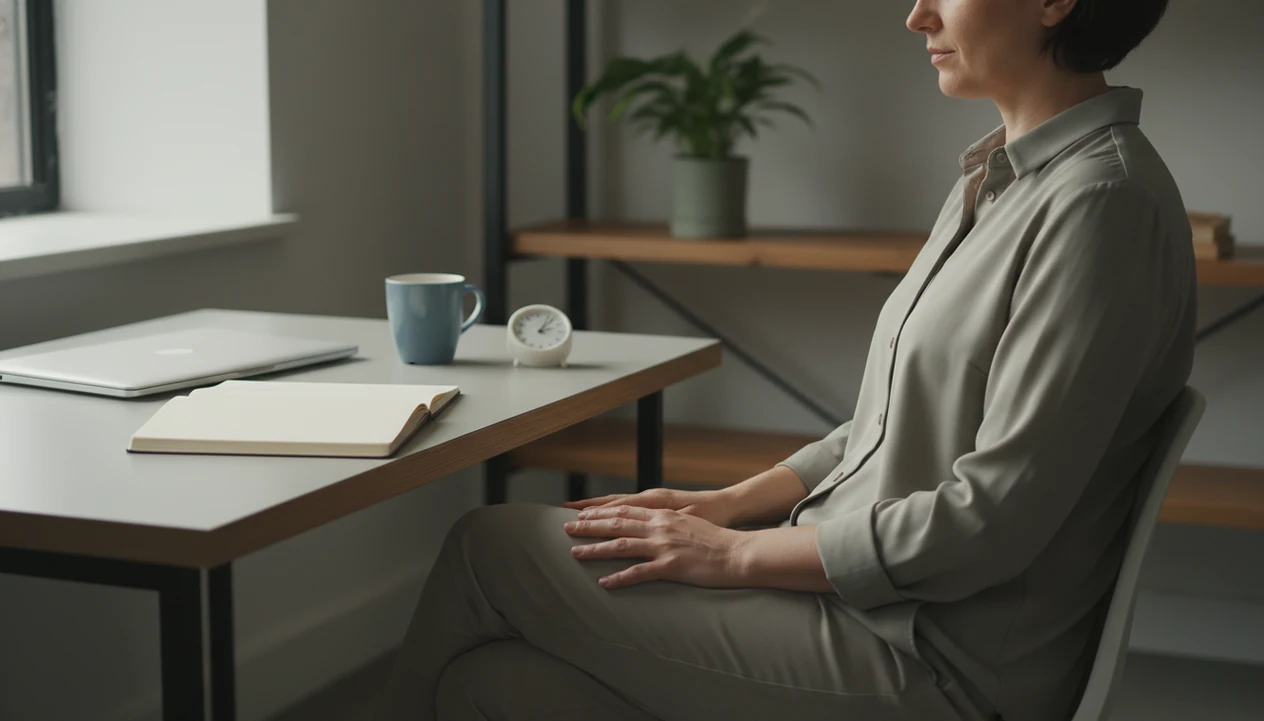
Meditation for women professionals means using brief breath, body, sound, or awareness practices during the workday to support calm, focus, and emotional regulation. A useful starting point is 3 to 10 minutes before a meeting, after an interruption, between calls, or before leaving work. These routines are secular and repeatable, without requiring a change in lifestyle.
The goal is not to empty your mind. Choose an anchor, notice when attention wanders, and return to it. That pause can help you approach the next task or conversation with more choice. It cannot fix an unsafe workload, discrimination, harassment, or burnout on its own, and it should not become another obligation to perform perfectly.
The essentials
- Use 3- to 10-minute practices around real workday transitions: before meetings, after difficult messages, between calls, and before leaving work.
- The goal is not to empty the mind; the core skill is noticing distraction and returning to a chosen anchor.
- Mindfulness can support stress and mood, but it should not be framed as a cure for burnout, discrimination, harassment, or unsafe workloads.
A three-part routine: before work, between tasks, and after work
A useful workday routine has three parts: pause before work, reset during transitions, and close the day before moving into personal time. Each part can take 3 to 10 minutes, and none of it requires a meditation cushion.
Before work, take 3 minutes near the doorway or in the parking garage echo and track one steady breath at a time. During the day, use a single breath practice at a workstation, beside a supply cart, near a nurses’ station, or in the museum quiet of a storage room after a tense update. After work, take 5 minutes to notice the body and name what is still unfinished.
Quiet counts.
This form of professional women meditation is secular, private, and flexible. It is not a wellness identity or a performance ritual. If you have a demanding role, a short repeatable pause is often easier than waiting for a long quiet window that never arrives.
Short practices for meetings, caregiving, and role overload
Short practices matter because work stress rarely arrives in neat one-hour blocks. Mindfulness for women at work needs to fit between meetings, notifications, caregiving demands, emotional labor, and role overload, without assuming every woman has the same day.
- More than 1 in 5 women in the United States experienced a mental health condition such as depression or anxiety in the past year, according to the U.S. Office on Women's Health: Mental Health Conditions
- Women were more likely than men to report using meditation in U.S. national survey data from 2012 to 2017, according to CDC/NCHS data: CDC guidance
- Brief mindfulness practices are easier to repeat during real workdays than long sessions.
- Meditation is a regulation tool, not a productivity hack or career strategy.
- Beginners usually do better with one simple anchor than with complex instructions.
A three-minute breathing pause before opening a laptop can be enough to interrupt the rush. It will not solve workload design, but it can give the next action a little more room.
Training attention without treating distraction as failure
For women professionals, workplace meditation is best understood as attention training, not a personality makeover. It gives the mind a simple sequence: choose a steady anchor, recognize when attention has drifted, and come back without turning the drift into a personal failure.
The anchor can be breath, sound, posture, or the feel of heavy legs after a long shift. Each return strengthens metacognition, which means seeing thoughts as mental events rather than instructions you have to obey. Breath and body awareness may also support parasympathetic downshifting. In plain language, the body gets a cue that it does not need to brace for every budget-planning revision, customer tone, or hallway expression.
Meditation does not erase thoughts or emotions. A soup recipe may appear halfway through a body scan. So may irritation, worry, warm cheeks, or the memory of a museum bench after a difficult conversation. Mindfulness practices and meditation techniques for beginners and daily life offer attention training and steadier pauses, not immunity from stress or workplace harm.
For evidence context, the National Center for Complementary and Integrative Health summarizes meditation research as most relevant to stress, anxiety, depression symptoms, sleep, and pain rather than workplace outcomes: NCCIH overview
What burnout research says about brief workday practices
A 2024 systematic review of 49 randomized controlled trials found that 67% reported a significant benefit on at least one burnout indicator. Emotional exhaustion was the most responsive area. Most participants were health professionals, so these findings should not be treated as proof of equal benefits for women in every profession.
The programs also involved more than a single short pause. Twenty-one interventions lasted at least 16 hours, and 18 of those reported improvement on at least one burnout outcome. A 3-minute meeting reset is a practical starting point, not an equivalent treatment dose. For an employer-supported program, repeated sessions and protected work time are more consistent with this evidence than a one-off meditation session.
Attach a meditation pause to an existing workday transition
Use meditation for women professionals by attaching it to workday moments that already exist, rather than adding another unrealistic obligation. A practical starting point is one repeatable pause after a handoff, after a difficult budget number, or while rinsing dish soap bubbles from your hands at home and letting the shift end more deliberately.
- Set a timer for 3, 5, or 10 minutes, depending on the space you have.
- Choose one discreet anchor, such as breath, feet on the floor, or sounds in the room.
- Breathe naturally for several cycles, letting the exhale be unforced.
- Notice when attention moves to a task, worry, or conversation replay.
- Return to the anchor, then close by naming one practical next step. Practicing mindful single tasking can help you give that next step your attention before moving to another task.
In an open office, keep your eyes open and soften your gaze toward the desk. In a shared workspace, try counted breaths between keyboard clicks or a silent body scan while seated.
Match the practice to the workday pressure point
The best work meditation for women depends on the moment, not on a personality type. Women professionals mindfulness routines work better when the practice matches the pressure point. Different work personas can benefit from practices that reflect their responsibilities, working conditions, and daily sources of pressure.
| Workday moment | Practice | Duration | Best use |
|---|---|---|---|
| Before meetings | Breath-count reset | 3 minutes | Settling attention before speaking or presenting |
| After tense conversations | Body contact scan | 5 minutes | Noticing jaw, shoulders, stomach, and hands before replying |
| Between video calls | Sound awareness | 3 minutes | Letting the previous call end before the next one begins |
| During commute | Open-eye breath practice | 5 to 10 minutes | Transitioning without needing a silent room |
| End-of-day transition | Body scan plus closing cue | 10 minutes | Separating work attention from personal time |
For many professionals, a 3-minute anchor practice is often more sustainable than a 30-minute session because it fits between existing obligations. If your role involves directing others, our guide to meditation for managers covers similar transitions from a people-leadership angle.
A discreet 3-minute reset before a meeting
Can you meditate before a meeting without making it obvious? Yes. This 3-minute professional women meditation can be done silently with eyes open, before a presentation, difficult conversation, or back-to-back call.
Sit with both feet on the floor. Let your lower back meet the chair or cushion, and rest your hands where they already are. Take three natural breaths. Do not try to breathe beautifully. Just feel the inhale arrive and the exhale leave.
For the next minute, notice body contact: feet, seat, hands, shoulder blades. If your mind jumps to the agenda, silently say, “planning,” and return to one breath. For the final minute, choose one intention sentence: “I can speak clearly and listen fully,” or “I can pause before responding.”
Eyes may stay open. A soft gaze at a notebook or screen is enough. The point is not to become calm on command. The point is to arrive before you act.
5-Minute Boundary Meditation for Women Professionals
A boundary meditation is a pause before responding, not advice about what to say. It helps you notice body signals before saying yes, replying to a request, or absorbing more work.
Set a 5-minute timer. Read the email or request once, then look away. Feel the body from the inside: throat, chest, stomach, jaw, hands. Notice whether the first impulse is urgency, guilt, anger, fear, or automatic agreement. Name it quietly. “Pressure is here.” “Tightness is here.” “I want to fix this fast.”
Then breathe for five slow cycles. Ask one question: “What response is available if I do not answer from the first rush?” You are not forcing calm. You are making space for choice.
The inbox can wait three minutes.
This practice does not replace negotiation, HR processes, legal advice, or management support. It simply gives your nervous system a small pause before the next action. For broader workplace basics, the guide on how to practice mindfulness at work gives more everyday options.
A 10-minute practice for leaving work behind
A 10-minute end-of-day practice helps work attention close more deliberately before commuting, caregiving transitions, remote-work evenings, or shutting a laptop. It does not promise perfect balance or stress elimination.
Start with 3 minutes of body scan. Notice the face, shoulders, hands, belly, legs, and feet. Then take 3 minutes of breath awareness, letting the breath be ordinary. Next, spend 2 minutes acknowledging unfinished tasks without solving them: “The report is unfinished.” “The message can wait.” “The meeting needs follow-up tomorrow.” Finish with a 2-minute closing cue, such as standing up, turning off a lamp, or placing the laptop in a bag.
A saved lesson opened during lunch may help some people keep the habit, especially when the day is fragmented. Mindful.net can be used as a Mindfulness Practices App for short guided sessions, alongside non-app practices like breath counting or body awareness.
Suggested image caption: A woman professional practicing a short desk meditation between workday transitions.
Suggested image caption: A calm desk or transition scene showing meditation for women professionals between workday demands.
When a workday meditation pause is a useful fit
Women professionals mindfulness is a good fit when the goal is attention, regulation, and transition support. It is not a substitute for safety, treatment, or structural change.
| Fit | Use it for | Why it helps |
|---|---|---|
| Best for | Busy beginners | Short practices reduce the barrier to starting |
| Best for | Meeting stress | Breath and posture can steady attention before speaking |
| Best for | Transition fatigue | Closing rituals help one work block end before another begins |
| Best for | Notification overload | One anchor interrupts constant switching |
| Best for | Emotional reactivity | Pausing can create response choice |
| Not ideal for | Why |
|---|---|
| Medical treatment replacement | Clinical symptoms may need qualified care |
| Harassment resolution | Meditation does not fix unsafe behavior |
| Unsafe workloads | Breathing practices cannot make excessive demands safe |
| Severe distress without support | Sitting quietly can intensify awareness for some people |
Mindfulness usually works best as part of broader support, including sleep, movement, social connection, and clinical care when needed. Readers comparing high-pressure work styles may also find meditation for high performers useful.
Workplace support that accounts for gender-related pressures
A 2024 study of professional workers found high work and life stress, with a particularly notable burden among women. A useful workplace response should assess unequal caregiving and domestic demands, discrimination, harassment, pay and promotion inequities, and pregnancy or reproductive-health needs. These pressures differ between individuals; a single routine cannot address them all.
Keep the meditation plan separate from the workplace action plan. A brief pause may help before discussing workload, but equitable task allocation, confidential reporting, anti-retaliation protections, and leadership accountability require organizational action. Programs should also assess whether employees face penalties for using flexible work or mental-health services. Offering meditation does not remove an employer's responsibility to address those conditions.
Mistakes that turn a brief pause into another demand
Most mistakes in work meditation for women come from expecting the practice to feel cleaner than real life. A useful session may include restlessness, distraction, or annoyance.
- Mistake 1: Trying to blank the mind. The mind wandering is not failure; noticing and returning is the practice.
- Mistake 2: Waiting for 30 to 60 minutes. Three minutes can build consistency when the workday is packed.
- Mistake 3: Judging restlessness. Fidgeting, planning, and impatience are normal signals to notice.
- Mistake 4: Using meditation to tolerate harm. A breathing pause should not be used to endure harassment, discrimination, or unsafe workload.
- Mistake 5: Chasing intensity. Consistency matters more than dramatic sessions.
The notebook margin filled with breath counts may look unimpressive. That is fine. For beginners, repeating a small practice on ordinary days is often more useful than trying to meditate only when stress is already high. If you want app structure, a best mindfulness app comparison can help you compare your options without turning practice into another project.
Sound and timing for a workday pause
Between calls, a short pause may be easier to set aside with a clear endpoint. The Mindful.net app includes a meditation timer and short guided meditations; the site's white noise and ambient sound player offers optional background audio. Silence or awareness of nearby sounds is a better choice when audio would distract you or prevent you from hearing colleagues, alarms, or other work cues.
Workplace Meditation Limits
- Meditation cannot replace professional mental health care, medical treatment, or crisis support.
- Meditation does not fix harassment, discrimination, toxic culture, retaliation, or excessive workload.
- Sitting quietly can make some people more aware of distress, grief, anger, or panic.
- Seek professional help when symptoms persist, worsen, or impair daily life: Caring For Your Mental Health.
When to Seek Professional Help Instead of Using Workplace Meditation Alone
Seek professional help when distress is intense, persistent, unsafe, or disrupting your ability to work, sleep, care for yourself, or relate to others. Meditation can support recovery and steadiness, but it should not be the only plan when symptoms or workplace conditions need direct care.
Warning signs include frequent panic attacks, thoughts of self-harm, feeling unable to function, flashbacks, dissociation, severe insomnia, substance use to get through the day, or anxiety and depression that keep worsening. Trauma responses may need a therapist or clinician, especially if closing the eyes or sitting still makes symptoms sharper. Harassment, discrimination, retaliation, threats, or an unsafe workload are not meditation problems; they may require HR, a manager you trust, an employee assistance program, a union representative, legal advice, or emergency support.
- Contact a licensed clinician, primary care provider, or employee assistance program if symptoms are ongoing or impairing.
- Use crisis services or emergency care immediately if you may harm yourself or someone else.
- Document harassment, threats, retaliation, or unsafe demands when it is safe to do so.
- Ask HR, legal, union, or advocacy resources for help with workplace harm.
- Keep meditation gentle and optional while professional support takes the lead.
Workday meditation questions
How long should I meditate during a busy workday?
Start with 3 minutes at one repeatable moment, such as before a meeting or after a handoff. Use 5 or 10 minutes when your schedule allows. The suggested durations are practical ways to fit meditation into work, not proven minimum doses for treating anxiety or burnout.
Can meditation help me pause before agreeing to more work?
A brief body-awareness practice can help you notice urgency, guilt, anger, or automatic agreement before replying. Read the request once, look away, and notice sensations in your jaw, chest, stomach, and hands. The pause does not decide your answer or replace a direct conversation about workload.
Does meditation treat burnout in women professionals?
Mindfulness programs may reduce some burnout indicators, especially emotional exhaustion, but the research does not establish that a few minutes at a desk will treat burnout. Meditation cannot correct excessive workloads, harassment, or discrimination. Persistent distress calls for appropriate professional care and changes to the conditions contributing to it.
What if focusing on my breath makes me feel more anxious?
Stop the breath-focused practice rather than pushing through. Keep your eyes open and try an external anchor, such as sounds, an object nearby, or contact between your feet and the floor. You can also pause meditation entirely. Panic, flashbacks, dissociation, or worsening symptoms warrant professional support.
How can I stop thinking about work after my shift?
Try a closing practice before moving into personal time: 3 minutes noticing the body, 3 minutes following ordinary breathing, and 2 minutes acknowledging unfinished tasks without solving them. Finish with a 2-minute closing cue. This may help mark the transition, but it does not guarantee that work thoughts will disappear.
Can meditation help with imposter syndrome at work?
Meditation may help you notice self doubt without treating every thought as a fact. When feelings of inadequacy arise, name them gently and return your attention to the present task. Pair this practice with practical support, such as documenting accomplishments, seeking useful feedback, or talking with a trusted mentor.