
Visualization Meditation for Goals
Visualization meditation for goals is a mindfulness-compatible practice where you calmly imagine both the goal you care about and the realistic steps you will take toward it. It can support clarity, motivation, and values-aligned action, but it should not be treated as a guarantee that a specific outcome will happen.
> Definition: Goal visualization meditation is an intentional mental imagery practice that combines present-moment awareness with vivid rehearsal of desired outcomes, process steps, obstacles, and values-based action.
TL;DR
- Use visualization to rehearse the process, not only the final result.
- Stay grounded in breath, body, and present-moment awareness while imagining future action.
- End every goal visualization meditation with one small real-world next step.
Goal visualization meditation in plain language
Goal visualization meditation is like mentally watching a realistic movie of yourself working toward a goal, while staying aware of your breath, body, and present surroundings. It is not just daydreaming about success or hoping the future bends your way.
In practice, you might picture the room you are in, the sound of your own voice, your posture before a difficult conversation, or the first page of a study plan. You include what you see, hear, feel, and do. The bus seat vibration under your thighs can even become a grounding cue before you imagine the next step.
Mindful visualization supports focus and intention, not control over outcomes. Meditation use has grown in the United States; the CDC reported that 17.8% of U.S. adults practiced meditation in 2017, up from 4.1% in 2012 CDC guidance.
Mental imagery mechanisms behind goal rehearsal
Mental imagery works as active rehearsal, not passive wishing. When you imagine yourself taking a specific action, you are practicing attention, sequence, effort, and emotional readiness in a low-stakes setting.
- Mental imagery is rehearsal: You picture the behavior, timing, setting, and response, instead of only enjoying the idea of the result.
- Attention gets primed: A clear image can make the next cue easier to notice, like the folder on your desk or the shoes by the door.
- Confidence may improve: Mental-practice research has found performance benefits when imagery is paired with real practice, although effects vary by task and skill level 0033 2909.116.3.481.
- Motor imagery has clinical evidence: Stroke rehabilitation reviews suggest mental practice may help some motor recovery outcomes when paired with physical therapy, but the evidence is mixed and context-dependent Full.
- Support still matters: Visualization usually works best with planning, repeated effort, and an environment that makes action easier.
For beginners, process-focused visualization is often easier than abstract goal thinking because it gives the mind something concrete to rehearse.
Outcome visualization versus process visualization for goals
Outcome visualization pictures the completed goal; process visualization pictures the work that gets you there. For everyday goals, process visualization is usually more useful because it rehearses behavior, not just reward.
| Visualization type | What you imagine | Useful for | Main risk |
|---|---|---|---|
| Outcome visualization | The completed goal, praise, relief, or reward | Clarifying why the goal matters | Can feel like success already happened |
| Process visualization | Steps, timing, effort, obstacles, and recovery | Preparing for real action | Can feel less exciting at first |
| Combined practice | A brief outcome image, then detailed process rehearsal | Linking motivation with behavior | Needs honesty about friction |
A student midterm study found that process simulation led students to start studying earlier and complete more practice problems, while outcome-only visualization did not improve performance APA research. Positive fantasizing can sometimes reduce effort if the mind treats imagined success as already done.
Reality first.
5 best-fit and poor-fit cases for mindful visualization practice
Mindful visualization is a good fit when you need clarity, rehearsal, and a small next step. It is a poor fit when future imagery increases distress or replaces practical support.
| Fit | Use case | Why it matters |
|---|---|---|
| Best for | Clarifying priorities | You can test whether a goal still feels values-aligned. |
| Best for | Difficult conversations | You can rehearse tone, posture, listening, and repair. |
| Best for | Study or work sessions | You can picture opening the document, setting a timer, and staying with one task. |
| Best for | Beginners | A 5 to 10 minute structure is enough to start small. |
| Not ideal for | Rumination, panic, dissociation, or self-blame | Imagery may intensify pressure instead of supporting action. |
Good mindfulness practices and meditation techniques for beginners and daily life build steadier attention and practical self-awareness, not guaranteed outcomes or personal blame. For more grounding before future-focused practice, the basics in how to practice mindfulness can help.
Before you start a goal visualization meditation
Start with one concrete goal, a quiet ordinary place, and permission to stop if the imagery becomes destabilizing. The setup should make the practice feel grounded enough to support action, not pressured or dramatic.
- Choose one specific goal you can imagine acting on, such as drafting one email, preparing for one exam, or practicing one conversation. Avoid broad life outcomes that are too large to rehearse clearly.
- Settle into a simple setting where you are unlikely to be interrupted. Use a short timer, even 5 minutes, so the practice has a clear beginning and end.
- Ground your body first if future images feel activating. Notice your feet, the chair, your hands, or one steady sound in the room before imagining anything.
- Pause or skip the practice during panic, dissociation, or imagery that feels unsafe, intrusive, or destabilizing. Return to present-moment cues or seek support if needed.
- Keep paper nearby so you can finish by writing one concrete next action, not a whole plan.
5-step guided visualization practice for goals
Use this goal visualization meditation when you have one clear goal and a few quiet minutes. A phone timer set for 5 minutes is enough; you do not need a long session.
- Set a timer for 5 to 10 minutes and choose one specific goal, such as preparing for an interview or finishing one assignment.
- Ground your attention with breath, feet on carpet or tile, or the feeling of your hands resting.
- Picture the outcome briefly so you remember why it matters, then shift toward the next realistic actions.
- Rehearse likely obstacles and imagine responding with flexibility, such as restarting after distraction or asking for help.
- Name one next step you will take today or this week, then write it down if that helps.
If you want a nearby practice, intention setting meditation uses a similar structure without requiring detailed imagery.
Short intention visualization practice script
Sit in a steady posture, with your feet supported and your shoulders allowed to drop. Let the breath move naturally. You do not need to make it deeper. Notice one inhale, one exhale, and the weight of your body.
Now name one goal that matters. If the goal feels unclear, name the direction instead. “I want to care for my health.” “I want to prepare for this meeting.” “I want to return to writing.” No forcing certainty.
Imagine yourself taking one values-based action. See the place if you can. Hear the room. Feel your posture. Maybe there is ambient room hum between prompts, or a notebook open beside your elbow. Picture the first small movement, not the whole life plan.
Now include one obstacle. The mind wanders to a grocery list. Doubt shows up. Time gets tight. Imagine yourself noticing, pausing, and returning kindly but firmly.
End by naming one grounded next step. This practice supports action, not guaranteed results.
Mindful visualization cues for clearer goal imagery
Goal imagery does not need to be crystal clear, visual, or cinematic. Many people practice mindful visualization through words, body sensations, emotional tone, sounds, location details, or movement cues.
- Action cue: Ask, “What am I doing first?” Picture opening the calendar, putting on shoes, or sending the message.
- Obstacle cue: Ask, “What might get in the way?” Include tiredness, avoidance, interruption, or fear of being judged.
- Response cue: Ask, “How do I respond kindly and firmly?” Imagine a reset, not a flawless performance.
- Body cue: Notice posture, breath, jaw tension, or the feeling of knees stacked under a blanket.
- Values cue: Ask, “Why does this matter beyond approval or comparison?”
Clinging, fear, pressure, and comparison are not failures. In meditation, they become objects to notice and return from. Tools such as the Mindful.net Mindfulness Practices App, Calm, and Headspace can offer guided structure if silence feels too open, but the useful part is still the same: grounded attention, process rehearsal, and one next action.
Common goal visualization meditation mistakes
The most common mistake is visualizing the finish line while skipping the work. Goal visualization becomes more grounded when it includes effort, uncertainty, and a next behavior.
- Mistake 1: Imagining only the finish line. Add the first three steps, the likely friction, and the recovery plan.
- Mistake 2: Treating the image as proof. A strong image is an experience in the mind, not evidence that the goal must happen.
- Mistake 3: Forcing perfect pictures. Use words, felt sense, sound, or vague impressions if images are dim.
- Mistake 4: Borrowing goals from comparison. Check whether the goal fits your values, not someone else’s feed.
- Mistake 5: Ending without action. Close with one call, one note, one calendar block, or one practice round.
The pocket check is real. If you keep reaching for your phone, make that part of the rehearsal.
Accessible image caption for a goal visualization meditation scene
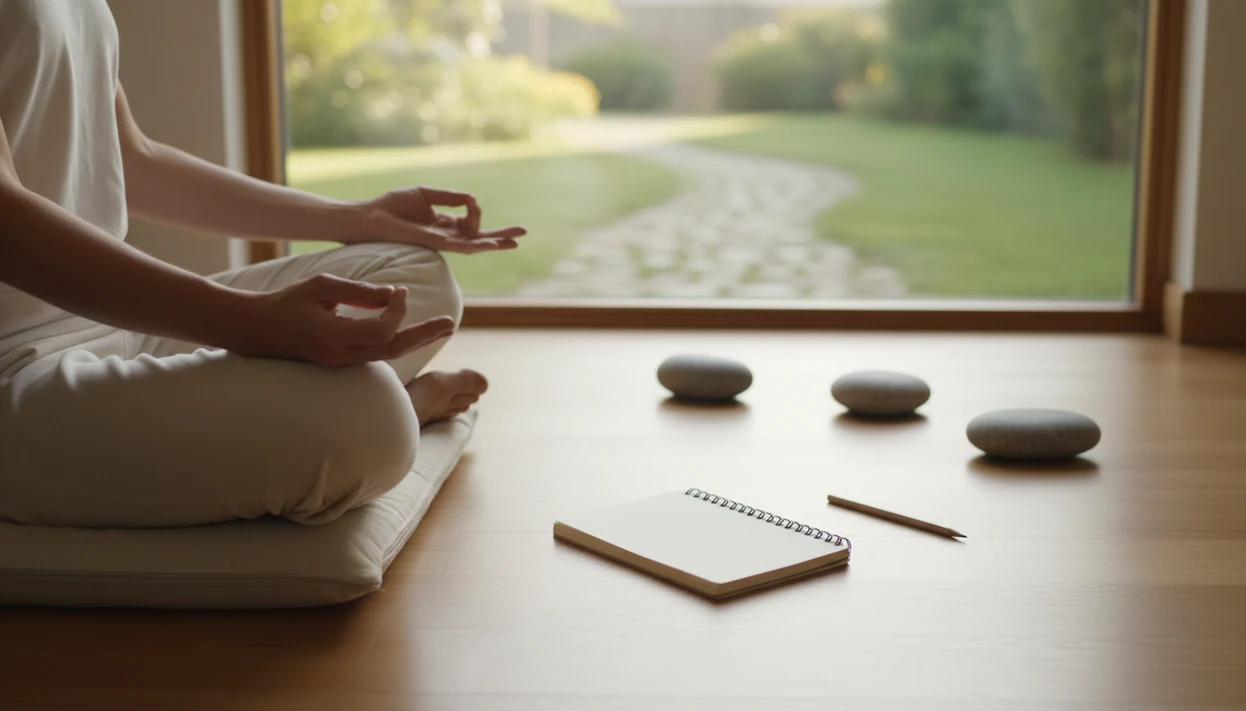
Suggested caption: A person sits quietly in a simple room with a journal nearby, practicing visualization meditation for goals through breath awareness, realistic goal rehearsal, and one written next action.
The image should show ordinary attention practice, not mystical symbolism or guaranteed-success imagery. A grounded scene might include a chair, soft daylight, a pen, and a page with a short action plan. The person does not need to look blissful. They can look calm, thoughtful, or simply present.
This caption helps accessibility because it names the setting, the practice, and the practical behavior that follows. It also keeps the frame secular: mindful visualization supports clarity and action-aware intention setting, not wealth promises, certainty, or magical control.
Limitations
Visualization meditation has useful applications, but its evidence for everyday goal achievement is limited. Much of what we know is partly extrapolated from sport performance, education, and motor imagery rehabilitation research.
- Visualization does not replace action, planning, skill training, social support, or professional care.
- Future-focused imagery may increase anxiety, rumination, perfectionism, or fear of failure for some people.
- Visualization cannot remove systemic barriers, financial constraints, discrimination, illness, or unsafe conditions.
- Manifestation-style framing can create self-blame when outcomes are shaped by factors outside personal control.
If you prefer a broader secular frame, our manifestation meditation guide separates intention, attention, and action from magical claims. Mindful.net also treats this as educational support, not medical or mental health treatment.
A Practical Observation
A field note from practice: we often see people improve the session when they make the image smaller, not more impressive. A single doorway, first note, opening sentence, or next rep can be enough to connect intention with action. We usually suggest ending before the practice becomes a fantasy loop, especially when motivation is low or the goal feels emotionally loaded.
What Surprised Us in Practice
Mistake: imagining only the finished outcome
Outcome images can feel motivating, but they often work better when paired with the next visible step. A steady breath, one clear anchor, and a realistic action usually beat a dramatic mental movie.
Mistake: treating visualization as a certainty tool
Visualization meditation may support attention and motivation, but it cannot guarantee a job offer, performance result, relationship outcome, or financial change. The more useful question is usually, “What action does this image help me take next?”
Mistake: expecting the image to stay crisp
Many people get flickers, symbols, or body sensations rather than a clear picture. That is not a failure; a vague but repeatable cue can still serve as a practical anchor.
Who This Is Actually For
| If you... | Try | Why | Note |
|---|---|---|---|
| A nurse or shift worker preparing for a demanding handoff | One-Step Rehearsal: picture the first calm action, then the first sentence you will say | A short session can reduce decision clutter without pretending the whole shift is controllable. | Keep it practical if fatigue is high; do not force elaborate imagery. |
| A parent with racing thoughts before a difficult conversation | Anchor-Then-Action: feel one steady breath, imagine one respectful phrase, then stop | A narrow image tends to be easier to repeat than a full scene. | If visualization turns into rehearsing arguments, switch to simple breathing exercises. |
| A musician, athlete, or presenter practicing a performance goal | Process-first visualization: imagine the opening cue, posture, and first movement | Process imagery often supports preparation better than replaying applause or praise. | Use it alongside real practice, feedback, and rest. |
| An office worker using mindfulness at work before a planning meeting | Meeting Reset plus goal visualization | A brief reset can clarify the intention before mentally rehearsing a useful contribution. | For a pure downshift, the Mindful.net Meeting Reset may fit better than goal rehearsal. |
Why Advice Conflicts Online
- Some guidance assumes you need silence, but many people only need a repeatable cue: one clear anchor, a steady breath, or a familiar starting phrase.
- A short session is often enough for goal rehearsal because the point is decision support, not a long escape from the day.
- If you are highly distracted, reduce the scene rather than increasing effort: one doorway, one sentence, one next step.
- Breathing exercises may be the better first move when your system feels overloaded and goal imagery becomes pressure.
- Visualization works best as preparation when the environment makes the next action easier, such as placing sheet music, shoes, notes, or water where you will use them.
The Cost-and-Effort Tradeoff
Advice conflicts because some teachers emphasize vivid imagery while others emphasize calm attention. In our view, the better tradeoff is often repeatability: a simple image you can return to tomorrow may be more useful than an elaborate scene you rarely practice. If the method takes more energy than the goal step itself, simplify it.
Technique Snapshot
| Technique | Best for | Minutes |
|---|---|---|
| One-Step Rehearsal | Starting a goal when the next action feels fuzzy | 3-5 min |
| Anchor-Then-Action | Pairing a steady breath with one realistic behavior | 2-6 min |
| Process-First Visualization | Preparing for practice, performance, or a planned conversation | 5-12 min |
Why Mindful.net fits this specific need
Mindful.net frames visualization meditation as a mindfulness-compatible support, not a promise that outcomes will happen. Readers using this at work may pair it with Mindfulness at Work or the Meeting Reset when they need a brief pause before choosing the next action.
FAQ
Does visualization meditation work?
Visualization meditation can help some people clarify goals, rehearse action, and prepare emotionally. It works best when combined with planning, practice, and realistic support.
How long should I visualize?
Start with 5 to 10 minutes. Consistency matters more than long sessions, especially for beginners.
What if I cannot visualize?
You can use words, body sensations, emotions, sounds, or vague impressions instead of sharp mental pictures. The practice is still valid if the image is unclear.
Is visualization the same as manifestation?
Grounded visualization is not the same as claims that thoughts alone create outcomes. It is a secular mindfulness practice for attention, intention, and behavior rehearsal.
Should I visualize outcomes or steps?
Include both, but spend more time on process steps, obstacles, and next actions. Outcome imagery can motivate, but process imagery better prepares you to act.