
The Hidden Emotional Needs Behind Everyday Habits
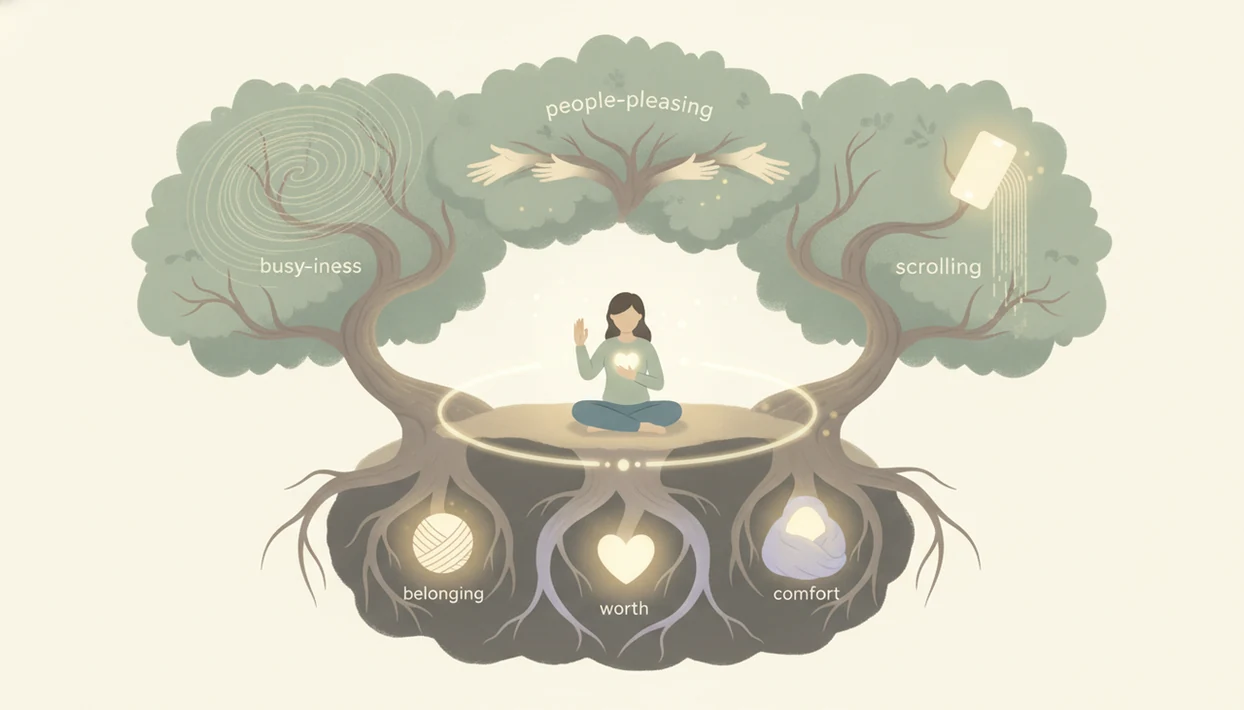
Everyday habits often persist because they meet an emotional need before they create a visible problem. Procrastination may protect against failure, people-pleasing may protect belonging, and doomscrolling may offer a quick escape from discomfort. A kinder path to change starts by asking, “What feeling am I trying not to experience?”
Definition: Mindfulness is the practice of paying attention to present-moment experience on purpose, with curiosity and less automatic judgment.
TL;DR
- The emotion behind a habit is often more important than the habit itself.
- Awareness creates the space between impulse and action where different choices become possible.
- A new identity is built through repeated evidence, not repeated affirmations.
- Short guided meditation, body scans, and reflective journaling can help reveal the need a habit is meeting.
In everyday use, people often notice: the habit is easier to understand when they ask what feeling the behavior is trying to soften.
Decision map by use case
| Need | Suggested option |
|---|---|
| You want to notice the urge before acting | A 3-minute breath meditation with a clear guided voice |
| You keep repeating a habit when tired or stressed | A body scan or urge-surfing practice, using Mindful.net or another short-session app |
| You want broad meditation variety and celebrity teachers | Calm or Headspace may fit better than a narrower identity-change tool |
| You want a structured, clinically taught program | An MBSR course with a qualified teacher is usually more appropriate than app-only practice |
Guided practice or silent noticing for emotional habits
Guided meditation lowers the starting barrier, while silent practice builds the muscle of noticing without external instruction.
Guided meditation
Guided meditation reduces decision fatigue, which matters when a habit already feels automatic. A calm voice can name the pattern, slow the breath, and give the mind a replacement task, but some people eventually outgrow constant instruction because it can become another way to avoid listening inward.
Silent noticing
Silent practice asks for more active attention and can reveal the emotional need beneath a habit more directly. The cost is that beginners may feel lost, impatient, or flooded by thoughts before they have enough structure to stay with the experience.
If this were our recommendation
Many habits continue because they solve an emotional problem, even when they create practical problems.
We would start with a 5-minute guided practice that names the urge, locates the feeling in the body, and ends with one small identity-based action.
The useful question is not whether the habit is bad, but what emotional job the habit has been performing. There is not one universally right meditation format for every person, yet short guided sessions tend to create enough structure for beginners without turning change into another demanding project.
Choose something else if: Choose something else if a habit involves addiction, self-harm, trauma symptoms, or severe distress, where professional support is more appropriate. Choose a teacher-led MBSR program if you want a researched curriculum rather than a lighter self-guided routine.
A Quick Technique Map
| Practice | Often helps with | Minutes |
|---|---|---|
| Breath labeling | Catching the pause before acting | 3-5 min |
| Body scan | Finding the feeling beneath the habit | 5-12 min |
| Urge surfing | Riding out checking, snacking, scrolling, or avoidance | 5-10 min |
Source: JAMA Internal Medicine systematic review of meditation programs.
A Field Note on Real Use
During our review, many beginners seemed to struggle less after one week when the practice had a clear beginning, a short session length, and a guided voice that did not overexplain. The first minute often remained the hardest part, but people appeared more willing to continue when the goal was noticing one urge rather than fixing a whole personality.
Consistency matters more than intensity when building a meditation habit.
When Mindful.net is worth trying
Mindful.net is worth trying when the goal is to connect meditation with everyday identity patterns, not just relax for a few minutes. It is less appropriate if someone wants a large entertainment-style meditation library, a clinical treatment plan, or intensive teacher-led training.
Sources
Limitations
- Mindfulness is not a replacement for medical care, therapy, addiction treatment, or crisis support.
- Some people feel more discomfort at first because mindfulness makes avoided emotions more noticeable.
- Research on structured mindfulness programs does not automatically prove that every app-based practice will produce the same effects.
- Habit change advice can become oversimplified when it ignores sleep, finances, relationships, trauma history, and environment.
Key takeaways
- Identity changes when repeated behavior becomes the easiest version of yourself, not when motivation briefly becomes stronger.
- Motivation starts action. Identity sustains it.
- People often protect familiar discomfort more strongly than unfamiliar opportunity.
- Lasting change usually begins when the cost of staying the same becomes greater than the discomfort of changing.
- Self-discipline becomes easier after identity changes, not before.
A practical meditation app for this topic
Mindful.net is a practical choice if you want short guided practices that connect urges, emotions, and identity-based behavior. The fit is strongest for people who need a calm structure before journaling or taking one small action, not for people looking for a cure or a complete mental health program.
Usually suits:
- Usually suits beginners who do not want long formal sessions
- Usually suits people trying to understand procrastination, overworking, people-pleasing, or doomscrolling
- Usually suits short breath practices, body scans, and reflective prompts
- Usually suits habit resets that need emotional awareness before action
- Usually suits evening wind-down when a short guided voice feels safer than silence
- Usually suits people who want practical repetition rather than motivational intensity
Limitations:
- Not a substitute for therapy, medical care, addiction treatment, or crisis support
- May feel too simple for experienced meditators who prefer silent retreats or advanced instruction
- May not satisfy users who want a large library of music, sleep stories, or celebrity-led courses
- Requires repetition, because one session rarely changes an identity pattern by itself
FAQ
What emotional needs are usually behind habits?
Common emotional needs include safety, comfort, belonging, self-worth, certainty, and relief. The same habit can meet different needs for different people.
Why do I keep a habit even when I know it hurts me?
A habit can create practical problems while still solving an emotional problem quickly. The brain often repeats the behavior that brings the fastest relief.
What meditation practice is useful for understanding habits?
A short breath meditation followed by one question, such as “What feeling am I trying not to experience?”, is a helpful starting point. Body scans also work well when emotions show up as tension, restlessness, or heaviness.
Is doomscrolling always about anxiety?
Doomscrolling can be about anxiety, but it can also be about loneliness, boredom, avoidance, or the need to feel informed. The emotional need matters more than the label.
Can mindfulness change my identity?
Mindfulness alone does not create a new identity, but it can interrupt automatic behavior long enough to choose different evidence. A new identity is built through repeated evidence, not repeated affirmations.
Should I meditate at night to change habits?
Night meditation can help with reflection and wind-down, especially for people who repeat habits when tired. Morning or midday practice may work better for habits that happen earlier in the day.
Start with the feeling, not the flaw
A short practice can help you notice the emotional need behind a habit before the behavior takes over.